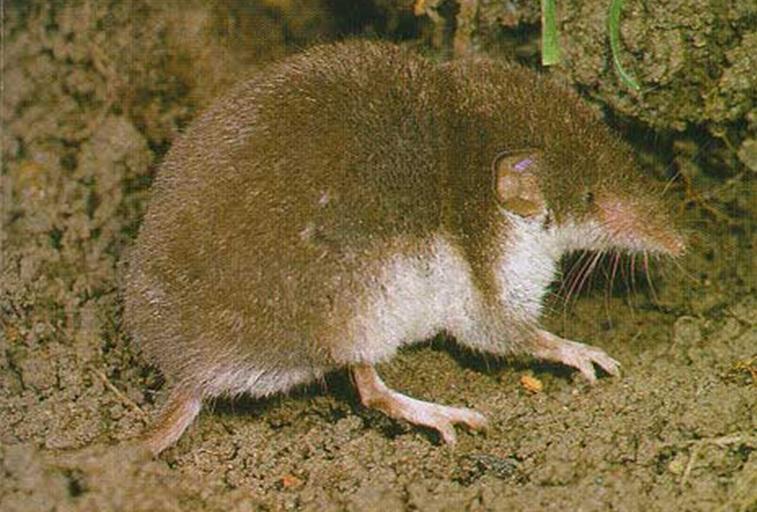
Bicoloured Shrew (Crocidura leucodon) lives in temperate forests across Europe and Asia. It feeds on insects and worms. Its conservation status is Least Concern.
Fascinating facts about the Bicoloured Shrew
- When threatened, a shrew pup seizes its mother's fur near the base of the tail with its jaws. One by one the siblings clasp the tail of the one in front, creating a linked chain that the mother darts away with. The mother then rapidly leads the family to safety while the young trail behind. Even if the mother is lifted, the youngsters keep their grip and dangle in a wriggling furry line.
- The bicoloured white-toothed shrew harbours the Borna disease virus, the agent of a meningoencephalitis that can affect sheep, horses, cattle, cats, birds and even humans. Because the shrew carries the virus without ill effect, it acts as a natural reservoir, maintaining the pathogen in wild populations. This role means the species can transmit the disease to domestic animals and may pose a health risk to people.
- The shrew's back is clothed in short, dense dark brown fur while its belly is pure white, separated by a sharply defined line that runs across the body. This stark contrast gives the animal a striking two-tone appearance that is unmistakable in the field. Young individuals are somewhat paler than adults, softening the colour division. The clear demarcation also highlights the long pink muzzle and white teeth.
- In the Alpine region the bicoloured white-toothed shrew can be found at elevations of up to 3,300 feet (1,000 m), demonstrating its ability to live in mountainous terrain. At these heights it occupies a range of open habitats, from pastureland and cultivated fields to gardens and hedgerows. It also makes use of piles of rubble, rubbish heaps and, in winter, occasionally seeks shelter in buildings while deliberately avoiding damp locations.
- The bicoloured shrew measures only 2.5-3.5 inches (64-89 mm) from head to the base of its body, and its tail is of equal length. Adults weigh between 7 and 13 grams.
Sources
Every fact above was checked against these pages, and kept only where one of them states it.
At a glance
RangeEurope and Asia
HabitatTemperate forests
DietInsects and worms
About the Bicoloured Shrew
In the underbrush, a tiny, frenetic form darts and weaves, the bicoloured shrew a whirlwind of energy as it pursues its relentless quest for sustenance. With each rapid heartbeat, it seems to embody the very essence of urgency, its slender body a blur of motion as it navigates the intricate labyrinth of leaf litter and twigs. As it moves, the shrew's distinctive colouration - a striking dichotomy of dark and light - serves as a fleeting glimpse into the secret life of this diminutive, yet extraordinary, creature.
Hear the Bicoloured Shrew, and 4,400+ more
Real recorded sounds, 11 nature games and a free Daily 5, 1v1 quiz duels, conservation wins and a safe Kids mode. Free on Feravox.