Photo: Feravox creator
Feravox · The Voice of the Wild
Azure Kingfisher
Ceyx azureus
Least Concern
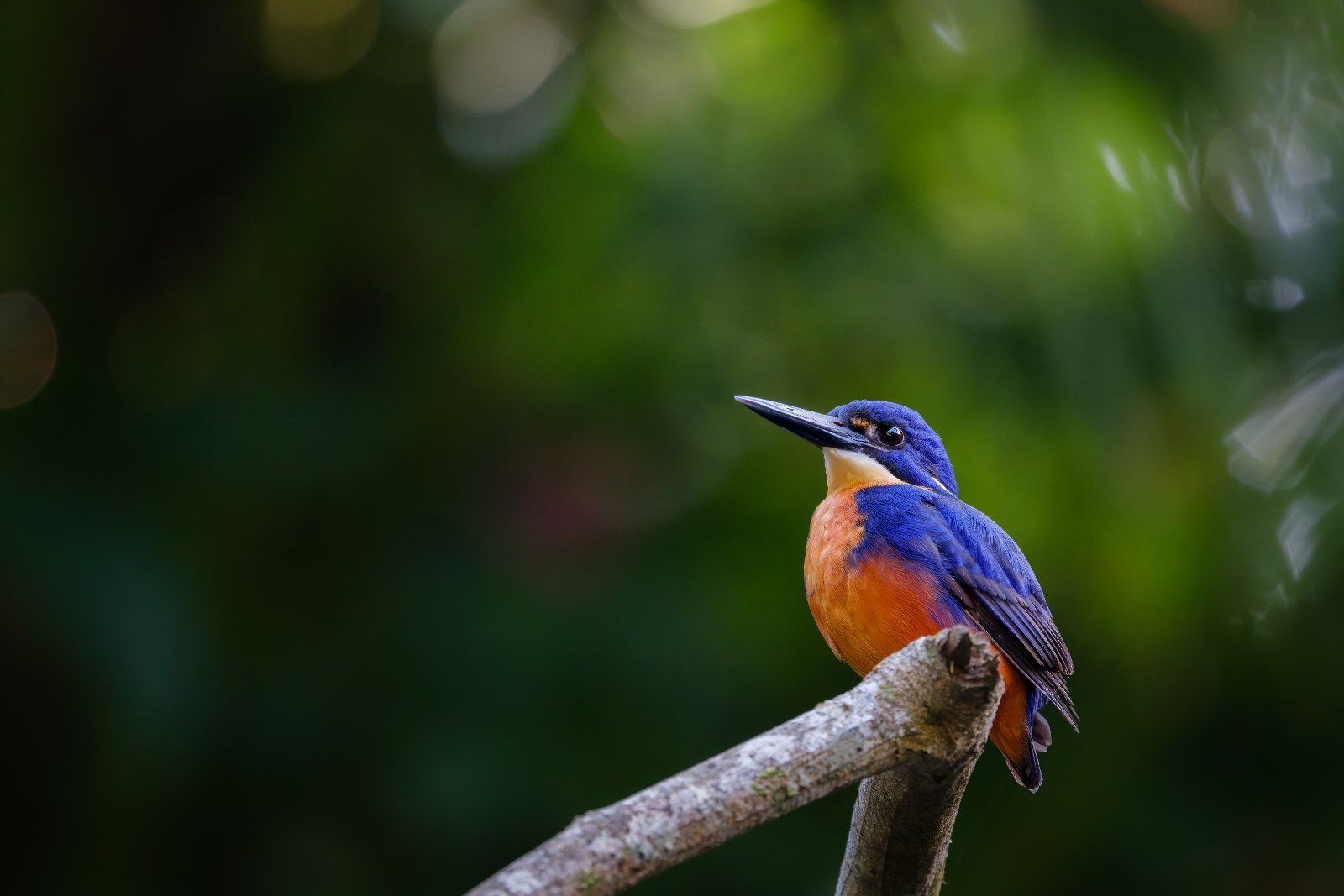
Azure Kingfisher (Ceyx azureus) lives in rainforest streams across New Guinea. It feeds on small fish and insects. Its conservation status is Least Concern.
Every fact above was checked against these pages, and kept only where one of them states it.
The Azure Kingfisher (Ceyx azureus) dazzles with a cobalt-blue mantle that shimmers like sun‑lit water, a bright orange chest band, and a white throat edged in black. Its slender, pointed bill, just a few centimeters long, fits perfectly for snatching prey from the surface of streams, while the iridescent plumage reflects the dappled canopy of its lowland rainforest homes. Endemic to the mist‑cloaked valleys of Borneo and Sumatra, this diminutive bird favors clear, slow‑moving forest streams bordered by dense, moss‑laden foliage, where it perches on low branches before diving in a flash of blue to capture aquatic insects, tiny fish, and crustaceans. Its hunting technique is a study in precision: the kingfisher hovers briefly, then plunges at a 45‑degree angle, the water rippling around its streamlined body as it emerges with a wriggling catch. Beyond its striking appearance, the Azure Kingfisher exhibits a surprising social quirk, pair bonds that last a lifetime, reinforced by elaborate aerial courtship displays where the male loops and rolls above the water, flashing his brilliant plumage to the female, a ritual that can span weeks and strengthens territorial fidelity. This intimate partnership not only secures breeding success but also fosters a cooperative defense of prime foraging stretches, pulling the reader toward the next hidden facet of its ecology. In the understory, the bird’s call, a sharp, metallic ‘tsee‑tsee’, echoes across the waterway, serving as both a territorial warning and a beacon for potential mates. Researchers have noted that the species adjusts its foraging times to the crepuscular activity of its prey, often hunting at dawn and dusk when insects emerge in swarms, a behavior that underscores its adaptability within a niche that many assume is static. The Azure Kingfisher’s reliance on pristine water quality makes it an inadvertent sentinel of forest health, a living barometer for the integrity of the ecosystems it inhabits.
Real recorded sounds, 11 nature games and a free Daily 5, 1v1 quiz duels, conservation wins and a safe Kids mode. Free on Feravox.