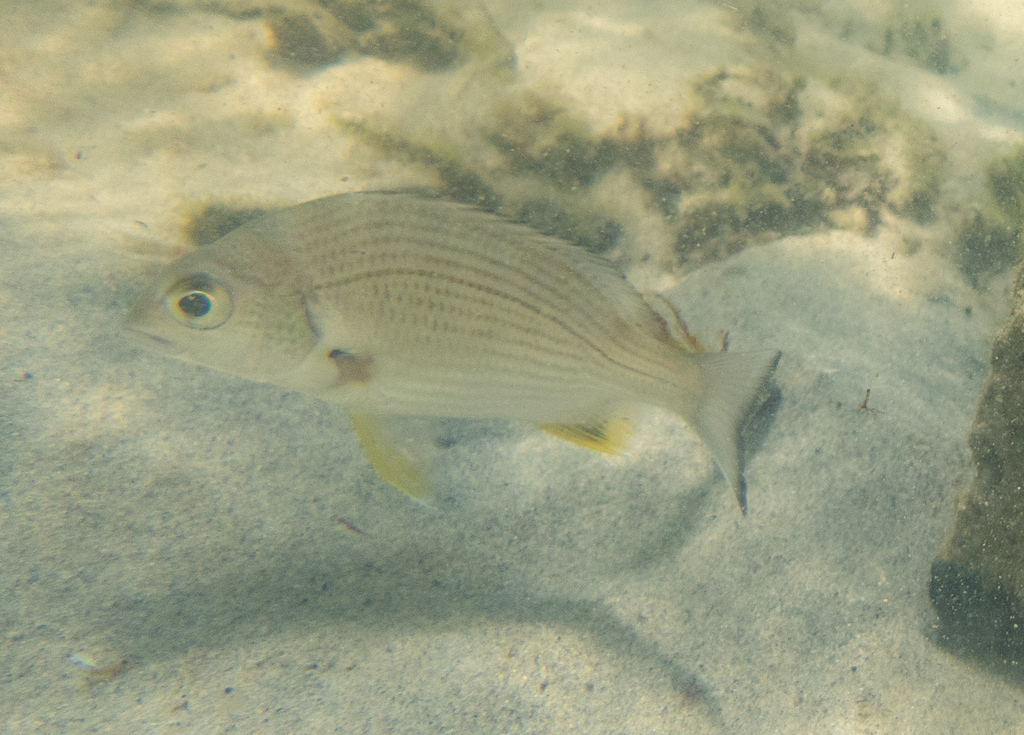
Photo: Rolf Lawrenz
Feravox · The Voice of the Wild
Australian Sea Bream
Acanthopagrus australis
Least Concern
Australian Sea Bream (Acanthopagrus australis) lives in estuarine and rocky reef across eastern Australian coast. Its conservation status is Least Concern.
The Australian sea bream, Acanthopagrus australis, is a deep-bodied sparid whose yellowish ventral and anal fins betray its common name, yellowfin bream. In the brackish reaches of estuaries its scales flash a silvery hue, while freshwater individuals turn bronze or brown, a chameleon-like shift that mirrors the shifting salinity of their homes. Growing slowly, they reach a fork length of about 23 cm (9 in) by age five, maturing at roughly 22 cm (8.7 in). Occasionally, a giant will surface, one caught in the Georges River in 1928 measured 56 cm (22 in) and weighed 7 lb 3 oz, and a later specimen from the Clarence River stretched to 58.5 cm (23 in) with a similar weight. Their life is a tide-driven drama: in winter they surge downstream to river mouths, where females deposit planktonic eggs that hatch after 2.5 days. The larvae drift for four weeks before settling in seagrass beds, feeding on the benthic bounty of crabs, oysters, polychaetes and small fish. A surprising twist lies in their reproductive biology, surf bream are protandrous, starting life as males and transforming into females after the spawning season, a strategy that balances the sex ratio in fluctuating estuarine populations.
Real recorded sounds, 11 nature games and a free Daily 5, 1v1 quiz duels, conservation wins and a safe Kids mode. Free on Feravox.