Red-tailed Tropicbird: a two-minute wildlife lesson
Its name comes from two long red tail feathers, called streamers, that are about twice as long as its body.
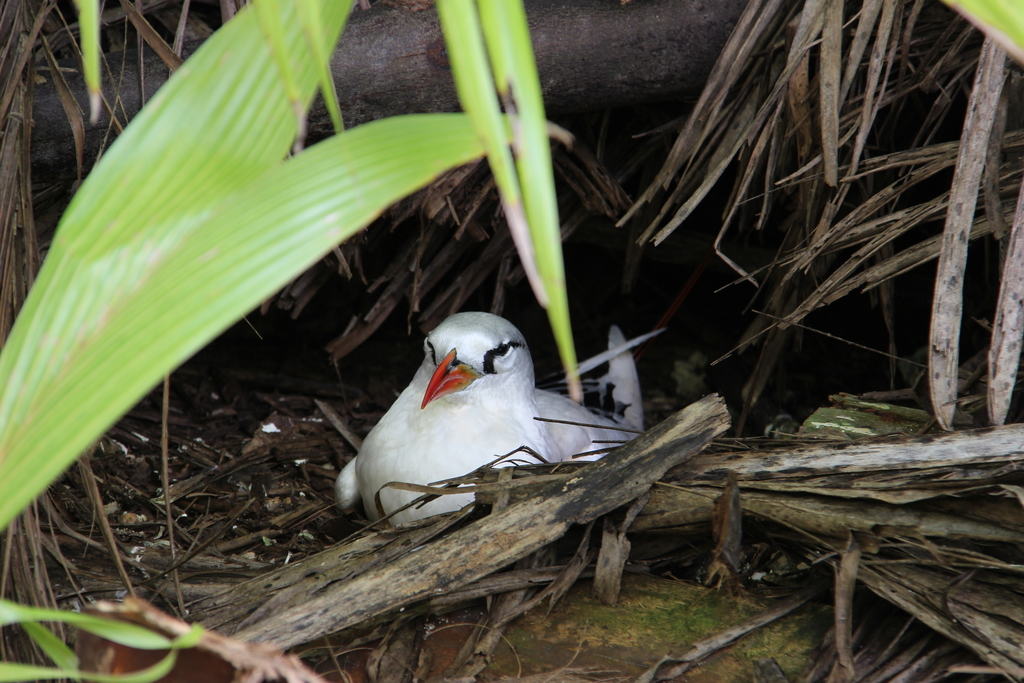
Seabirds · day 3 of 7
Five facts
- Its name comes from two long red tail feathers, called streamers, that are about twice as long as its body.
- Facing into the wind, it can hover in one spot. During courtship, pairs even fly backwards while circling each other.
- A poor walker, it lands by stalling in the wind and dropping down. It often nests within one metre of shade to save steps.
- Squid and flying fish are its main food, and it sometimes snatches flying fish right out of the air.
- After hatching, parents split the work: one makes short trips of about three hours to feed the chick, the other long ones to feed itself.
The quiz
1. How long are a red-tailed tropicbird's tail streamers?
- About half its body length
- About twice its body length (correct)
- About ten times its body length
- As long as its bill
Adults have red streamers about twice as long as their body.
2. What can pairs do in the air during courtship?
- Fly upside down for hours
- Carry each other
- Fly backwards (correct)
- Sing a long duet underwater
In courtship flights, a pair can circle one another and even fly in reverse.
3. Why does it often nest close to the edge of a shrub?
- Because it walks poorly (correct)
- To eat the berries
- To hide from the rain only
- Because it cannot see well
It does not walk well, so a nest near the shade's edge keeps walking to a minimum.
4. Which prey does it sometimes catch in mid-air?
- Butterflies
- Bats
- Small birds
- Flying fish (correct)
It sometimes grabs flying fish in the air.
5. How do the parents share the work after the chick hatches?
- Both leave the chick alone for weeks
- One stays in the nest and never eats
- One makes short trips for the chick, the other long ones for itself (correct)
- They take turns sitting on the chick for a month each
One parent makes short trips of about three hours to feed the chick while the other forages far for itself.
More about the Red-tailed Tropicbird
Same week
Today’s lesson is waiting
Two minutes a day, a new wild animal. Free on iPhone, Android and the web.
Hear them, don't just read about them
Feravox is a free wildlife app: 4,400+ species with real recorded sounds, 11 nature games and a free Daily 5, 1v1 quiz duels, conservation wins, and a safe Kids mode.