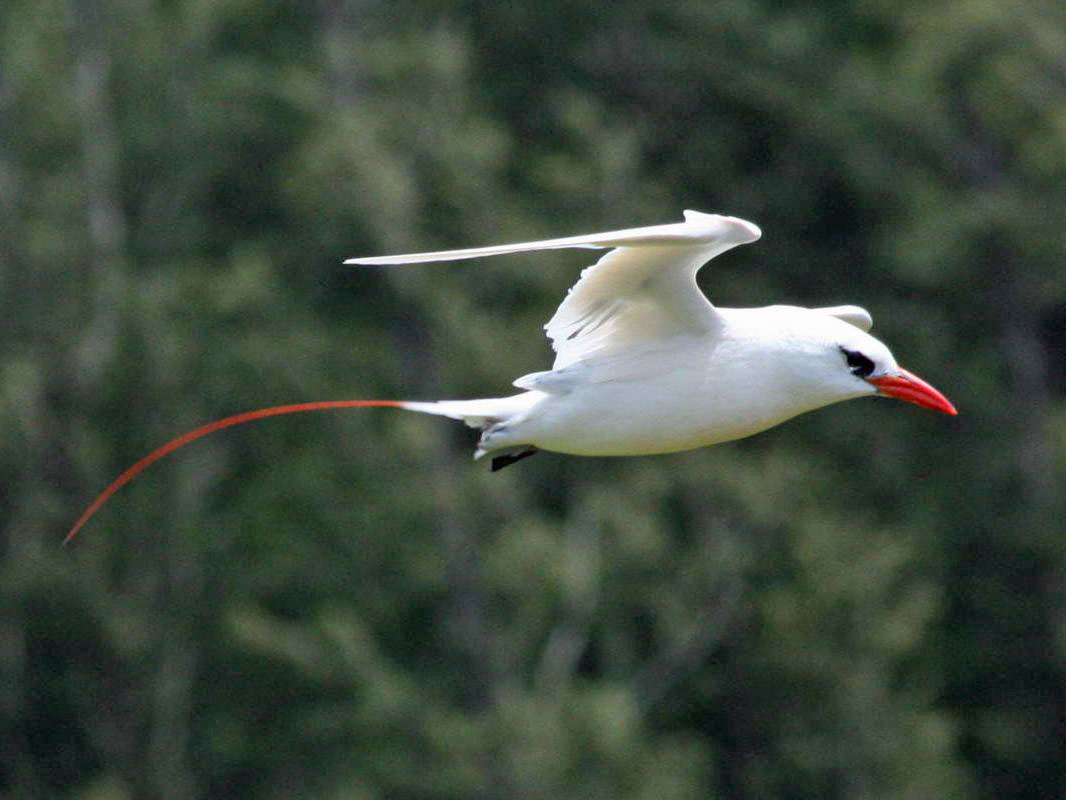
Red-tailed Tropicbird (Phaethon rubricauda) lives in tropical oceans across Pacific Ocean. It feeds on fish and squid. Its conservation status is Least Concern.
Hear the Red-tailed Tropicbird
A real field recording of the Red-tailed Tropicbird, made in the wild.
Red-tailed tropicbirds sport tail streamers that stretch to roughly twice the length of their bodies, turning a 95-to-104 cm bird into a striking aerial marvel. Their average weight of about 800 g and wingspan of 111-119 cm give them a solid, streamlined build. These flamboyant feathers aren't just for show; they are a key factor in mate choice, with longer streamers making individuals more attractive and likely to pair with similarly adorned partners. The dramatic length therefore drives reproductive success in this oceanic flyer.
During incubation, each parent embarks on a marathon foraging trek lasting about 153 hours, venturing far into productive waters to bring back food for the single egg. Once the chick hatches, the parents split duties: one makes short three-hour trips to feed the youngster, while the other takes much longer 57-hour voyages to replenish its own reserves. This bimodal pattern balances self-maintenance with chick provisioning, ensuring both adults stay healthy and the chick receives regular meals during its 67-to-91 day nest stay.
Red-tailed tropicbirds dive from heights of 6-to-50 metres, plunging up to 4.5 metres below the surface, and stay submerged for an average of just 26.6 seconds before resurfacing with prey. Their diet is dominated by flying fish and squid, with the purpleback flying squid (Sthenoteuthis oualaniensis) being the most frequently consumed cephalopod. This hunting style lets them capture agile prey mid-air or just beneath the waves.
Johnston Atoll hosts the world's largest red-tailed tropicbird colony, with 10,800 nests recorded in 2020. These birds nest in shallow scrapes on cliffs, crevices, or sandy beaches, often within a metre of shrub edges to minimise walking, an adaptation to their awkward terrestrial gait. Rats and feral cats prey on eggs and chicks.
Genetic studies place the red-tailed tropicbird's closest living relative, the white-tailed tropicbird, at a divergence of roughly four million years ago, indicating a deep evolutionary split within the Phaethontidae family.
Sources
Every fact above was checked against these pages, and kept only where one of them states it.
As the Red-tailed Tropicbird soars through the tropical skies, its snowy plumage glistens like a beacon, set ablaze by the vibrant hues of its bill and tail, a striking counterpoint to the cerulean expanse below. With effortless elegance, it glides on thermals of warm air, its long, slender wings beating in a slow, hypnotic rhythm, as it surveys its domain with an air of serene dominion. In its majestic, looping arcs, the Red-tailed Tropicbird embodies the very essence of the oceanic realm, a master of the wind and waves, unencumbered and free.
Advertisement
Hear the Red-tailed Tropicbird, and 4,400+ more
Real recorded sounds, 11 nature games and a free Daily 5, 1v1 quiz duels, conservation wins and a safe Kids mode. Free on Feravox.