Feravox · The Voice of the Wild
Green Iguana: a two-minute wildlife lesson
A green iguana has a third eye on top of its head. It can't form images, but it senses light, dark and movement overhead.
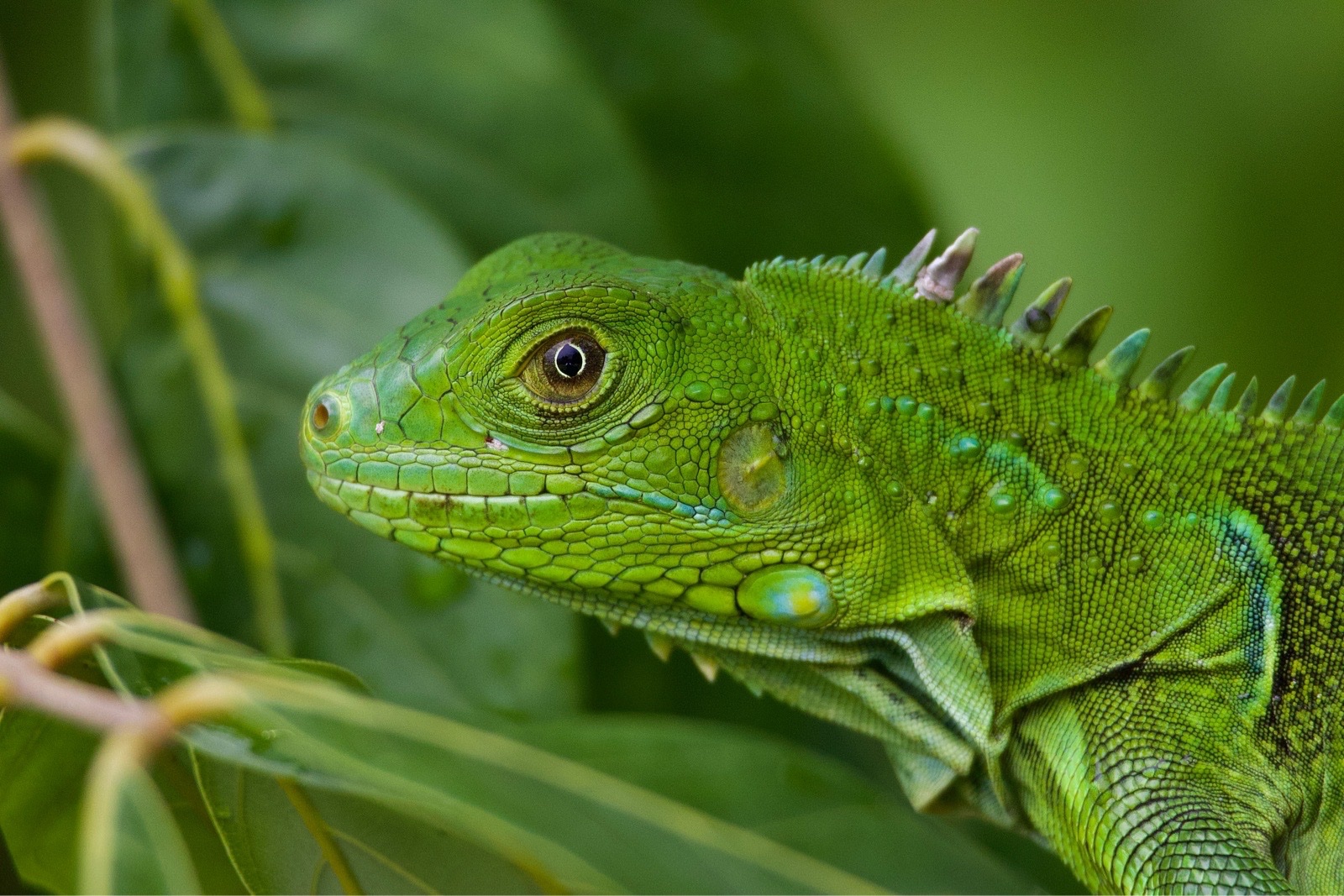
Lizards · day 6 of 7
Five facts
- A green iguana has a third eye on top of its head. It can't form images, but it senses light, dark and movement overhead.
- Green iguanas can drop from as much as 15 m up and land unharmed, grabbing leaves and branches with their hind claws to slow the fall.
- In 1995 a hurricane washed green iguanas ashore on Anguilla, showing they can reach new islands by sea.
- Young green iguanas stay in family groups for their first year. The males often use their own bodies to shield the females from predators.
- A green iguana is usually 1.2 to 1.7 m long, and most of that is tail. A few have topped 2 m and 9 kg.
The quiz
1. What can a green iguana's third eye do?
- Form sharp images
- See in colour
- Sense light, dark and movement overhead (correct)
- Hear distant sounds
The third eye cannot form images but senses light, dark and movement, which helps spot predators from above.
2. How do green iguanas slow a long fall?
- Grasping branches with their hind claws (correct)
- Spreading skin flaps like wings
- Whipping their tail like a parachute
- Rolling into a ball
They grasp leaves and branches with their hind claws to break the descent.
3. What carried green iguanas to Anguilla in 1995?
- A cargo ship
- A river flood
- Migrating birds
- A hurricane (correct)
A hurricane washed green iguanas ashore on Anguilla in 1995.
4. In a young iguana family group, who shields the females from predators?
- The mother
- Young males (correct)
- Older females
- Nobody does
Young males often use their own bodies to shield the females from predators.
5. What makes up most of a green iguana's length?
- Its neck
- Its body
- Its tail (correct)
- Its legs
The tail makes up much of the iguana's length.
Same week
Today’s lesson is waiting
Two minutes a day, a new wild animal. Free on iPhone, Android and the web.
Hear them, don't just read about them
Feravox is a free wildlife app: 4,400+ species with real recorded sounds, 11 nature games and a free Daily 5, 1v1 quiz duels, conservation wins, and a safe Kids mode.
Nature documentaries
Blue Planet III2026 · BBC OnePlanet Earth III2023 · BBC OneBlue Planet II2017 · BBC OnePlanet Earth II2016 · BBC OneFrozen Planet II2022 · BBC OneSeven Worlds, One Planet2019 · BBC OneMammals2024 · BBC OneSecret Garden2026 · BBC OneWild Isles2023 · BBC OneOur Planet2019 · NetflixOur Planet II2023 · NetflixThe Blue Planet2001 · BBC One