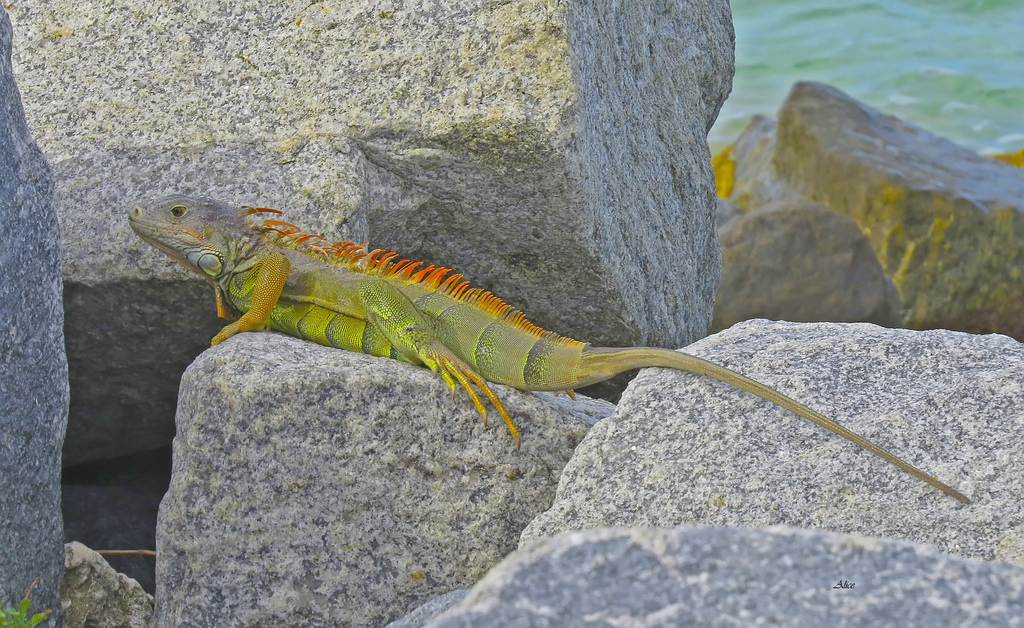
Green Iguana (Iguana iguana) lives in tropical rainforest across Central and South America. It feeds on leaves and fruits. Its conservation status is Least Concern.
Fascinating facts about the Green Iguana
- The green iguana can exceed two metres in total length, with some individuals reaching more than two metres and weighing upwards of nine kilograms. Such size makes it one of the largest lizards in its family, rivalled only by a few Cyclura species in weight. Its massive tail accounts for most of this length, while the snout-to-vent portion remains only thirty to forty-two centimetres. This extreme growth is recorded in wild specimens across its native range.
- In 1995 a hurricane washed green iguanas ashore on Anguilla, directly demonstrating that oceanic dispersal can transport the species to islands where it was previously absent. The storm-driven arrival provided concrete proof of this natural colonisation mechanism, confirming observations of other introduced populations. Such events explain how the iguana has become invasive on many distant islands after being carried by currents.
- The green iguana retains a white photosensory organ on the top of its head, known as the parietal eye or third eye, a primitive feature lost in most other lizards. This organ lacks a fully formed retina and lens, so it cannot create images, but it is sensitive to changes in light and dark and can detect movement overhead. By sensing shifts in illumination, it helps the iguana spot approaching predators from above.
- Juvenile green iguanas remain in family groups for about a year after hatching, staying close to one another as they grow. Within these groups, young males will position their bodies between females and any approaching predator, effectively shielding the females from danger. This protective behaviour is noted as unique among reptiles, with no other species showing a similar pattern of male-led defence for females.
- Green iguanas are agile climbers that often perch high in trees, and they can survive falls from great heights. They are capable of dropping from as much as 15 metres and landing unharmed, because they use the claws on their hind legs to grasp leaves and branches that break the descent. This ability allows them to escape predators or move quickly between canopy levels without injury.
Sources
Every fact above was checked against these pages, and kept only where one of them states it.
At a glance
RangeCentral and South America
HabitatTropical rainforest
DietLeaves and fruits
About the Green Iguana
In the lush, vibrant canopies of the tropical rainforest, the green iguana reigns supreme, its scaly, emerald body undulating effortlessly as it navigates the intricate network of branches and leaves with a slow, deliberate grace. As it moves, its long, whip-like tail swishes back and forth, a counterbalance to the deliberate, almost regal, pace of its claws, which grasp and release the rough bark with a gentle precision. With its spiky, dinosaurian profile and unblinking, golden gaze, the green iguana is a true monarch of its domain, a creature of ancient, unyielding power.
Common questions
What does the Green Iguana eat?
Diet: leaves and fruits.
Where does the Green Iguana live?
Habitat: tropical rainforest. Range: Central and South America.
Is the Green Iguana endangered?
The Green Iguana is listed as Least Concern on the IUCN Red List.
How can I learn about the Green Iguana?
Feravox has a two-minute lesson on the Green Iguana: five facts and five questions. See the lesson
Hear the Green Iguana, and 4,400+ more
Real recorded sounds, 11 nature games and a free Daily 5, 1v1 quiz duels, conservation wins and a safe Kids mode. Free on Feravox.
Green Iguana photographed on Feravox
More reptiles to discover