Feravox · The Voice of the Wild
Eastern Newt: a two-minute wildlife lesson
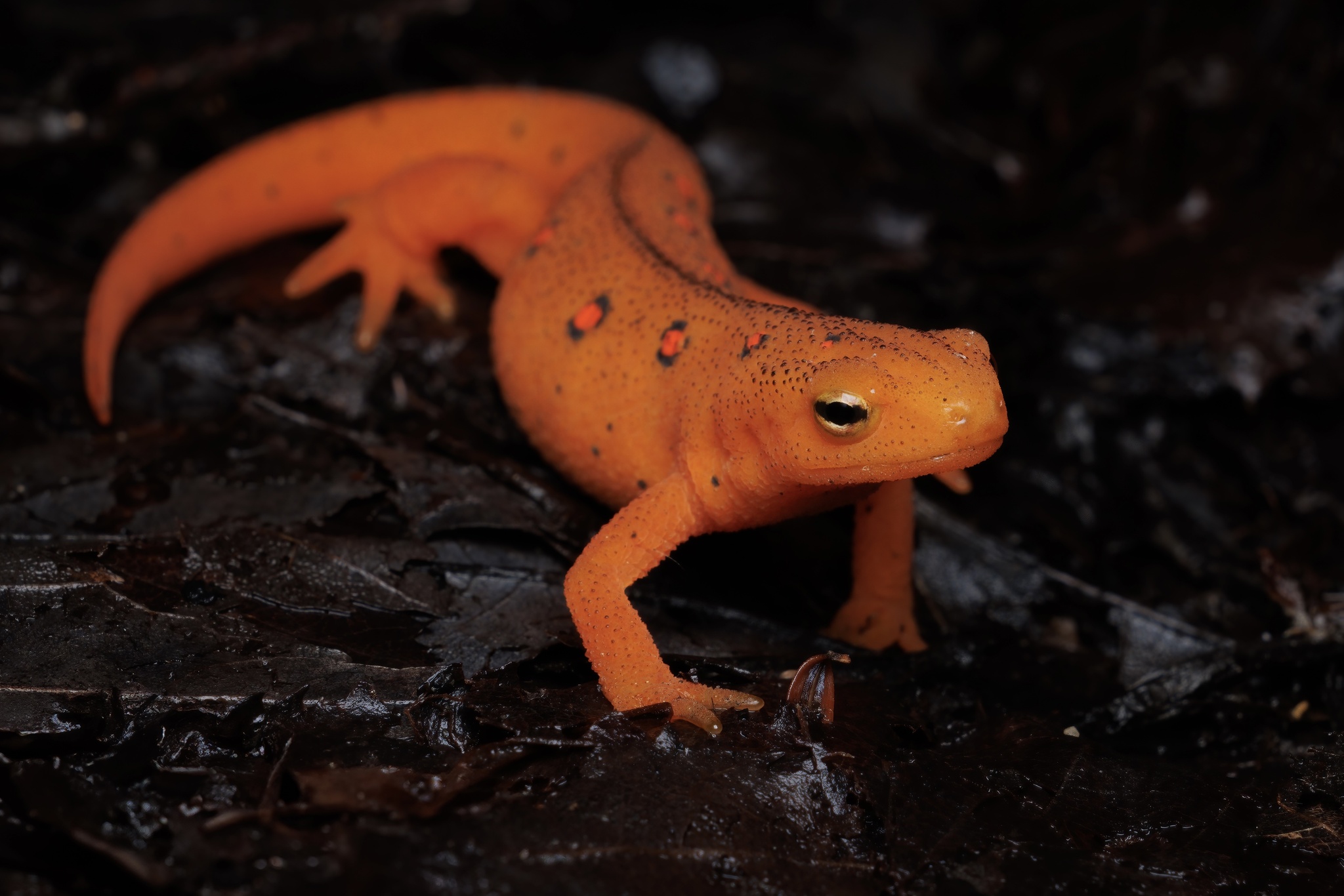
Eastern newts carry a toxin, tetrodotoxin, that makes them taste bad to predatory fish and crayfish. The bright orange young warn them off.
Newts and Salamanders · day 2 of 7
Five facts
- Eastern newts carry a toxin, tetrodotoxin, that makes them taste bad to predatory fish and crayfish. The bright orange young warn them off.
- On an average night, an eastern newt moves about 15 m, and the longest trails recorded were over 70 m.
- Only about two out of every hundred larvae survive to become the bright-colored eft.
- A female eastern newt lays 200 to 400 eggs in one batch, sticking them to underwater plants. They hatch after 3 to 8 weeks.
- Eastern newts are very sensitive: they can sense how clean and how warm their water is, and react when it changes.
The quiz
1. What stops predatory fish and crayfish from eating eastern newts?
- The newts hide underground
- The newts are too fast
- The newts are toxic (correct)
- The newts glow at night
A toxin in their body makes them taste bad to predatory fish and crayfish.
2. About how far does an eastern newt travel on an average night?
- 70 m
- 15 m (correct)
- 2 m
- 400 m
On an average night, eastern newts move about 15 m.
3. How many larvae survive to become an eft?
- About two out of every hundred (correct)
- About half
- About nine out of ten
- About one in a thousand
Only about two out of every hundred larvae survive to become the eft.
4. How many eggs does a female lay in one batch?
- Between 5 and 10
- Between 20 and 40
- Between 2,000 and 4,000
- Between 200 and 400 (correct)
A female lays 200 to 400 eggs in a single batch.
5. What can eastern newts detect and respond to?
- Distant thunderstorms
- Changes in water quality and temperature (correct)
- The songs of frogs
- Changes in moonlight
They sense shifts in how clean and how warm the water is, and react to them.
Same week
Today’s lesson is waiting
Two minutes a day, a new wild animal. Free on iPhone, Android and the web.
Hear them, don't just read about them
Feravox is a free wildlife app: 4,400+ species with real recorded sounds, 11 nature games and a free Daily 5, 1v1 quiz duels, conservation wins, and a safe Kids mode.
Nature documentaries
Blue Planet III2026 · BBC OnePlanet Earth III2023 · BBC OneBlue Planet II2017 · BBC OnePlanet Earth II2016 · BBC OneFrozen Planet II2022 · BBC OneSeven Worlds, One Planet2019 · BBC OneMammals2024 · BBC OneSecret Garden2026 · BBC OneWild Isles2023 · BBC OneOur Planet2019 · NetflixOur Planet II2023 · NetflixThe Blue Planet2001 · BBC One