Feravox · The Voice of the Wild
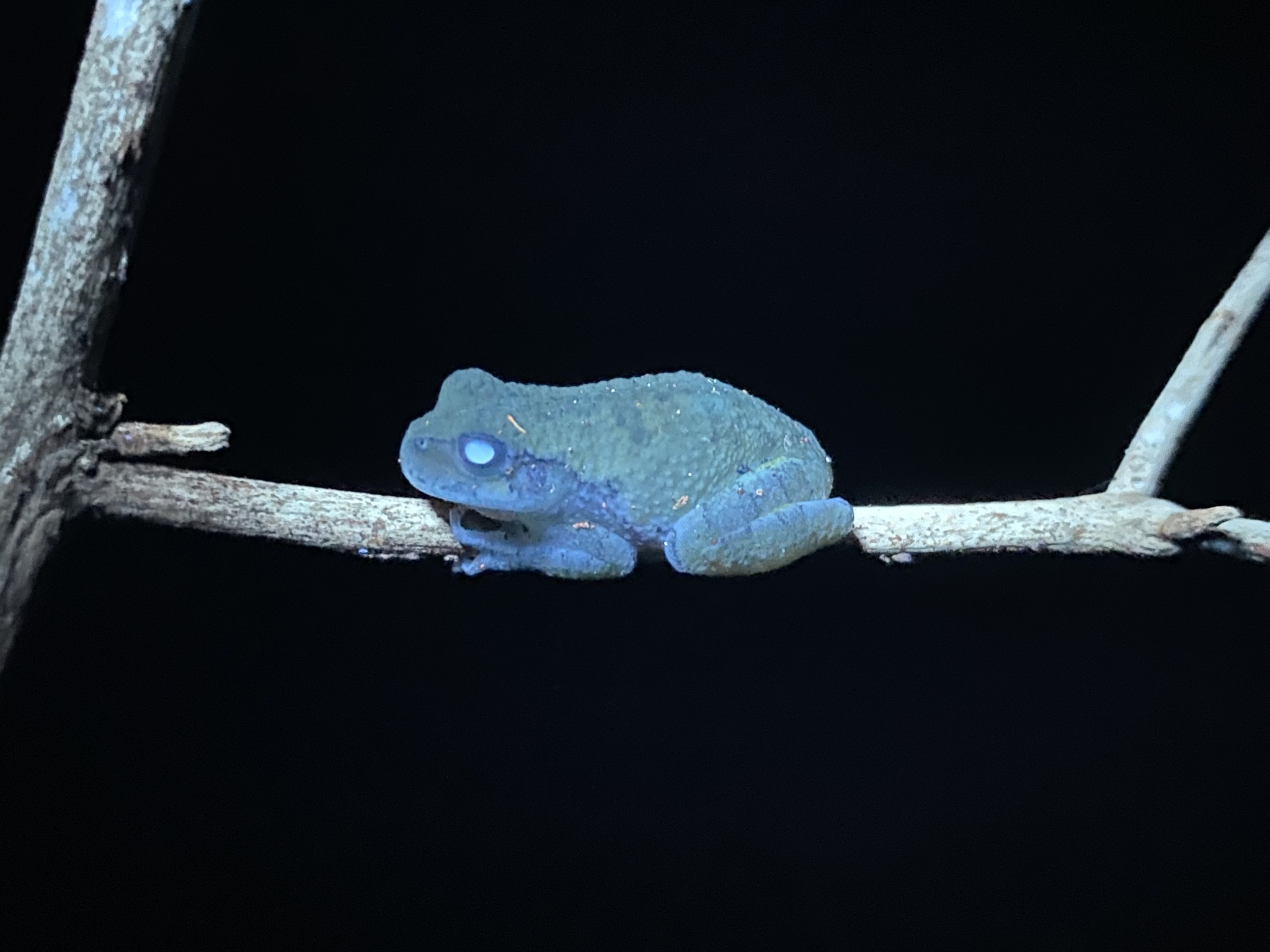
Cope's Gray Treefrog: a two-minute wildlife lesson
Cope's gray treefrog can survive being frozen, thanks to glycerol, a trick only a few frog species use.
Newts and Salamanders · day 7 of 7
Five facts
- Cope's gray treefrog can survive being frozen, thanks to glycerol, a trick only a few frog species use.
- It can survive temperatures as low as -8 °C. In wintering frogs, 40 to 50 % of their body water was found frozen.
- Breeding males call at 85 to 90 dB.
- Its calls are faster and slightly higher-pitched than the gray treefrog's, and female treefrogs can tell apart calls just a few decibels apart.
- When it jumps, hidden bright-yellow marks on its hind legs flash into view and can startle a predator.
The quiz
1. What helps Cope's gray treefrog survive freezing?
- Thick fur
- Digging deep
- Glycerol (correct)
- Antlers
It produces glycerol as a cryoprotectant.
2. How much of its body water can turn to ice?
- Up to half (correct)
- None at all
- A tenth
- All of it
In wintering frogs, 40 to 50 % of body water was frozen.
3. How loud can male calls get?
- 15 to 20 dB
- 85 to 90 dB (correct)
- 40 to 45 dB
- 120 to 130 dB
Male calls reach 85 to 90 dB.
4. How do its calls differ from the gray treefrog's?
- Slower and lower
- Much longer
- Silent
- Faster and slightly higher-pitched (correct)
Its calls are faster-paced and slightly higher-pitched.
5. What is revealed on its hind legs when it jumps?
- Red stripes
- Blue spots
- Bright-yellow markings (correct)
- White fur
Hidden bright-yellow markings flash into view.
Same week
Today’s lesson is waiting
Two minutes a day, a new wild animal. Free on iPhone, Android and the web.
Hear them, don't just read about them
Feravox is a free wildlife app: 4,400+ species with real recorded sounds, 11 nature games and a free Daily 5, 1v1 quiz duels, conservation wins, and a safe Kids mode.
Nature documentaries
Blue Planet III2026 · BBC OnePlanet Earth III2023 · BBC OneBlue Planet II2017 · BBC OnePlanet Earth II2016 · BBC OneFrozen Planet II2022 · BBC OneSeven Worlds, One Planet2019 · BBC OneMammals2024 · BBC OneSecret Garden2026 · BBC OneWild Isles2023 · BBC OneOur Planet2019 · NetflixOur Planet II2023 · NetflixThe Blue Planet2001 · BBC One