Feravox · The Voice of the Wild
Chestnut-sided Warbler: a two-minute wildlife lesson
To win a mate, the male whistles a song often written as 'pleased, pleased, pleased to MEECHA'.
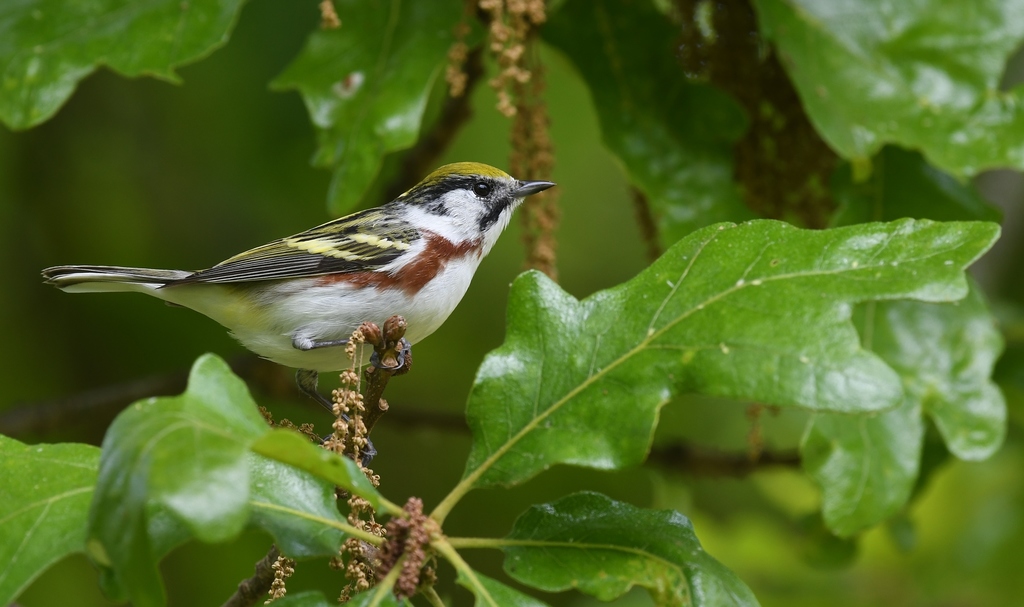
Little Birds of the Americas · day 3 of 7
Five facts
- To win a mate, the male whistles a song often written as 'pleased, pleased, pleased to MEECHA'.
- Without the 'MEECHA' ending, the song is a warning to rival males. Males that only sing this version find mates less easily.
- It loves young regrowing woods. After trees are cut, its numbers climb within a year and peak seven to eight years later.
- It mainly eats caterpillars and fly larvae, picking most of its food off leaves. Now and then it snatches an insect in mid-air.
- In 2018, a rare bird in Pennsylvania turned out to be a mix of three species. Its father was a chestnut-sided warbler.
The quiz
1. How is the male's courtship song often written?
- Pleased, pleased, pleased to MEECHA (correct)
- Teacher, teacher, teacher
- Drink your tea
- Who cooks for you
Its whistled song, used to attract a female, ends in 'MEECHA'.
2. What happens to males that sing only the song without 'MEECHA'?
- They attract more females
- They find mates less easily (correct)
- They lose their territory at once
- They stop singing in summer
They are less successful at finding mates than males that sing both songs.
3. When do its numbers peak after a forest is cut?
- After one week
- After one month
- Seven to eight years later (correct)
- Only after 100 years
Its numbers rise within a year and peak seven to eight years after.
4. What does the chestnut-sided warbler mainly eat?
- Flower nectar
- Small fish
- Tree sap
- Caterpillars and fly larvae (correct)
Its main food is the larvae of moths, butterflies and flies.
5. What was special about the bird found in Pennsylvania in 2018?
- It was pure white
- It was a mix of three species (correct)
- It had four wings
- It sang like a frog
It was a three-species hybrid with a chestnut-sided warbler father.
More about the Chestnut-sided Warbler
Same week
Today’s lesson is waiting
Two minutes a day, a new wild animal. Free on iPhone, Android and the web.
Hear them, don't just read about them
Feravox is a free wildlife app: 4,400+ species with real recorded sounds, 11 nature games and a free Daily 5, 1v1 quiz duels, conservation wins, and a safe Kids mode.
Nature documentaries
Blue Planet III2026 · BBC OnePlanet Earth III2023 · BBC OneBlue Planet II2017 · BBC OnePlanet Earth II2016 · BBC OneFrozen Planet II2022 · BBC OneSeven Worlds, One Planet2019 · BBC OneMammals2024 · BBC OneSecret Garden2026 · BBC OneWild Isles2023 · BBC OneOur Planet2019 · NetflixOur Planet II2023 · NetflixThe Blue Planet2001 · BBC One