Feravox · The Voice of the Wild
Black-and-white Warbler: a two-minute wildlife lesson
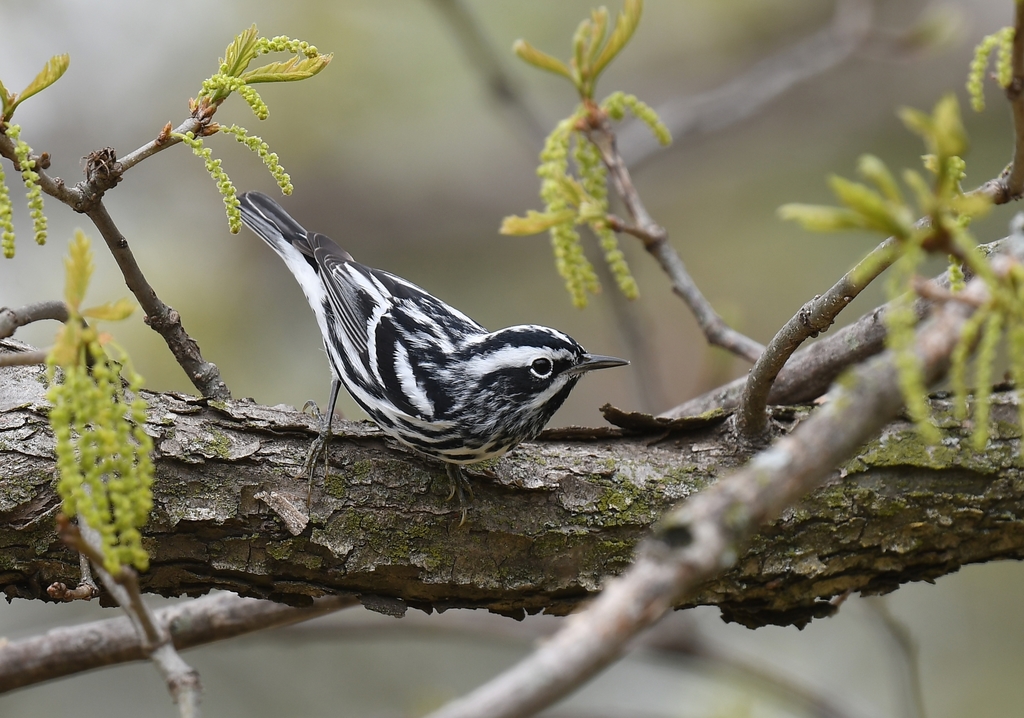
It creeps up and down tree trunks like a nuthatch. No other wood-warbler in North America searches for food on bark.
Little Birds of the Americas · day 4 of 7
Five facts
- It creeps up and down tree trunks like a nuthatch. No other wood-warbler in North America searches for food on bark.
- Its short legs and long back toe are built for this bark-climbing way of feeding.
- The summer male is so boldly striped in black and white that it has been called a flying humbug, like the striped sweet.
- Its high song is a 'wee-see' said over and over, at least six times in a row.
- Though it feeds on tree trunks, it nests on the ground, tucking a cup of grass and leaves among roots and lining it with moss.
The quiz
1. Where does the black-and-white warbler hunt for food?
- In the water
- On tree trunks and branches (correct)
- Only in flowers
- In the sand
Like a nuthatch, it moves up and down trunks and along branches.
2. Which body feature helps it cling to bark?
- A stiff, spiky tail
- Webbed feet
- A long hind toe (correct)
- Hooked wings
Short legs and a long hind toe suit its way of feeding.
3. What has the striped male been described as?
- A flying humbug (correct)
- A tiny zebra
- A piano key
- A chessboard
Its bold black-and-white streaks earned it the name flying humbug.
4. How many times in a row is its 'wee-see' repeated, at least?
- Once
- Twice
- Three times
- Six times (correct)
Its wee-see comes at least six times, one after another.
5. Where does the black-and-white warbler usually build its nest?
- High in a treetop
- On the ground among roots (correct)
- Inside a woodpecker hole
- Under a bridge
It nests on the ground, often among roots or against a tree.
More about the Black-and-white Warbler
Same week
Today’s lesson is waiting
Two minutes a day, a new wild animal. Free on iPhone, Android and the web.
Hear them, don't just read about them
Feravox is a free wildlife app: 4,400+ species with real recorded sounds, 11 nature games and a free Daily 5, 1v1 quiz duels, conservation wins, and a safe Kids mode.
Nature documentaries
Blue Planet III2026 · BBC OnePlanet Earth III2023 · BBC OneBlue Planet II2017 · BBC OnePlanet Earth II2016 · BBC OneFrozen Planet II2022 · BBC OneSeven Worlds, One Planet2019 · BBC OneMammals2024 · BBC OneSecret Garden2026 · BBC OneWild Isles2023 · BBC OneOur Planet2019 · NetflixOur Planet II2023 · NetflixThe Blue Planet2001 · BBC One