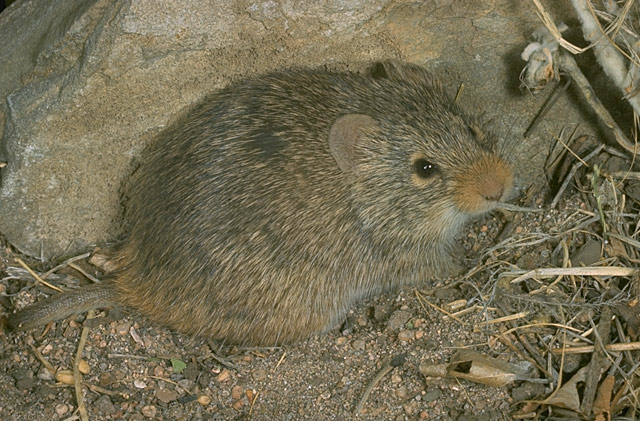
Yellow-nosed Cotton Rat (Sigmodon ochrognathus) lives in desert grasslands across Southwestern North America. Its conservation status is Least Concern.
Fascinating facts about the Yellow-nosed Cotton Rat
- The yellow-nosed cotton rat's tail is covered in countless tiny scales, each no wider than half a millimetre, giving it a sleek, almost hair-like appearance. The tail itself is described as hairy and the scales are so small they create a smooth surface. Its upper side is blackish while the underside is a muted gray, adding subtle contrast to the otherwise uniform tail.
- Nests built by yellow-nosed cotton rats are constructed entirely from grass and can reach a diameter of 18 to 40 centimetres, forming sizable domes in the vegetation. They are typically concealed within dense tussocks of grass or other thick plant cover, making them hard to spot. By using the surrounding grass both as building material and camouflage, the nests provide shelter for the young while protecting them from predators.
- Female yellow-nosed cotton rats become sexually mature at about 45 days old and then carry a gestation of roughly 34 days before giving birth. Each litter usually contains two to six offspring, which are born precocial and can leave the nest shortly after birth. Their eyes open within the first day, they grow rapidly, and they are weaned at around 15 days, allowing them to become independent quickly.
- It is a poor competitor with other cotton-rat species such as the white-eared cotton rat, so where their ranges meet it confines itself to thinly vegetated, rocky slopes dotted with grass tussocks. These slopes are typically on the lower, drier sides of mountains below 1 950 m. The habitat is characterised by pinyon-juniper woodland and scattered scrub, making it the most xerophilous member of its genus.
- It occupies the abandoned burrows of the southern pocket gopher and also shelters in cavities beneath boulders. It shares its habitat with the fulvous harvest mouse and moves quickly along its daytime runways, reducing exposure to predators.
Sources
Every fact above was checked against these pages, and kept only where one of them states it.
At a glance
RangeSouthwestern North America
HabitatDesert grasslands
DietSeeds and grasses
About the Yellow-nosed Cotton Rat
In the dense undergrowth of the desert southwest, the Yellow-nosed Cotton Rat weaves a secretive existence, its tawny fur blending seamlessly with the dusty terrain as it scurries through the shadows. With an air of furtive intensity, it darts between cactus and mesquite, its large ears twitching to the slightest rustle of predator or prey, its very presence a testament to the resilience of life in this arid landscape. As it forages for seeds and succulent plants, its busy, whiskered face is a picture of industry and determination, a small but vital thread in the intricate tapestry of the desert ecosystem.
Hear the Yellow-nosed Cotton Rat, and 4,400+ more
Real recorded sounds, 11 nature games and a free Daily 5, 1v1 quiz duels, conservation wins and a safe Kids mode. Free on Feravox.