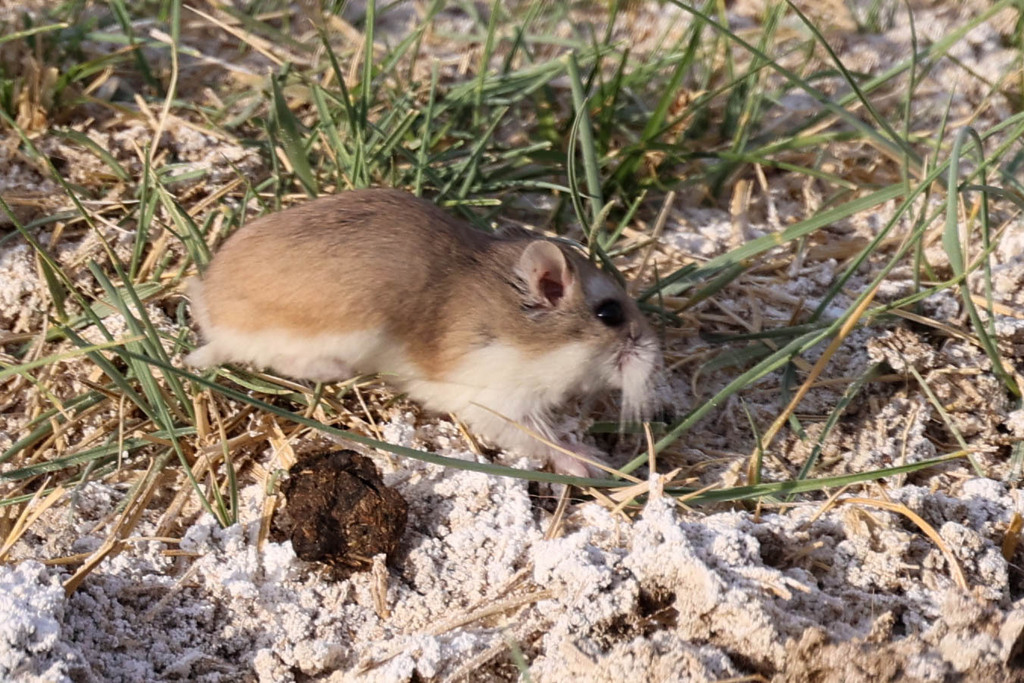
Desert Hamster (Phodopus roborovskii) lives in desert grasslands across Central Asia. It feeds on seeds and insects. Its conservation status is Least Concern.
Fascinating facts about the Desert Hamster
- At just 1.6 cm long when born, a newborn Roborovski hamster, yet it grows to a modest 6.3 cm adult length and weighs only 16 g. Their lifespan stretches 2-4 years, with captive individuals reaching the upper end of that range. Despite this diminutive size, they are built for speed, having been reported to run up to 6 miles a night.
- Roborovski hamsters carve burrows that plunge as deep as six feet beneath the sand, creating steep tunnels. They prefer loose-sand habitats at elevations of roughly 1,200-1,450 m. Their burrows include special food chambers where they stash seeds and insects for winter survival. By staying underground during the cold months.
- A Roborovski hamster consumes about two grams of plant seeds each day, a figure calculated from field data on body-weight-scaled intake. Researchers expressed this relationship as N = (1,422 × ln(M / gram), 1,780) gram, where N is daily food intake and M is body mass. Juveniles eat proportionally more than adults, reflecting their rapid growth needs.
- Roborovski hamsters reproduce at a breakneck pace: gestation lasts only 20-22 days, and a single litter can contain three to nine pups, with an average of six. Breeding can occur year-round, with up to four litters produced between February and October, and captive individuals often breed continuously. The newborns weigh a mere 1 gram and are born hairless, eyes sealed, and unable to regulate their own temperature. By day 14 they are fully furred.
- Metabolic measurements show Roborovski hamsters can shift their oxygen consumption from a basal 2.61 ml O₂ / hour to as high as 8.79 ml O₂ / hour during non-shivering thermogenesis, a response to cold nights in their arid range. Their thermoneutral zone lies between 28 °C and 34 °C, with well-fed individuals tolerating temperatures up to about 35 °C. Body temperature normally hovers around 35.7 °C, dropping slightly when acclimated to winter photoperiods. These physiological tweaks let them maintain energy balance despite daily temperature swings of up to 20 °C in the desert.
Sources
Every fact above was checked against these pages, and kept only where one of them states it.
At a glance
RangeCentral Asia
HabitatDesert grasslands
DietSeeds and insects
About the Desert Hamster
In the scorching expanse of the desert, a tiny, whirlwind creature darts across the sand, its paws a blur as it navigates the arid landscape with an air of urgent purpose. The desert hamster, with its soft, velvety fur and beady eyes, is a master of stealth and agility, its nocturnal wanderings a testament to its adaptability in one of the harshest environments on Earth. As it scurries through the darkness, its high-pitched squeaks punctuate the stillness, a reminder of the hidden world of life that thrives beneath the desert's unforgiving surface.
Hear the Desert Hamster, and 4,400+ more
Real recorded sounds, 11 nature games and a free Daily 5, 1v1 quiz duels, conservation wins and a safe Kids mode. Free on Feravox.