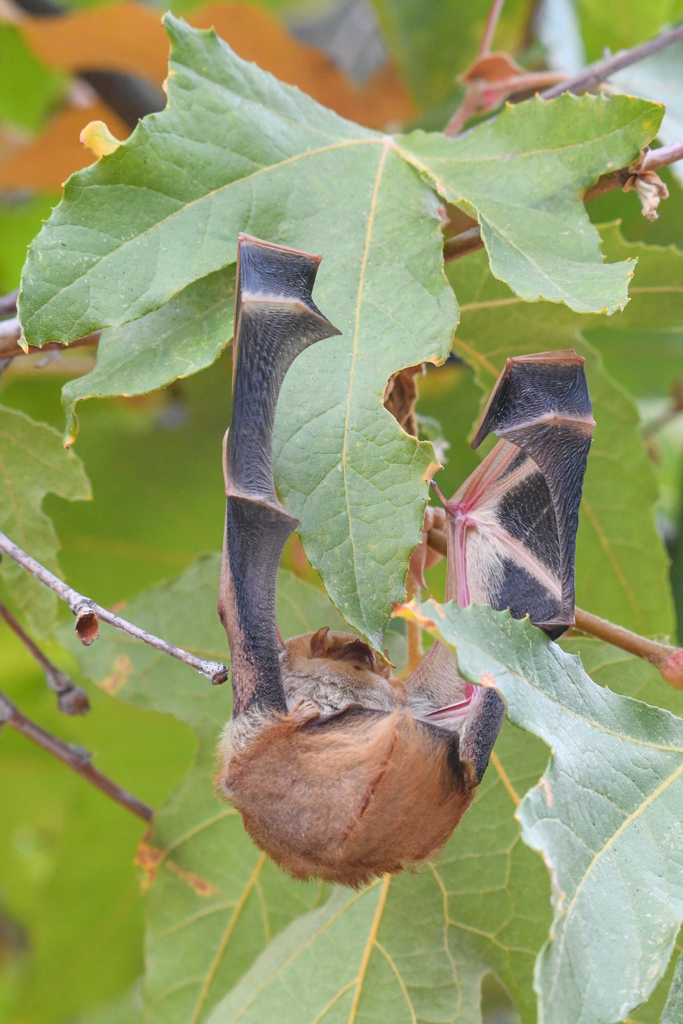
Western Red Bat (Lasiurus frantzii) lives in desert shrubland across Southwest North America. It feeds on insects and fruit. Its conservation status is Least Concern.
Fascinating facts about the Western Red Bat
- The western red bat can produce up to four offspring in a single birth, far more than the single pup typical of most bats. Mating occurs in August and September, and the young are born about ninety days later. A mother may carry as many as four pups until they are able to fly, which takes up to six weeks, and the juveniles reach maturity after one to three years.
- Desert red bats are equipped with four nipples instead of the usual two, matching their ability to rear multiple pups at once. This extra teating supports litters of up to four babies, allowing the mother to nurse each offspring simultaneously. The species therefore combines a larger litter size with a longer developmental period, taking up to six weeks before the young can fly and up to three years to reach full maturity.
- Although its name suggests a desert dweller, the western red bat actually spends winter hibernating beneath forest leaves rather than in arid scrub. It roosts in leaf litter where its reddish coat blends with dead foliage, providing effective camouflage. This behaviour allows the bat to avoid predators while remaining concealed during the colder months.
- The western red bat's reddish fur matches the colour of dead leaves, allowing it to remain unseen while roosting during daylight hours. Although its name suggests a desert habitat, it actually spends the winter hibernating beneath forest leaf litter where the camouflage is most effective. This concealment reduces the risk of predation from owls, raccoons and other daytime hunters, and lets the bat conserve energy until it can resume nightly foraging.
- The western red bat undertakes a long-distance seasonal migration, moving to the southern parts of the Americas each winter and returning north in the summer. Its range stretches from southern Canada, through the western United States, and down through Central America to Panama.
Sources
Every fact above was checked against these pages, and kept only where one of them states it.
At a glance
RangeSouthwest North America
HabitatDesert shrubland
DietInsects and fruit
About the Western Red Bat
In the warm, golden light of dusk, the Western red bat unfurls its delicate wings, a crimson cloak that billows as it takes to the evening skies, its gentle, fluttering flight a mesmerizing dance amidst the whispers of the forest. With each agile swoop, it weaves an intricate tapestry of sound and motion, its high-pitched calls punctuating the air as it pursues the insect hordes that rise to greet the night. As it flits and darts, its very existence seems a whispered secret, a fleeting glimpse of a world that thrives in the shadows, hidden from human eyes.
Hear the Western Red Bat, and 4,400+ more
Real recorded sounds, 11 nature games and a free Daily 5, 1v1 quiz duels, conservation wins and a safe Kids mode. Free on Feravox.