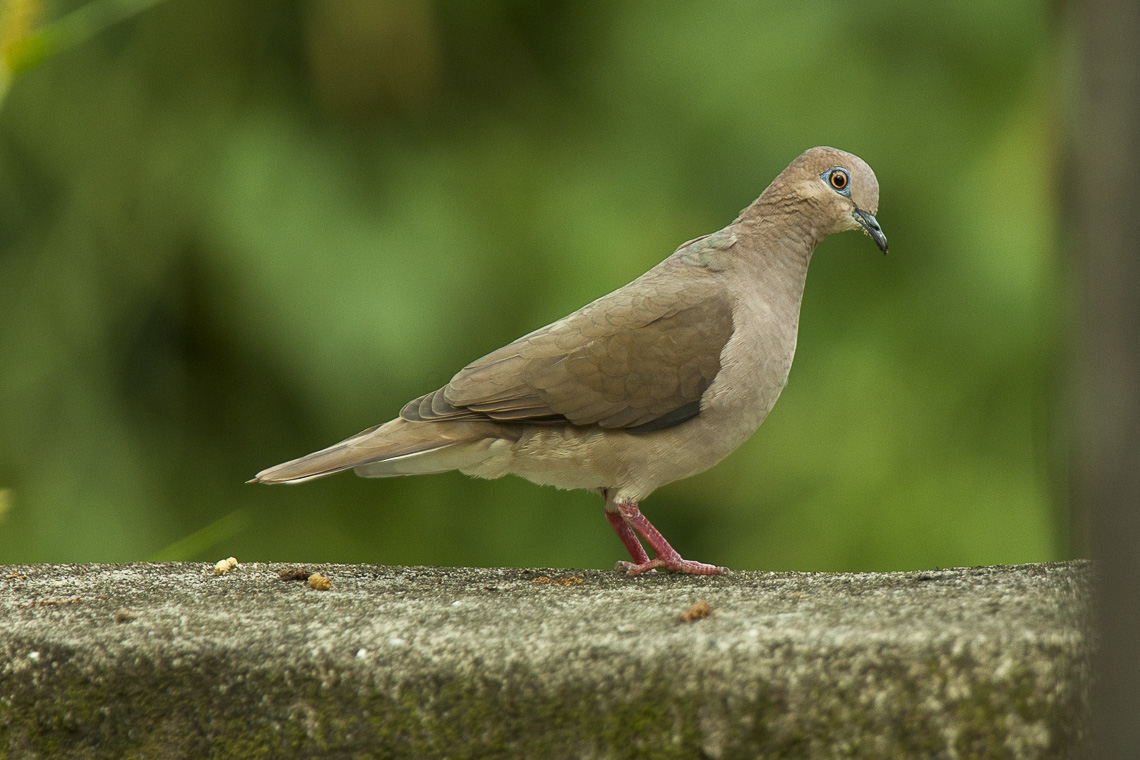
White-Tipped Dove (Leptotila verreauxi) lives in tropical rainforest across Central and South America. It feeds on fruits and seeds. Its conservation status is Least Concern.
Fascinating facts about the White-Tipped Dove
- The white-tipped dove's eye-ring changes colour across its range. In most of its distribution the ring is red, but birds living in the Amazon basin and northern South America display a striking blue ring. This geographic shift is useful for field identification, although in some overlap zones the colour can be unreliable because both species may show red rings. The variation reflects the dove's wide tropical habitat from Texas to Argentina.
- The tail of the white-tipped dove is broadly tipped with white, a feature that stands out when the bird is seen from below or in flight. Its upperparts and wings are a muted grey-brown, so the bright white tail tip creates a clear contrast during rapid, direct flight. This visual cue can help observers track the dove as it darts through scrub and woodland habitats. The white tip is most noticeable when the bird is airborne.
- A 2023 taxonomic review reinstated the original name of the southern-Bolivian and southeast-Brazilian subspecies, confirming it as chlorauchenia rather than chalcauchenia. This form occupies southern Bolivia and southeast Brazil, extending south to northern Argentina. Restoring the earlier name clarifies the classification of this population within the species' extensive range from Texas to central Argentina.
- The white-tipped dove constructs a sizable stick nest in a tree close to the ground, where the female lays a clutch of two white eggs. After about two weeks of incubation, the eggs hatch and the chicks remain in the nest for roughly another fifteen days before fledging. This breeding strategy keeps the young safe in dense scrub and woodland where the species lives. The modest clutch size reflects the dove's steady territorial habit.
- The dove's call is a deep, hollow ooo-wooooo that consists of two notes at the same pitch, an introductory hoot followed by a longer, resonant note. This vocal pattern is used to defend its territory, attract mates, signal food sources, warn of predators and keep contact with a partner. The steady, low-frequency sound carries well through the scrub and forest habitats the bird frequents. Its simple two-note structure makes the call easy to recognise in the field.
Sources
Every fact above was checked against these pages, and kept only where one of them states it.
At a glance
RangeCentral and South America
HabitatTropical rainforest
DietFruits and seeds
About the White-Tipped Dove
In the dappled shade of the forest, the White-Tipped Dove moves with serene elegance, its muted plumage blending seamlessly into the surroundings as it glides effortlessly across the underbrush. With each deliberate step, its tail feathers bob gently, like a metronome marking the rhythm of its quiet existence, as it searches for the seeds and fruits that sustain it. As it takes to the skies, the dove's soft coos fill the air, a soothing serenade that underscores its status as a ubiquitous yet unassuming presence in these lush, vibrant ecosystems.
Hear the White-Tipped Dove, and 4,400+ more
Real recorded sounds, 11 nature games and a free Daily 5, 1v1 quiz duels, conservation wins and a safe Kids mode. Free on Feravox.