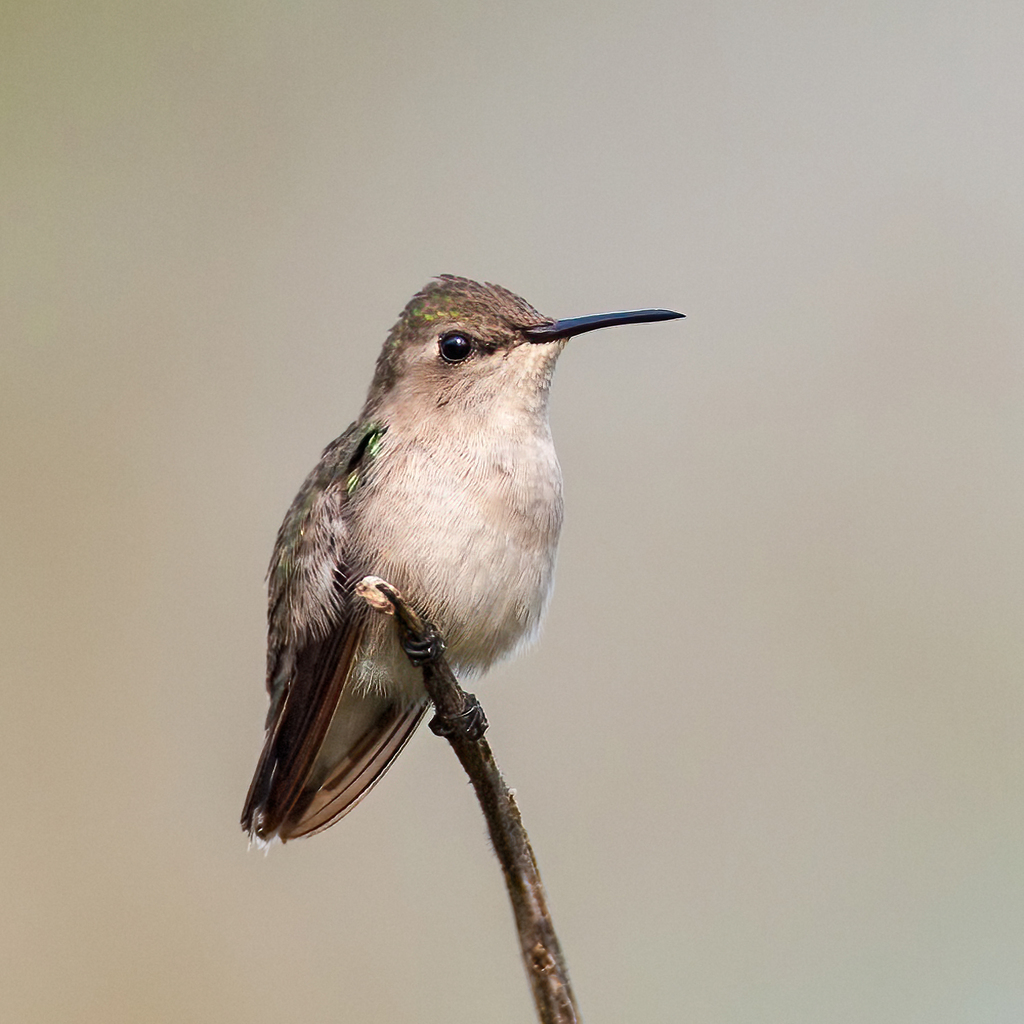
Bee Hummingbird (Mellisuga helenae) lives in tropical rainforest across Cuba and Isle of Youth. It feeds on nectar & insects. Its conservation status is Near Threatened.
Fascinating facts about the Bee Hummingbird
- The bee hummingbird holds the title of the smallest living bird, a distinction reflected in its minute dimensions. Females reach 6.1 cm in length and weigh 2.6 g, while the slightly smaller males measure 5.5 cm and average 1.95 g. This tiny size is consistent across its range, as the species is endemic to Cuba and its surrounding islands, where it inhabits dense growths of lianas and epiphytes.
- When it takes to the air, the bee hummingbird can reach speeds of 40-48 km/h, a rapid pace for a bird only a few centimetres long. Its wings beat between 80 and 200 times each second, a motion that creates the lift needed to hover motionless while it extracts nectar from flowers. This extraordinary wingbeat, combined with its strong, swift flight, enables it to dart between blossoms throughout the daylight hours.
- A single bee hummingbird may visit as many as 1,500 flowers in one day, rapidly moving from bloom to bloom in search of nectar. While feeding, it transfers pollen and acts as a pollinator for the ten plant species it visits, nine of which are native to Cuba.
- The bee hummingbird can gulp roughly half its own weight in food each day, a massive intake for a bird that weighs only about 2 g. To meet this demand it darts among blossoms, visiting up to 1 500 flowers in a single daylight period while probing each flower with its rapid-tongued bill. Its diet is dominated by nectar, but it supplements the energy boost with occasional insects and spiders caught on the wing.
- The female constructs a tiny cup-shaped nest only 2.5 cm across, hanging 3 to 5 m above the ground and woven from strands of cobweb, bark and lichen. Inside she places just one or two eggs, each roughly the size of a coffee bean, and the entire structure is used only once before being abandoned. This delicate cradle is built on slender branches of mature jucaro or juvenile ocuje trees within the dense Cuban thickets.
Sources
Every fact above was checked against these pages, and kept only where one of them states it.
At a glance
RangeCuba and Isle of Youth
HabitatTropical rainforest
DietNectar & insects
About the Bee Hummingbird
In the sun-drenched gardens of Cuba, a fleck of iridescent green darts through the air, its wings a mesmerizing blur as the Bee Hummingbird flits from flower to flower, sipping nectar with an insatiable hunger. With a metabolism that demands constant fuel, this tiny avian dynamo is a whirlwind of energy, its bright plumage glimmering like a shard of stained glass as it hovers, pauses, and dashes through its domain with an irresistible allure. As it dances on the breeze, its very existence seems a defiance of gravity, a testament to the boundless wonder that can be found in the smallest of creatures.
Hear the Bee Hummingbird, and 4,400+ more
Real recorded sounds, 11 nature games and a free Daily 5, 1v1 quiz duels, conservation wins and a safe Kids mode. Free on Feravox.