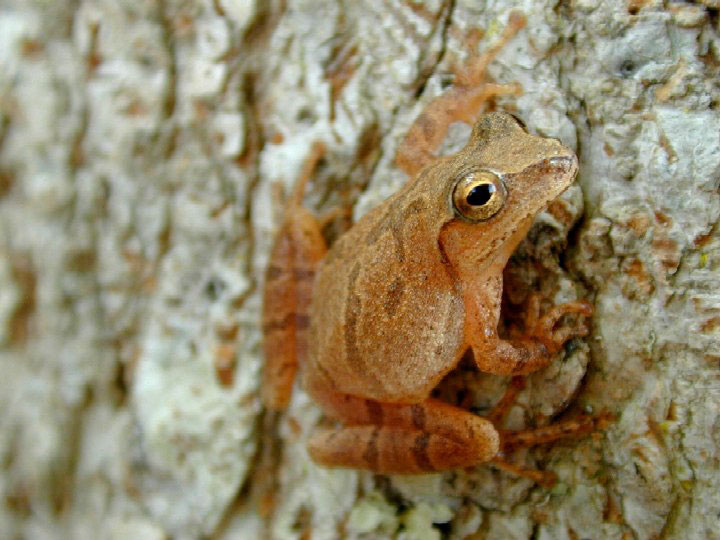
Spring Peeper (Pseudacris crucifer) lives in wooded wetlands across Eastern North America. It feeds on insects and spiders. Its conservation status is Least Concern.
Hear the Spring Peeper
A real field recording of the Spring Peeper, made in the wild.
In freezing northern winters the spring peeper floods its bloodstream with a glucose solution that acts as an antifreeze, letting its heart and other organs pause safely. Its liver exudes the glucose cryoprotectant, which not only prevents ice crystals from forming but also allows the heart to enter a protected dormancy. Tissue glucose levels can rise ten- to one-hundred-fold, giving the frog the ability to survive internal fluid freezing.
Spring peepers can endure their body fluids freezing to as low as minus eight degrees Celsius, allowing them to hibernate under logs and bark through harsh spells. The glucose-based cryoprotectant they produce distributes throughout the body, limiting cell shrinkage and keeping tissues from ice damage. By entering a state of protected dormancy, vital organs such as the heart cease activity without injury.
Male spring peepers emit a high-pitched peep many times during a night, creating a chorus that marks the start of spring. Only males possess a vocal sac that expands and deflates like a balloon to generate the short, distinct peeping sound used to attract mates. Warm spells trigger a massive increase in calling rate, so the chorus becomes louder and more frequent when temperatures rise.
A female spring peeper deposits about nine hundred eggs in each clutch, and in especially favourable conditions she may lay as many as one thousand. The eggs are not bundled together; each is placed singly or in tiny groups of two or three. These clusters are tucked beneath submerged vegetation or other debris at the bottom of the pond, keeping them hidden from predators.
When danger approaches, a spring peeper can change its skin colour in as little as fifteen to forty-five minutes, allowing it to match the colour of leaf litter or bark. This rapid shift is part of a dynamic colour system that responds to both temperature and light conditions. By blending into the forest floor, the frog reduces the risk of being seen by birds and other visual predators.
Sources
Every fact above was checked against these pages, and kept only where one of them states it.
In the ephemeral wetlands of North America, a tiny, tuneful king holds court, as the Spring Peeper unleashes its haunting, whistled melody into the evening air, a siren's call that echoes across the landscape. With a fleeting, almost ethereal presence, this diminutive frog navigates its world with an air of quiet urgency, its sticky pads barely touching the ground as it darts between the leaf litter and shallow pools. As the last wisps of winter's chill dissipate, the Spring Peeper's irrepressible song becomes a triumphant declaration of the season's arrival, a joyous fanfare that heralds the return of life to the thawing wilderness.
Advertisement
Hear the Spring Peeper, and 4,400+ more
Real recorded sounds, 11 nature games and a free Daily 5, 1v1 quiz duels, conservation wins and a safe Kids mode. Free on Feravox.