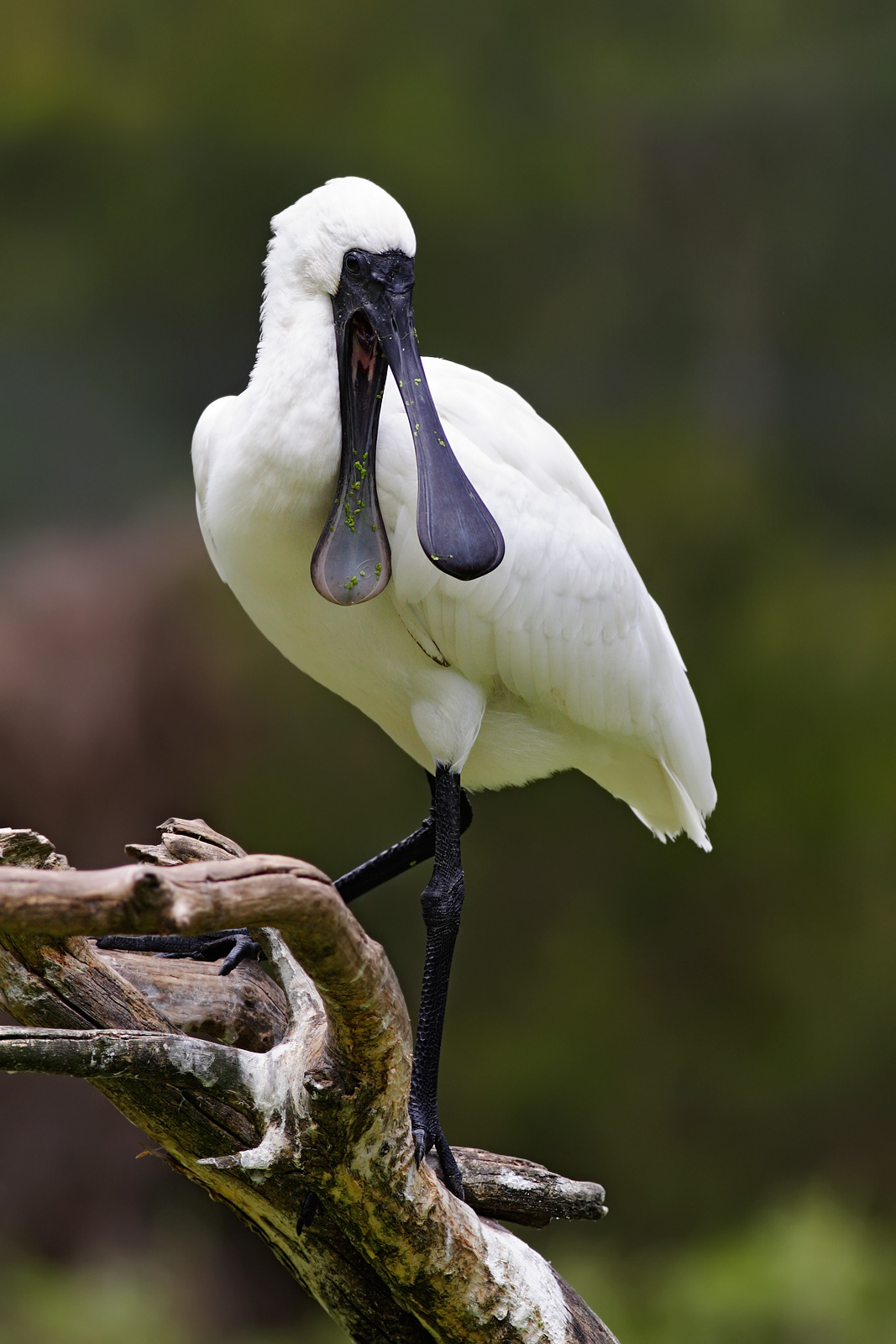
Royal Spoonbill (Platalea regia) lives in wetland areas across Australia, New Zealand, Southeast Asia. It feeds on small fish crustaceans. Its conservation status is Least Concern.
Fascinating facts about the Royal Spoonbill
- At just under a meter tall, the royal spoonbill stands about 80 cm (31 in) high and weighs between 1.4 kg and 2.07 kg (3.1-4.6 lb). Its black, spoon-shaped bill is broader at the tip, working more like a pair of tongs than the narrow forceps of its yellow-billed cousin.
- When hunting, a royal spoonbill opens its bill tip 2 to 4 cm (1 to 1.5 in) and sweeps an arc of roughly 100 degrees in front of it, dragging water and debris to uncover hidden crustaceans and fish. This side-to-side motion can cover a swath in a single pass, efficiently flushing prey from the substrate. The bird then snaps shut, swallowing the captured animal whole, a technique that lets it exploit a broad range of tiny wetland creatures without needing to chase them.
- During breeding season, the royal spoonbill grows long white plumes on the back of its head and colorful facial patches, then builds an open stick platform in a tree where the female lays two or three eggs. The chicks hatch after exactly 21 days, but the colony is extremely skittish, any minor disturbance can cause entire groups to abandon their nests.
- John Gould first described the royal spoonbill in 1838, assigning it the name Platalea regia and noting its similarity to the Eurasian spoonbill. A 2010 mitochondrial DNA study by Chesser and colleagues later confirmed that the royal spoonbill's closest living relative is the black-faced spoonbill, placing the two as sister species within the spoonbill lineage.
- The royal spoonbill inhabits intertidal flats and shallow wetlands across Australia, New Zealand, Indonesia, Papua New Guinea and the Solomon Islands, with occasional vagrants spotted in New Caledonia. Despite this broad distribution, the species is listed as Least Concern on the IUCN Red List.
Sources
Every fact above was checked against these pages, and kept only where one of them states it.
At a glance
RangeAustralia, New Zealand, Southeast Asia
HabitatWetland areas
DietSmall fish crustaceans
About the Royal Spoonbill
As the sun rises over the tranquil wetlands, the Royal Spoonbill emerges, its majestic form gliding effortlessly across the shallow waters, its distinctive spoon-shaped bill swooping and swaying in a gentle, rhythmic motion. With each deliberate step, the spoonbill probes the murky depths, seeking out the unsuspecting crustaceans and fish that lie hidden beneath the surface, its snowy plumage and yellow bill a striking contrast to the dull, earthy tones of its surroundings. In this serene and timeless world, the Royal Spoonbill reigns supreme, a vision of elegance and refinement, its very presence a testament to the beauty and wonder of the natural world.
Hear the Royal Spoonbill, and 4,400+ more
Real recorded sounds, 11 nature games and a free Daily 5, 1v1 quiz duels, conservation wins and a safe Kids mode. Free on Feravox.