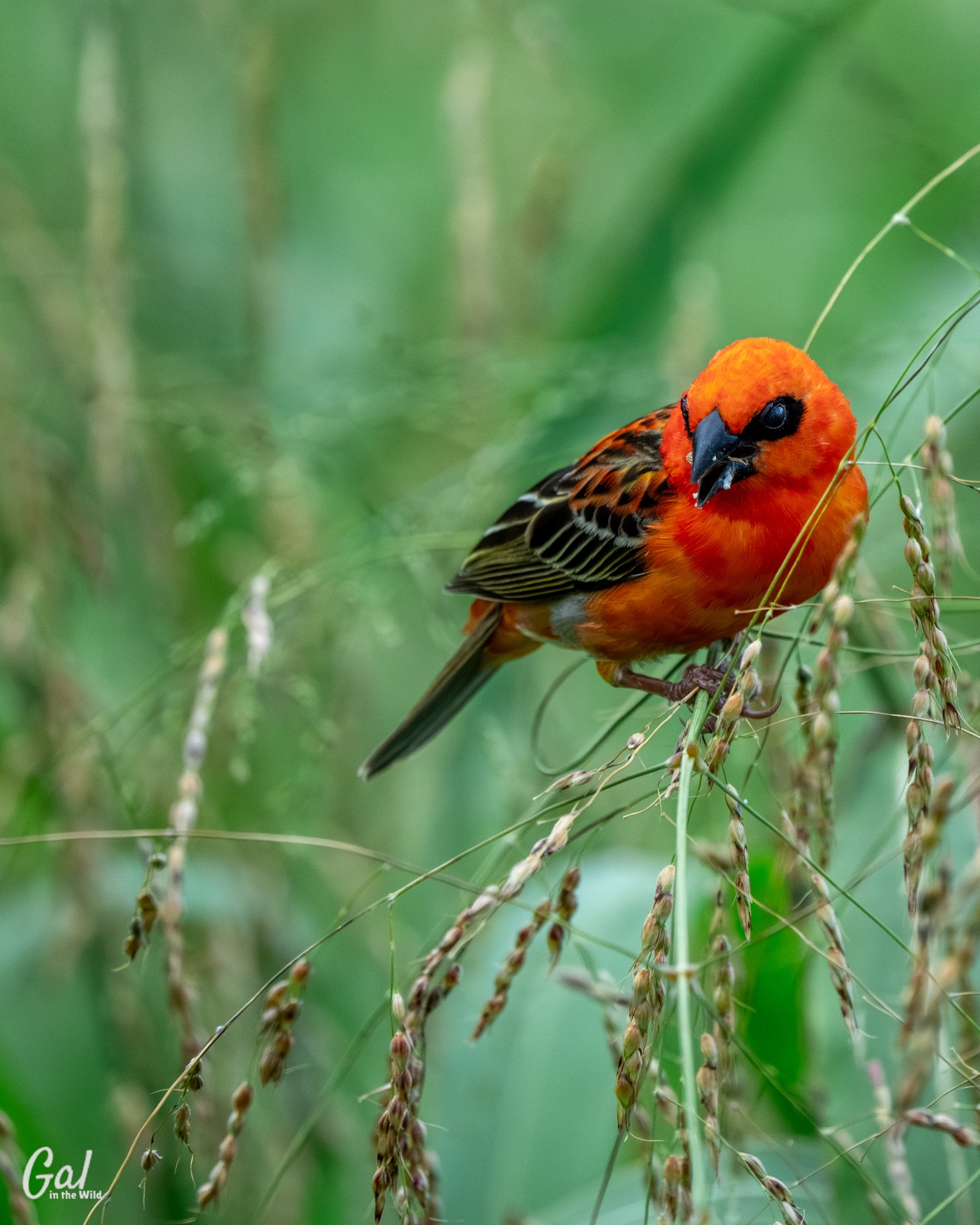
Red Fody (Foudia madagascariensis) lives in forest clearings, grassland and cultivated land, never dense forest across Madagascar. Its conservation status is Least Concern.
Hear the Red Fody
A real field recording of the Red Fody, made in the wild.
The male builds before he courts. He claims a territory about 30 metres across and, in the middle of it, weaves a globular nest from rootlets, tendrils, grasses and other long strands of vegetation, with a side entrance and a small porch or short tube over the doorway. It takes him roughly eight days. Only then does he try to attract a female, and if none approves, the finished nest is simply abandoned. Fodies nest in loose colonies, so one tree can carry a cluster of these woven globes, some occupied and some rejected.
The bird gave its name to its entire genus. Foudia comes from the Malagasy word for this species, fody, and when the German naturalist Ludwig Reichenbach created the genus in 1850 he named no type species; George Gray settled it in 1855 by designating the red fody, making it the reference bird for the seven living fodies of the western Indian Ocean. Europeans reached for a different image. Brisson described it in 1760 as le cardinal de Madagascar, and on Reunion and Mauritius it is still the cardinal, kardinal in creole.
In Madagascar it is treated as a pest of rice. The red fody lives largely on seeds, and on grass seeds above all, which puts flocks of them straight into the paddies. Outside the breeding season the birds are gregarious and move around in groups. They are also not fussy: insects, fruit, nectar, copra and household scraps all go down as well, and that flexibility is much of why the species thrives in clearings, grassland and cultivated land while avoiding dense forest altogether.
People carried the red fody across the Indian Ocean, to the Seychelles, the Comoros, the Amirantes, Mauritius, Reunion and the Chagos Archipelago, and on to Bahrain and Saint Helena. On the islands it now shares it competes for food and space with fodies that have nowhere else to go: the endangered Mauritius fody, down to perhaps a hundred breeding pairs by 2001, and the vulnerable Rodrigues fody, reduced to five or six pairs by 1968.
Sources
Every fact above was checked against these pages, and kept only where one of them states it.
HabitatForest clearings, grassland and cultivated land, never dense forest
DietGrass seeds and insects, plus fruit, nectar, copra and scraps
About the Red Fody
The red fody is a small weaver from Madagascar, about 13 centimetres long and weighing 14 to 19 grams. It belongs to Foudia, a genus of seven living species scattered across the islands of the western Indian Ocean, and it is by far the most successful of them. It keeps to forest clearings, grassland and cultivated ground rather than deep forest, which in practice means it lives wherever people have opened the country up: rice fields, village gardens, roadsides and plantations. A breeding male is unmistakable, red from head to rump with black lores and brown wings and tail, and red underparts that separate him from the other fodies wherever he has been introduced. Females, young birds and males out of season are olive-brown above and greyish brown below, streaky and easy to overlook. The species is monogamous, and the male weaves his domed, side-entrance nest before he has a mate to show it to. Carried across the Indian Ocean by people and established from the Seychelles to Mauritius and on to Saint Helena, it is now one of the most familiar birds of the region, and in several places an unwelcome neighbour to its rarer cousins.
Advertisement
Hear the Red Fody, and 4,400+ more
Real recorded sounds, 11 nature games and a free Daily 5, 1v1 quiz duels, conservation wins and a safe Kids mode. Free on Feravox.