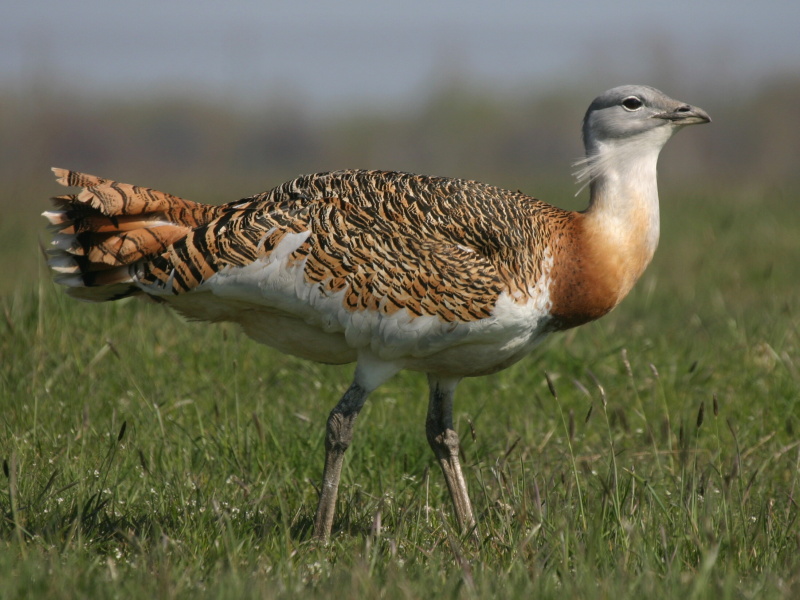
Great Bustard (Otis tarda) lives in grasslands, steppes across Europe, Asia. It feeds on insects and seeds. Its conservation status is Endangered.
Fascinating facts about the Great Bustard
- A male great bustard can tower up to 105 cm tall with a wingspan reaching 2.7 m, yet its weight swings wildly, from a light 5.8 kg to a massive 18 kg, making it one of the heaviest birds that still take to the air. The biggest confirmed individual, shot in Manchuria, tipped the scales at about 21 kg, setting a world record for flying birds, and a Spanish study even recorded a 19 kg male.
- Great bustards are the most sexually dimorphic birds alive: Spanish males weigh on average 2.48 times more than females, while females stand only about a third shorter in height. A typical female measures 75-85 cm tall, 90 cm long and weighs between 3.1 and 8 kg, compared with males that can exceed 18 kg. This size gap fuels fierce male battles during the lek, where the larger birds clash bill-to-bill, but it also means females can slip through grassland unnoticed.
- Birds breeding along Russia's Volga River fly roughly 1,000 km to winter in Crimea and Kherson, while those from northern Mongolia trek over 2,000 km to reach Shaanxi Province in China. During these journeys they can cruise at 48-98 km/h, showing that despite their bulk they are capable of long-distance, high-speed flight when the season demands it.
- Great bustards usually live around a decade, yet some individuals push past 15 years and the longest-recorded bird reached 28 years, an impressive lifespan for such a large ground-dwelling bird. However, adult males die at higher rates because they repeatedly clash during breeding displays, skewing the adult sex ratio to as many as 4.1 females per male. This mortality pattern shows how the species' spectacular courtship comes at a steep cost to male survival.
- Globally, only about 44,000-51,000 great bustards remain, with roughly 30,000 of them living in Spain, over half the world's total. Portugal and Spain together hold about 60 % of the species.
Sources
Every fact above was checked against these pages, and kept only where one of them states it.
At a glance
RangeEurope, Asia
HabitatGrasslands, steppes
DietInsects and seeds
About the Great Bustard
As the sun rises over the rolling grasslands, the Great Bustard stirs, its majestic form unfolding like a ghostly apparition, its soft, feathery plumage glistening with dew. With deliberate, loping strides, it moves through the landscape, its long neck scanning the terrain with an air of quiet vigilance, as if savoring the fragile beauty of its endangered world. In this fleeting moment, the Great Bustard embodies a poignant synthesis of elegance and vulnerability, a reminder of the precious, vanishing heritage of the natural world.
Hear the Great Bustard, and 4,400+ more
Real recorded sounds, 11 nature games and a free Daily 5, 1v1 quiz duels, conservation wins and a safe Kids mode. Free on Feravox.