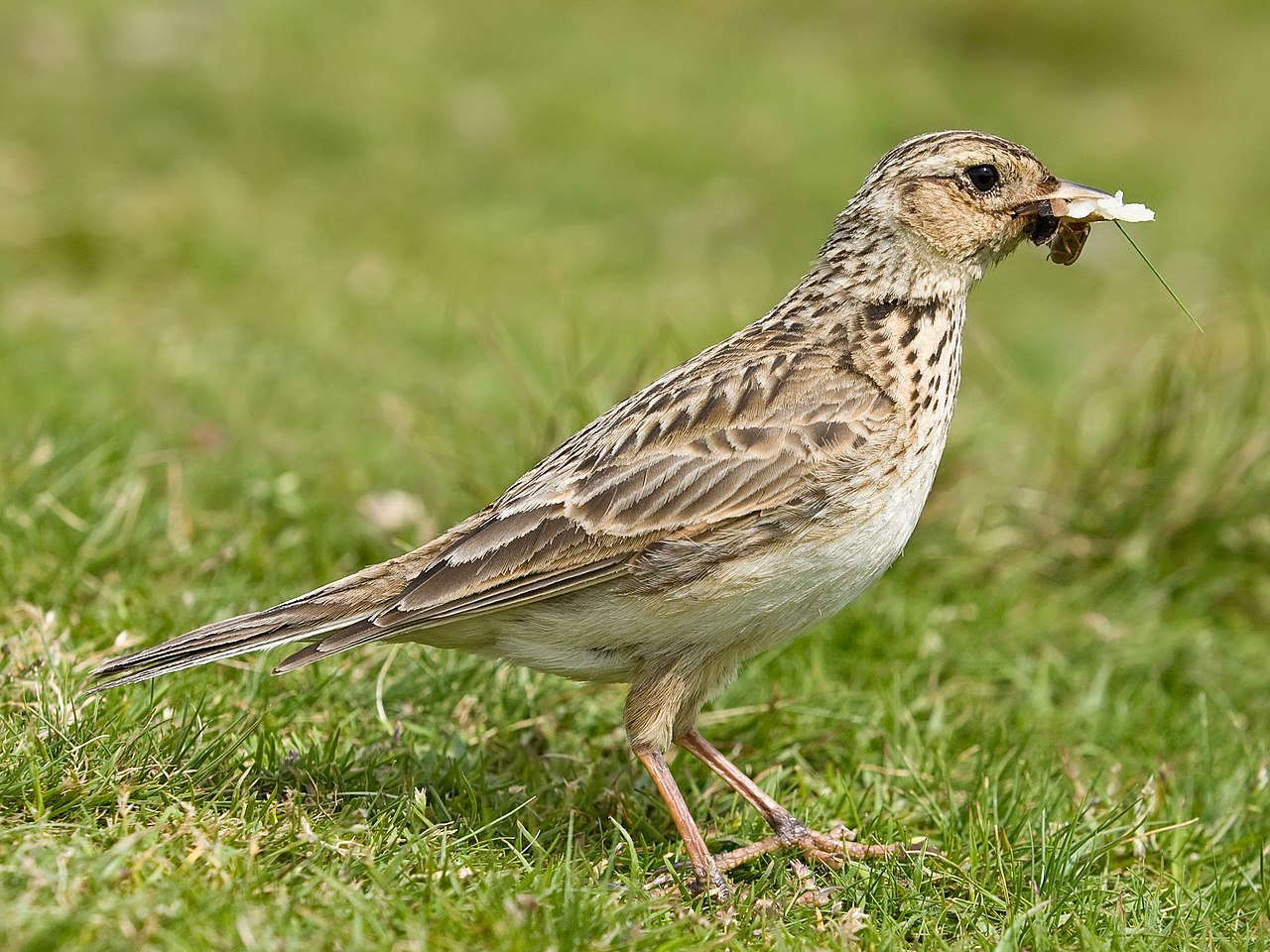
Eurasian Skylark (Alauda arvensis) lives in open grasslands across Europe and Asia. It feeds on insects and seeds. Its conservation status is Least Concern.
Hear the Eurasian Skylark
A real field recording of the Eurasian Skylark, made in the wild.
A male Eurasian skylark turns the sky into a concert hall, singing while hovering at heights of 50 to 100 m (160 to 330 ft). The melody usually drifts for two to three minutes, but in the later breeding weeks a single bout can stretch to 20 minutes or more. Neighbouring males share local microdialects, tiny song signatures that let birds tell friends from strangers. This aerial serenade not only draws mates.
A female skylark builds a shallow ground nest and lays three to five eggs, which she incubates for about 11 days. Both parents feed the hatchlings, but the chicks abandon the nest after just eight to ten days, long before they can fly. They stay hidden in the grass, receiving food until they master flight at 18 to 20 days old.
Human hands have carried the skylark far beyond its native Eurasian fields. In the 19th century it was released in New Zealand, spreading across both islands by the 1920s, and introduced to southeastern Hawaiian islands in 1865. A 1986 survey counted roughly 10,000 individuals remaining on Hawaii and Maui.
In the UK the skylark has been losing ground fast: over the last 10 years the population fell by 4-10 % and by 6-28 % over the last 22-25 years. Researchers link this drop mainly to modern farming practices that replace spring-sown cereals with winter crops, making fields too dense for the birds to forage. Pesticides play a smaller role, but together the changes shrink the open grassland the skylark needs to feed and breed.
A Eurasian skylark fits on the tip of a ruler, measuring just 18-19 cm (7.1-7.5 in) long, with a wingspan of 30-36 cm (12-14 in). Females weigh between 17 and 47 g, while males are a bit heavier at 27-55 g, yet both sexes look alike in their streaked brown-grey plumage. Their compact size and cryptic coloring let them slip through open fields, staying hidden from predators while they hop on the ground searching for seeds and insects.
Sources
Every fact above was checked against these pages, and kept only where one of them states it.
As the sun rises over the rolling hills and grasslands, the Eurasian Skylark takes to the skies, its melodic song echoing across the landscape as it soars with effortless ease, its wings beating in a hypnotic rhythm. With a fluid, erratic flight, it dances on the breeze, its brown plumage glistening in the morning light as it searches for insects and seeds to fuel its energetic exploits. In this aerial ballet, the skylark is a true master, its unbridled joy and abandon a testament to the sheer exhilaration of flight.
Advertisement
Hear the Eurasian Skylark, and 4,400+ more
Real recorded sounds, 11 nature games and a free Daily 5, 1v1 quiz duels, conservation wins and a safe Kids mode. Free on Feravox.