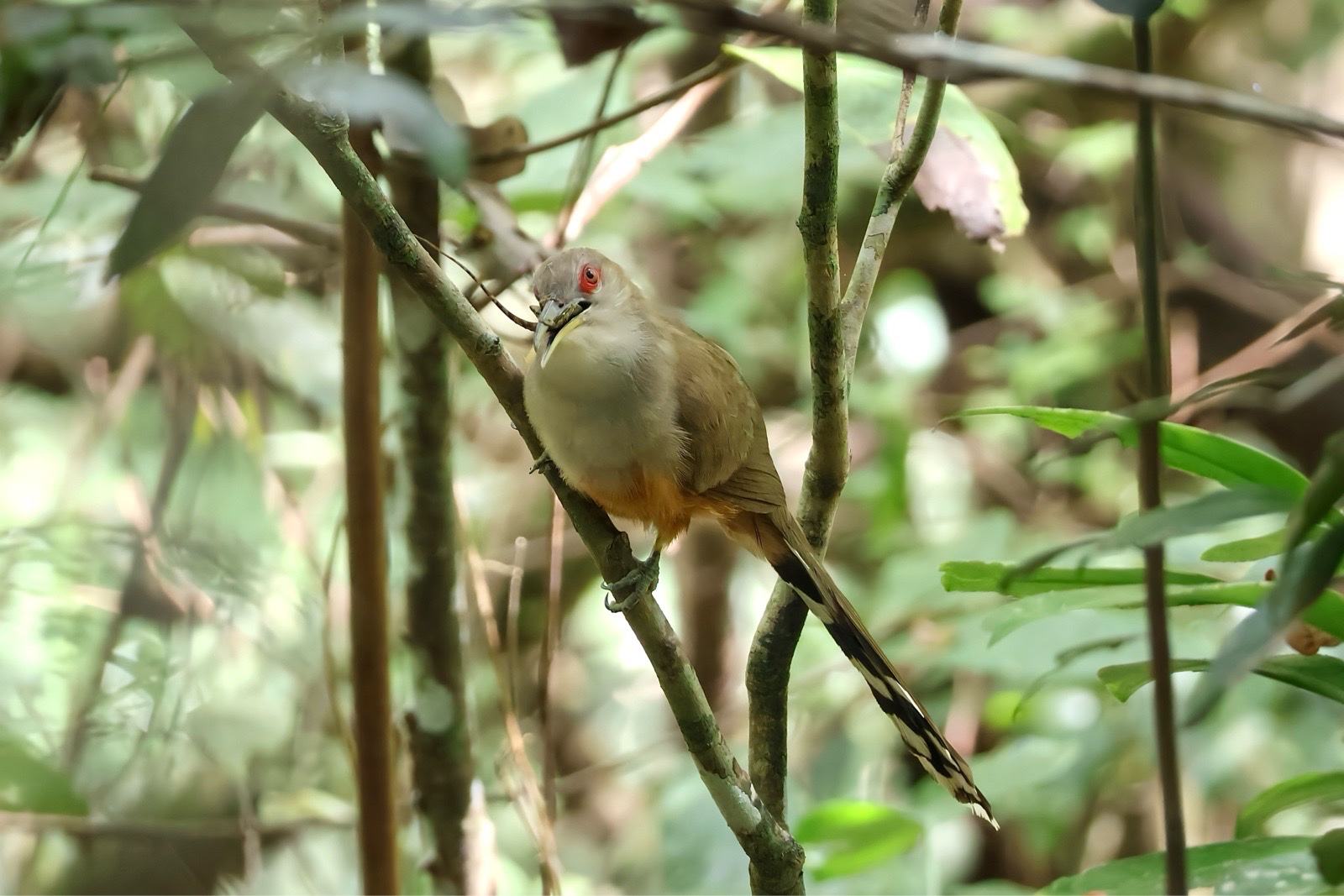
Puerto Rican Lizard Cuckoo (Coccyzus vieilloti) lives in various forest types, coffee plantations, limestone hills across Throughout Puerto Rico. Its conservation status is Least Concern.
Hear the Puerto Rican Lizard Cuckoo
A real field recording of the Puerto Rican Lizard Cuckoo, made in the wild.
Fascinating facts about the Puerto Rican Lizard Cuckoo
The cuckoo often remains motionless, relying on its keen hearing to locate prey, and it never undertakes seasonal migrations. Its breeding nest is a loose platform of sticks perched in a tree or large bush, where the female lays a clutch of two or three eggs. The bird's most recognizable sound is a harsh series of ka-ka-ka-ka notes that can fill the forest; locals call it pájaro de lluvia because the call is believed to herald rain. By preying on Anolis lizards, insects and occasional frogs, it helps regulate these populations, linking forest health to the island's agricultural areas where it is also heard.
Measuring 40 to 48 cm (16 to 19 in) in total length, about half of which is tail, the Puerto Rican lizard cuckoo displays a long decurved bill that is black on the upper mandible and yellow with a black tip on the lower. Both sexes share identical plumage: the upperparts are uniformly gray-brown, the throat and breast are gray, and the belly and undertail coverts are tawny. The tail's upper surface mirrors the body's gray-brown tone, while the underside darkens to black near the large white tips. A distinctive bare red skin ring surrounds the eye, a feature that helps identify the species in the field.
The bird is found throughout the main island of Puerto Rico, occupying a broad elevational span from sea level up to 900 m (3,000 ft) and even reaching the island's highest peaks. It thrives in a mosaic of forested habitats: semi-open woodlands, dense montane forest, dry coastal forest, and swamp forest all support its presence. Human-altered landscapes such as coffee plantations and brushy limestone hills also host populations, demonstrating the species' adaptability to both natural and cultivated environments. This wide habitat tolerance, combined with its island-wide distribution, makes the cuckoo a common sight across Puerto Rico's varied terrain.
Foraging primarily in the middle to upper forest layers, the Puerto Rican lizard cuckoo also descends to the understory and ground when hunting. It moves stealthily, climbing along branches or walking on the forest floor, and its diet is dominated by lizards, especially Anolis species. In addition to reptiles, the bird consumes adult and larval insects, eggs, and on occasion, small frogs, reflecting a versatile predatory strategy that exploits a range of small vertebrate and invertebrate prey found in its forest habitats.
Sources
Every fact above was checked against these pages, and kept only where one of them states it.
The Puerto Rican lizard cuckoo (Coccyzus vieilloti) is a medium-sized, endemic bird of Puerto Rico, measuring 40 to 48 cm in length with a long, decurved bill and a striking red eye ring. Its uniform gray-brown upperparts, gray throat and breast, and tawny belly give it a subtle but distinctive appearance, while the tail's dark underside and white tips aid identification. The species occupies a wide range of forested habitats across the island, from lowland woodlands to montane and swamp forests, and even adapts to coffee plantations and limestone hills up to 900 m elevation. Primarily a stealthy predator, it hunts lizards, insects, eggs, and occasional frogs from mid-canopy to ground level, often remaining motionless and being heard more than seen. Its call, a harsh series of ka-ka-ka-ka notes, is a familiar sound in Puerto Rican forests, sometimes interpreted locally as a rain-forecasting omen.
Advertisement
Hear the Puerto Rican Lizard Cuckoo, and 4,400+ more
Real recorded sounds, 11 nature games and a free Daily 5, 1v1 quiz duels, conservation wins and a safe Kids mode. Free on Feravox.