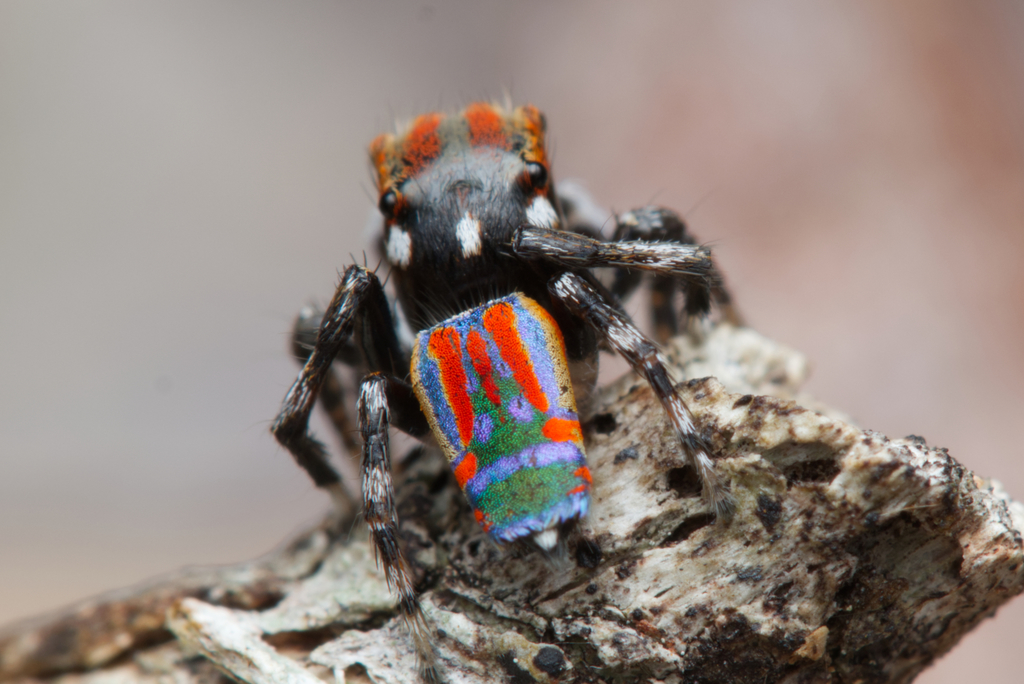
Peacock Spider (Maratus volans) lives in forest across Australian Outback. It feeds on flies and insects. Its conservation status is Least Concern.
Fascinating facts about the Peacock Spider
- Both sexes reach about 5 mm in body length, yet the male's flamboyant abdomen flaps turn a 5-mm spider into a living fireworks display. During courtship the male raises and expands these flaps while waving his third legs, creating a white-fringed, circular field of colour that rivals a peacock's tail. This visual spectacle lasts around twenty-four minutes on average, but can range from six to fifty minutes.
- Peacock spiders have eight eyes equipped with a telephoto lens, tiered retina, and ultraviolet-sensitive photoreceptor, pushing the physical limits of optical resolution for a creature its size. This ultra-sharp vision lets them spot prey and also detect the ultraviolet hues of a rival's fan. The same visual power fuels their complex courtship dances, where the male's bright flaps and leg waves are judged in both visible and UV light.
- When a male Maratus volans steps onto the stage, he doesn't just flash colours, he also shakes his abdomen to send vibrations. Males who put forth more effort in both the visual display and the vibratory signaling had a higher success in mating, yet visual displays are more strongly linked to mating success than vibratory signaling. These combined signals act as a fitness billboard, telling the female that the dancer is healthy and vigorous.
- A Maratus volans can leap up to 40 times its own body length, turning a 5-mm spider into a tiny projectile. This extraordinary jumping ability, powered by its keen eyesight, lets it stalk and pounce on insects without a web. The same agility that makes it a formidable hunter also lets it escape aggressive females who may attack, kill, and even cannibalise the male if his dance fails to impress.
- Maratus volans is confined to specific parts of Australia, Queensland, New South Wales, the Australian Capital Territory, Western Australia and Tasmania, yet it thrives across many habitats from sand dunes to leaf-littered twigs. Adults are most active in the Austral spring; mature males appear from August to December, while females emerge later and live longer, laying between 6 and 15 eggs per clutch in hidden underground nests in December. Lifespan of about one year.
Sources
Every fact above was checked against these pages, and kept only where one of them states it.
At a glance
RangeAustralian Outback
HabitatForest
DietFlies and insects
About the Peacock Spider
In the scorching Australian outback, a diminutive yet dazzling creature emerges, the peacock spider, its iridescent exoskeleton glimmering like a shard of stained glass as it dances across the arid landscape. With each delicate step, it showcases its remarkable courtship display, a whirling dervish of color and movement that belies its tiny stature, as it strives to outdo its rivals and win the heart of a potential mate. As it spins and weaves, its vibrant fan of feathers - or rather, abdominal flaps - glows with an otherworldly light, a beacon of beauty in the harsh, sun-baked wilderness.
Hear the Peacock Spider, and 4,400+ more
Real recorded sounds, 11 nature games and a free Daily 5, 1v1 quiz duels, conservation wins and a safe Kids mode. Free on Feravox.
More insects and spiders to discover