Photo: Johannes Schuster
Feravox · The Voice of the Wild
Paradise Tree Snake
Chrysopelea paradisi
Least Concern
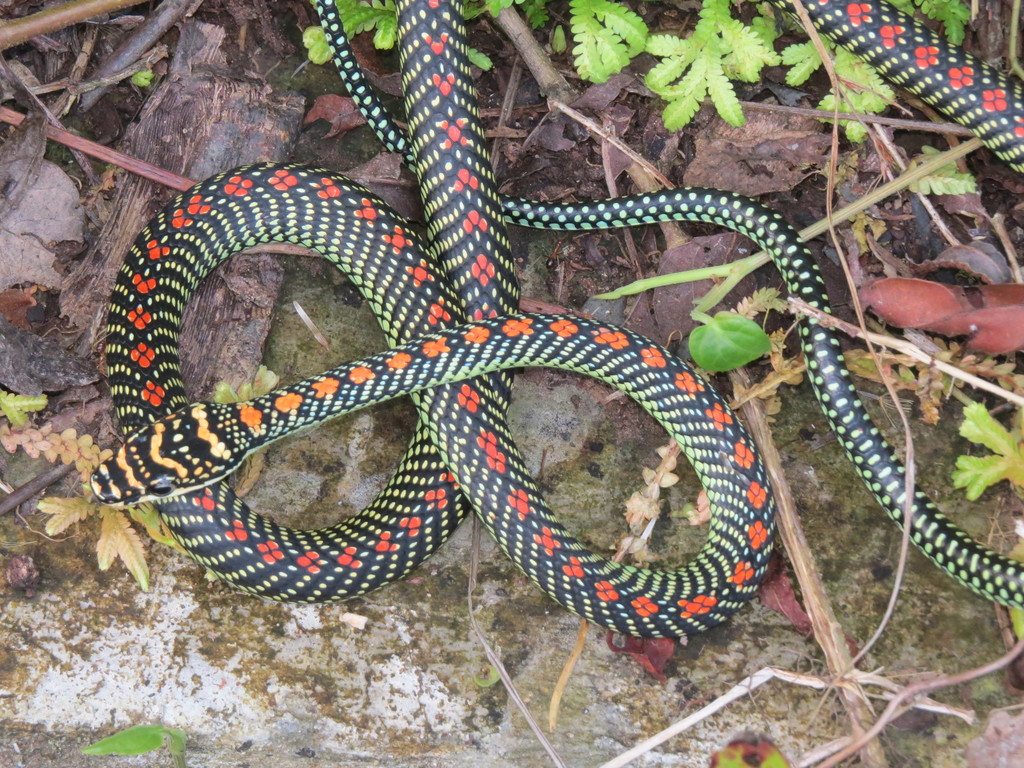
Paradise Tree Snake (Chrysopelea paradisi) lives in moist forests across Southeast Asia. It feeds on mostly lizards and bats. Its conservation status is Least Concern.
The Paradise tree snake (Chrysopelea paradisi) is a sleek, arboreal colubrid that glides like a living kite through the moist forests of Southeast Asia. Its elongated body, capable of flattening into a triangular cross-section, is supported by flexible ribs that spread like a parachute, allowing it to launch from a branch and travel horizontal distances of 10 meters (33 feet) or more. Its coloration blends with dappled canopy light, while the head remains remarkably steady during flight, a fact revealed by slow-motion photography that shows an elegant undulation of the rest of the body as it steers through the air. The snake’s diet is primarily composed of agile lizards and nocturnal bats, which it subdues with a combination of mild rear-fang venom from Duvernoy’s glands and a swift constriction, a dual strategy that underscores its adaptability in the treetops. Life in the canopy defines every aspect of C. paradisi’s existence. Fully arboreal and oviparous, it nests in the folds of branches, rarely descending to the forest floor. Its gliding technique, anchored J-loop take-off, triangular body shaping, and aerial undulation, sets it apart from other gliding vertebrates that rely on limbs or membranes. Encounters with humans are uncommon, but a 2013 incident in which a 45-year-old woman was bitten on her thumb by a snake hanging on a window grill illustrates that the species, though shy, possesses a mild venom capable of causing localized effects. This blend of graceful aerial locomotion and understated potency makes the Paradise tree snake a true marvel of evolutionary innovation, continually reminding us that even the most unassuming forest dwellers can surprise with their hidden talents
Real recorded sounds, 11 nature games and a free Daily 5, 1v1 quiz duels, conservation wins and a safe Kids mode. Free on Feravox.