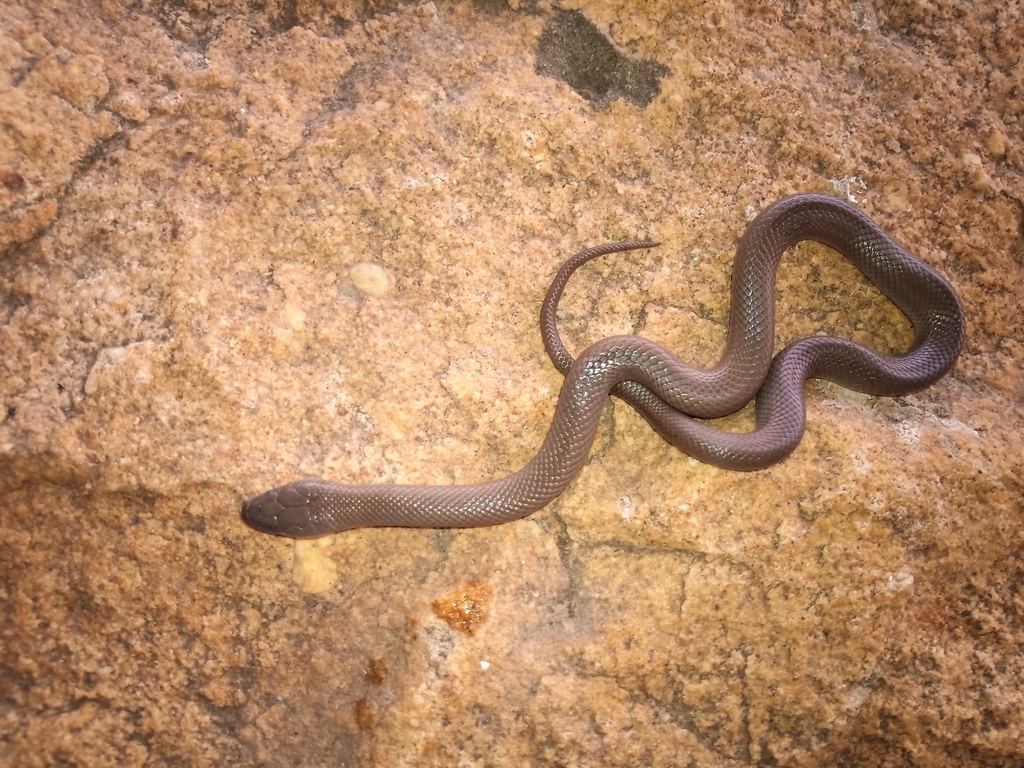
Photo: Ryan van Huyssteen
Feravox · The Voice of the Wild
Olive House Snake
Lycodonomorphus inornatus
Not Evaluated
Olive House Snake (Lycodonomorphus inornatus) lives in coastal bushveld across South Africa, Eswatini. It feeds on lizards, small rodents, snakes.
Elaiophis inornatus, the olive house snake, is a sleek, non-venomous lamprophiid that typically measures 45–75 cm, though some individuals have been recorded at a striking 130 cm. Its coloration ranges from dark olive to deep black, while lighter forms display a uniform light brown to olive-grey-green hue, often with a slightly paler belly and a subtly lighter chin, throat, and neck. This modest size and muted palette allow the snake to blend seamlessly into the moist coastal bushveld, fynbos, and grassveld of South Africa and Eswatini, where it frequents low-veld regions from the southwestern Cape through East London to the Transkei, and extends into the KwaZulu-Natal escarpment, Mpumalanga, and Limpopo Province. Nocturnal and primarily terrestrial, the olive house snake prowls the ground under the cover of night, moving slowly and displaying a docile temperament unless provoked. Its diet is opportunistic, comprising lizards, small rodents, and even other snakes, while females lay clutches of five to fifteen eggs. A surprising trait for a modest snake is its role as both predator and prey: raptors such as the snake eagle and secretary bird, as well as larger snakes, regularly hunt it, weaving the olive house snake into a dynamic nocturnal food web that pulses through southern Africa’s moist habitats.
Real recorded sounds, 11 nature games and a free Daily 5, 1v1 quiz duels, conservation wins and a safe Kids mode. Free on Feravox.