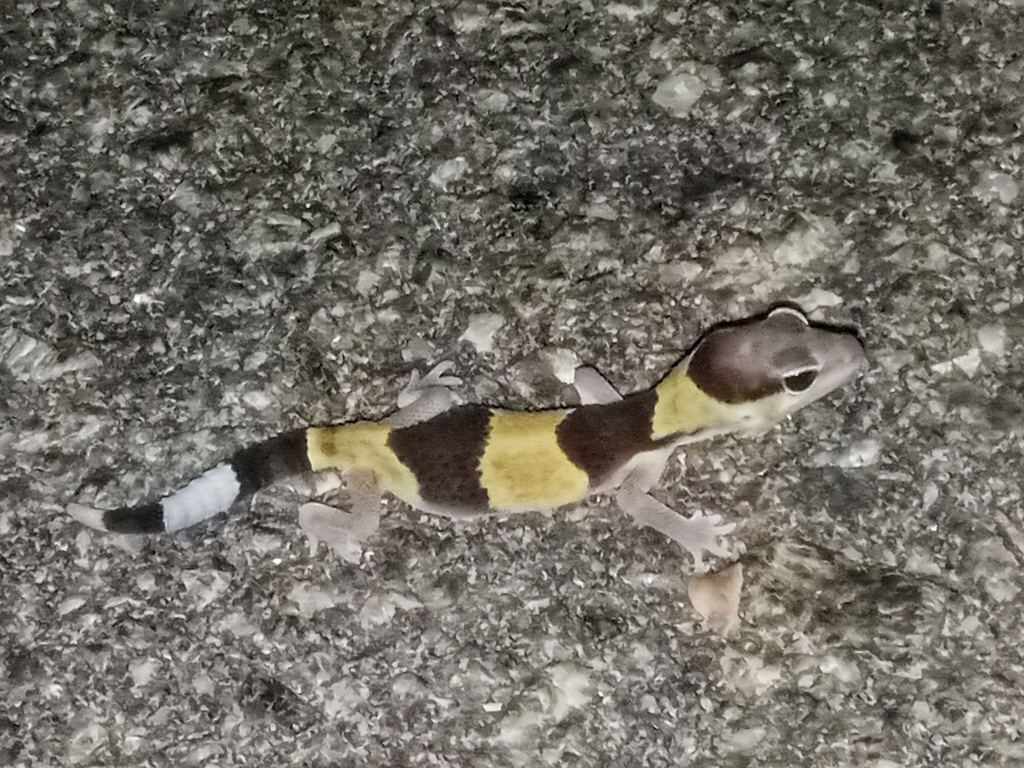
Photo: Lucky Okpanachi Atabo
Feravox · The Voice of the Wild
African Fat-tailed Gecko
Hemitheconyx caudicinctus
Least Concern
African Fat-tailed Gecko (Hemitheconyx caudicinctus) lives in dry Sahel savannah across West Africa. It feeds on insectivorous, insects and invertebrates. Its conservation status is Least Concern.
The African fat-tailed gecko, Hemitheconyx caudicinctus, is a stout, ground-dwelling lizard of the subfamily Eublepharinae, distinguished by its movable eyelids, vertical pupils and the conspicuous absence of adhesive toe pads. Adults measure roughly 7–8 inches and weigh up to 75 g, with females a shade smaller than the males. Their dorsal canvas is a tapestry of brown and tan or beige stripes, sometimes bisected by a thin white line, while the ventral side glows in pale pink or off-white. The most remarkable feature is the tail, a living pantry of fat that can sustain the gecko for days without food and doubles as a decoy; when seized by a predator the tail detaches, later regenerating as a smoother, bulbous appendage that never quite mirrors the original. In the dry Sahel and the wet or dry savannahs stretching from Senegal through Nigeria into northern Cameroon, these nocturnal hunters spend daylight hours concealed in dark, humid refuges such as termite mounds, burrows, under rocks or fallen logs. By night they emerge to stalk insects, worms, crickets and the occasional beetle or cockroach, their keen eyes adapted to low light. Their ability to vary size, scale pattern and colour across micro-habitats not only camouflages them but also fuels successful repopulation across a fragmented landscape, a subtle yet powerful adaptation that underscores the gecko’s resilience.
Real recorded sounds, 11 nature games and a free Daily 5, 1v1 quiz duels, conservation wins and a safe Kids mode. Free on Feravox.