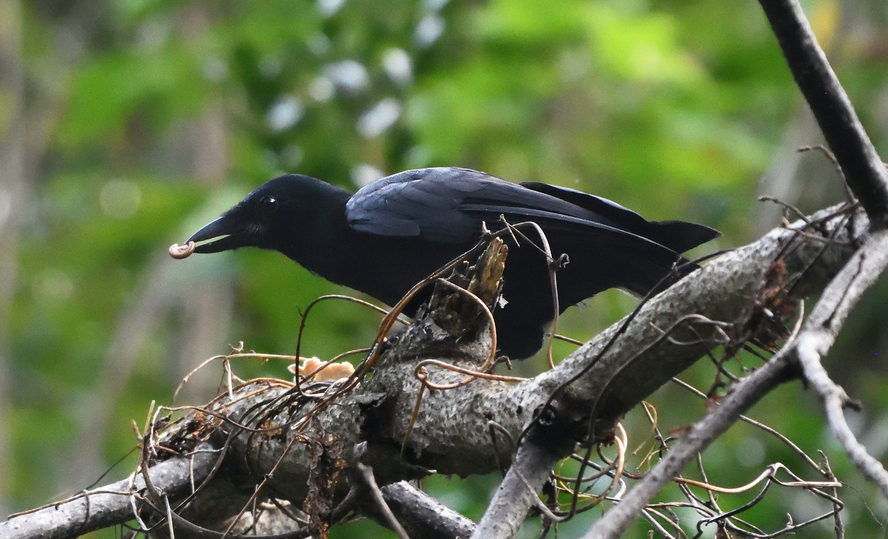
New Caledonian Crow (Corvus moneduloides) lives in forest across Pacific Islands. It feeds on insects and fruit. Its conservation status is Least Concern.
Fascinating facts about the New Caledonian Crow
- The New Caledonian crow is the only non-primate known to exhibit cumulative cultural evolution in its tool-making. Researchers documented over 5,500 leaf-tool remnants across the island, showing that the newer narrow and stepped designs are refinements of an earlier wide tool type. The spatial pattern of these tool types indicates they originated once and then spread, rather than being invented independently in different locations.
- In a 2002 experiment, a crow named Betty was presented with a straight wire and a bucket of food hidden in a vertical pipe. When the straight wire failed, she bent it into a hook and used the improvised tool to lift the bucket. Across ten successful trials she fashioned a hook nine times, usually beginning by probing with the straight wire before reshaping it. This behaviour shows purposeful invention of a novel tool from an unfamiliar material.
- The crow's beak is of moderate size but its lower mandible ends in an upward-angled tip, giving it a chisel-like profile. Scientists propose that this unusual shape developed because the birds need to hold tools straight while probing holes for prey. The angled tip therefore aids in stabilising the stick or leaf tool as it is inserted into crevices, enhancing the bird's already sophisticated foraging technique.
- Endemic to New Caledonia's primary forest, the crow lives only on Grande Terre and Maré Island where true woodpeckers are absent. By inserting stick or leaf tools into bark cracks it extracts insects and larvae, a foraging method that mirrors the role of woodpeckers elsewhere. This behaviour lets the species occupy the ecological niche normally filled by woodpeckers, providing a similar predatory function in the island's forests.
- Meta-tool use, where a crow employs one implement to obtain another, has been demonstrated in laboratory trials. In a typical test a short stick was given that could not reach food, but the bird used it to pull a longer stick from a second box and then retrieved the food with the longer tool. Six of seven individuals solved the problem on their first attempt, a performance previously recorded only in primates, highlighting the crow's advanced cognition.
Sources
Every fact above was checked against these pages, and kept only where one of them states it.
At a glance
RangePacific Islands
HabitatForest
DietInsects and fruit
About the New Caledonian Crow
In the misty forests of New Caledonia, a mastermind of innovation weaves its way through the underbrush, the New Caledonian Crow a paragon of problem-solving prowess. With eyes that shine like polished onyx, this ebony silhouette flits from branch to branch, its sleek form slicing through the dappled light as it pursues its next meal or crafting opportunity. As it moves, the crow's deft beak probes and manipulates its surroundings, a testament to the remarkable intelligence that has earned this bird a reputation as one of the most clever creatures in the animal kingdom.
Hear the New Caledonian Crow, and 4,400+ more
Real recorded sounds, 11 nature games and a free Daily 5, 1v1 quiz duels, conservation wins and a safe Kids mode. Free on Feravox.