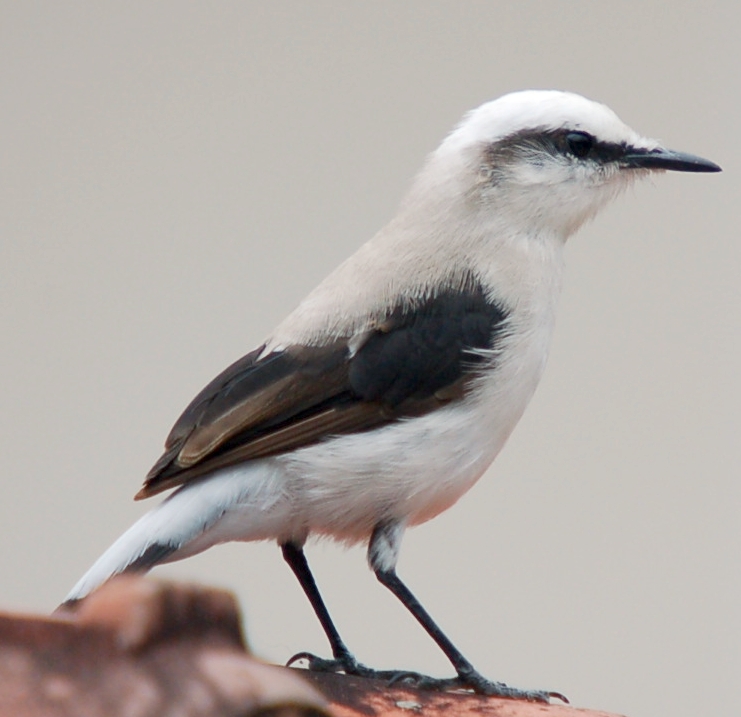
Masked Water-Tyrant (Fluvicola nengeta) lives in freshwater wetlands across South America. It feeds on insects and spiders. Its conservation status is Least Concern.
Fascinating facts about the Masked Water-Tyrant
- At just 14.5 to 15 cm long, the masked water tyrant fits on the tip of a ruler yet flashes a bold black eye-mask that looks like a painted stripe. Adults are mostly white, but a brownish-gray tinge shades the back, black wings and a black tail tipped in white complete the look. Both subspecies share a dark iris, a black bill and black legs and feet.
- First described in 1766 as a shrike, the masked water tyrant's taxonomic journey landed it in the genus Fluvicola in 1827, a name that literally means "river dweller." Two subspecies, F. n. nengeta and F. n. atripennis, split their homes across South America, with the nominate roaming eastern Brazil down to Santa Catarina and the atripennis line threading from southwestern Colombia through western Ecuador into northwestern Peru.
- The bird favors watery edges, open shrublands, marshes, rice fields, and the banks of ponds, lakes, streams and rivers. Its nest is a ball of grass and stems with a side entrance, holding a clutch of three white eggs speckled with brown. The female incubates alone for about 15 days, after which both parents feed the hatchlings.
- Unlike many migratory flycatchers, the masked water tyrant stays put year-round across its two disjunct ranges, making it a reliable presence for local observers. It forages singly or in pairs, hopping on the ground or among floating vegetation, and snatches insects with short sallies, quick runs, and upward leaps. Its tame, conspicuous nature and "high, sharp peep" call in Brazil (or a "sharp kirt!" in Ecuador) mean birders can hear and see it without long waits, turning everyday parks into wildlife classrooms.
- The IUCN lists the masked water tyrant as Least Concern, noting its large, expanding range and a population believed to be increasing despite unknown exact numbers. Its tolerance of converted habitats, urban parks, rice fields, cleared forest edges, has helped it spread southward in Brazil and establish in Argentina, Paraguay and Uruguay. The first Colombian record came only in 2011.
Sources
Every fact above was checked against these pages, and kept only where one of them states it.
At a glance
RangeSouth America
HabitatFreshwater wetlands
DietInsects and spiders
About the Masked Water-Tyrant
In the sun-drenched wetlands, the Masked Water-Tyrant reigns supreme, its sleek, grey plumage glistening like polished stone as it darts with precision, its black mask a striking accent that seems to intensify its piercing gaze. With each swift, economical movement, it navigates the tangled vegetation with an air of quiet confidence, its sharp, black bill twitching as it snatches unsuspecting insects from the air. As it flits between the water's edge and the surrounding scrub, its very presence seems to embody the dynamic, unfettered spirit of its aquatic realm.
Hear the Masked Water-Tyrant, and 4,400+ more
Real recorded sounds, 11 nature games and a free Daily 5, 1v1 quiz duels, conservation wins and a safe Kids mode. Free on Feravox.