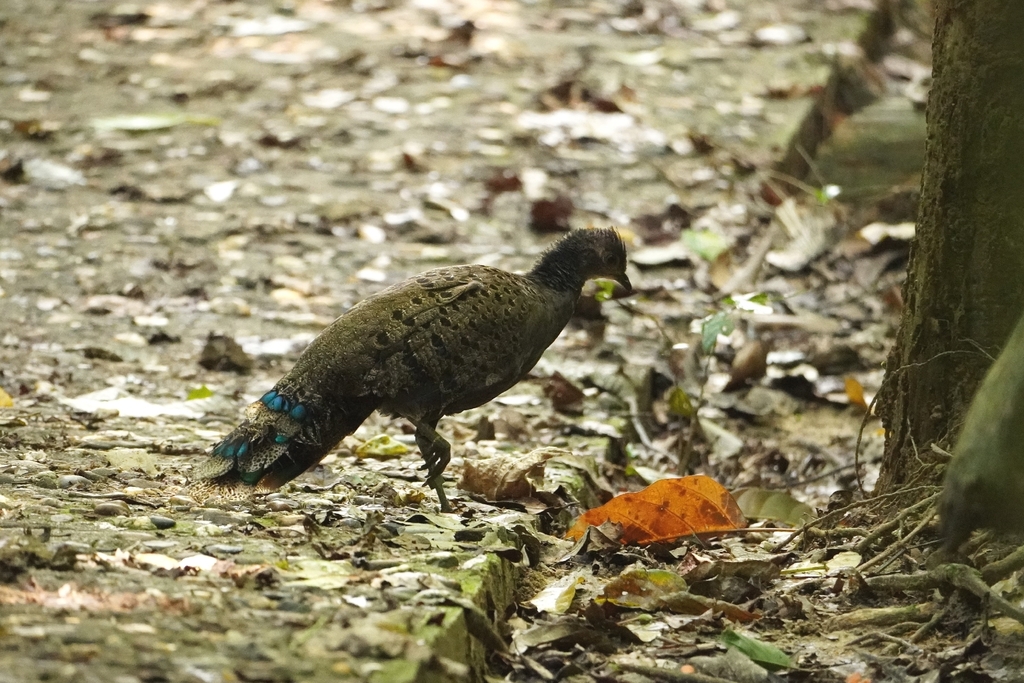
Malayan Peacock-Pheasant (Polyplectron malacense) lives in rainforest floor across Southeast Asia. It feeds on insects and fruit. Its conservation status is Endangered.
Fascinating facts about the Malayan Peacock-Pheasant
- The Malayan peacock-pheasant produces only one egg per breeding attempt, a rarity among its relatives. This single-egg clutch is laid in a very simple nest made of twigs and large leaves on low, firm ground or a short termite mound. After the egg is laid, incubation lasts about twenty-two to twenty-three days before the chick hatches. Because the whole reproductive output rests on that one egg, any loss can greatly affect the pair's success.
- In the last ten years the species' numbers have dropped by roughly two-thirds, and this decline is projected to continue for at least another decade. The total adult population was estimated at about eight thousand individuals in 2008, a figure close to the maximum the remaining habitat can support. Ongoing habitat loss and the bird's already limited range have led to its classification as endangered on the IUCN Red List.
- Deforestation has removed more than three-quarters of the forest that once supported the Malayan peacock-pheasant since the 1970s, drastically shrinking its usable habitat. Over half of the sites where the bird was recorded in the 1970s are now unsuitable, forcing the remaining birds into fragmented refuges. The species relies on extensive primary forest and cannot thrive in heavily logged areas.
- Adult male Malayan peacock-pheasants reach about 50 cm in total length, with the tail contributing roughly half of that measurement, which makes them one of the shortest-tailed members of their group. Their tarsus is about 6.5 cm long and the wings span 20-21 cm, giving them a compact build. They weigh between just over 600 g and nearly 700 g, a size that supports their ground-dwelling lifestyle in lowland forests.
- During courtship the normally pink facial skin of the Malayan peacock-pheasant flashes a vivid orange-red, creating a striking contrast with its muted brown plumage. This colour change surrounds eyes that have a bluish-white iris, enhancing the visual display. The bird also shows iridescent blue-green eyespots on its wings and a dark blue-green crest on the forehead, all of which are used in elaborate ritualised postures to attract a mate.
Sources
Every fact above was checked against these pages, and kept only where one of them states it.
At a glance
RangeSoutheast Asia
HabitatRainforest floor
DietInsects and fruit
About the Malayan Peacock-Pheasant
In the dappled understory of Southeast Asia's ancient forests, the Malayan Peacock-Pheasant unfurls its resplendent plumage, a kaleidoscope of emerald and sapphire hues that seem to shimmer in tandem with the rustling leaves. As it moves with stately elegance, its long tail feathers trailing behind like a silken banner, this magnificent bird weaves a subtle path through the shadows, its very existence a testament to the enduring beauty of a fragile ecosystem. With each deliberate step, the Malayan Peacock-Pheasant embodies the quiet majesty of a realm where nature's splendor is both captivating and precarious.
Hear the Malayan Peacock-Pheasant, and 4,400+ more
Real recorded sounds, 11 nature games and a free Daily 5, 1v1 quiz duels, conservation wins and a safe Kids mode. Free on Feravox.