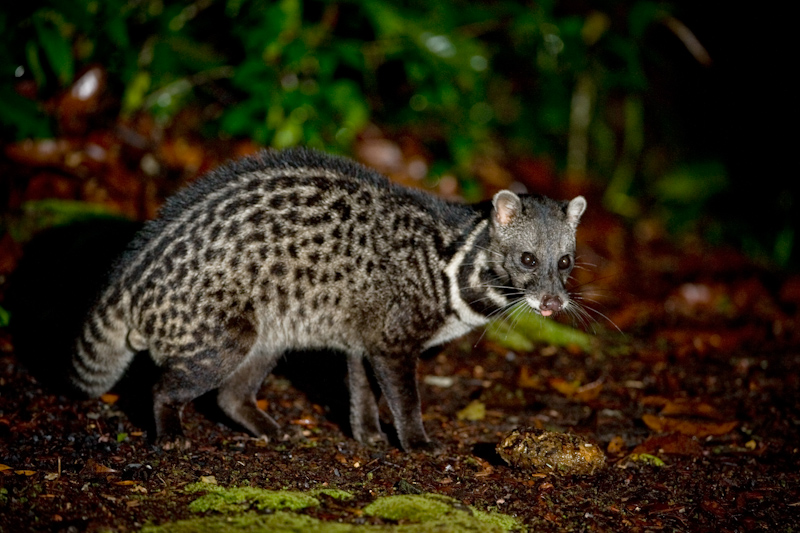
Malay Civet (Viverra tangalunga) lives in tropical rainforest across Southeast Asia. It feeds on fruits and insects. Its conservation status is Least Concern.
Fascinating facts about the Malay Civet
- Measuring 585 to 950 mm from nose to rump and sporting a 300-482 mm tail, the Malay civet weighs between 5 and 11 kg, about the heft of a small backpack. Its compact body and retractile claws, protected by skin lobes on the third and fourth fore-foot digits, enable occasional tree climbs despite being mainly ground-dwelling. It inhabits both forest and village edges.
- From the Malay Peninsula to Sumatra, Borneo, Bangka and the Philippines, the civet's historic range stretches across Indonesia, Malaysia, Brunei, Singapore and beyond. Humans have even introduced it to Sulawesi, the Maluku Islands. A 2012 camera trap in Singapore captured an individual, confirming its persistence in heavily urbanized zones. This broad distribution shows the species' ability to thrive amid both pristine forests and bustling towns.
- Densities of Malay civets are higher in unlogged than in logged forests. In untouched woods, fruit makes up a larger share of their diet. Logging may lead to increased competition with arboreal frugivores like palm civets that can harvest fruit directly from trees, whereas the mainly terrestrial Malay civet must forage on the ground.
- Eleven Malay civets were trapped in cages inside forest near oil-palm plantations, highlighting their willingness to roam disturbed habitats. Researchers warn that such adaptable carnivores can act as viral carriers, moving pathogens from domestic cats on plantations into wild forest communities. The study found that species like the Malay civet, which frequently use plantation edges, may spread feline panleukopenia to vulnerable wild cats. Their bridge role amplifies disease risk for endangered felids sharing the same landscape.
- Black above, ringed below, the Malay civet's tail looks like a painted brushstroke, a stark contrast to its tawny body. maintains its role as a solitary, nocturnal hunter across diverse forests.
Sources
Every fact above was checked against these pages, and kept only where one of them states it.
At a glance
RangeSoutheast Asia
HabitatTropical rainforest
DietFruits and insects
About the Malay Civet
In the dappled shadows of Southeast Asia's tropical forests, the Malay civet weaves a secretive path, its sleek, grey coat blending seamlessly with the misty undergrowth as it pads silently through the night. With eyes aglow like lanterns in the dark, this enigmatic creature navigates the forest floor with ease, its long, bushy tail twitching like a metronome as it searches for the ripe fruits and insects that sustain it. As it moves, the Malay civet embodies the very essence of the forest's hidden world, a mysterious and elusive presence that whispers of the magic that lies just beyond the reach of human sight.
Hear the Malay Civet, and 4,400+ more
Real recorded sounds, 11 nature games and a free Daily 5, 1v1 quiz duels, conservation wins and a safe Kids mode. Free on Feravox.