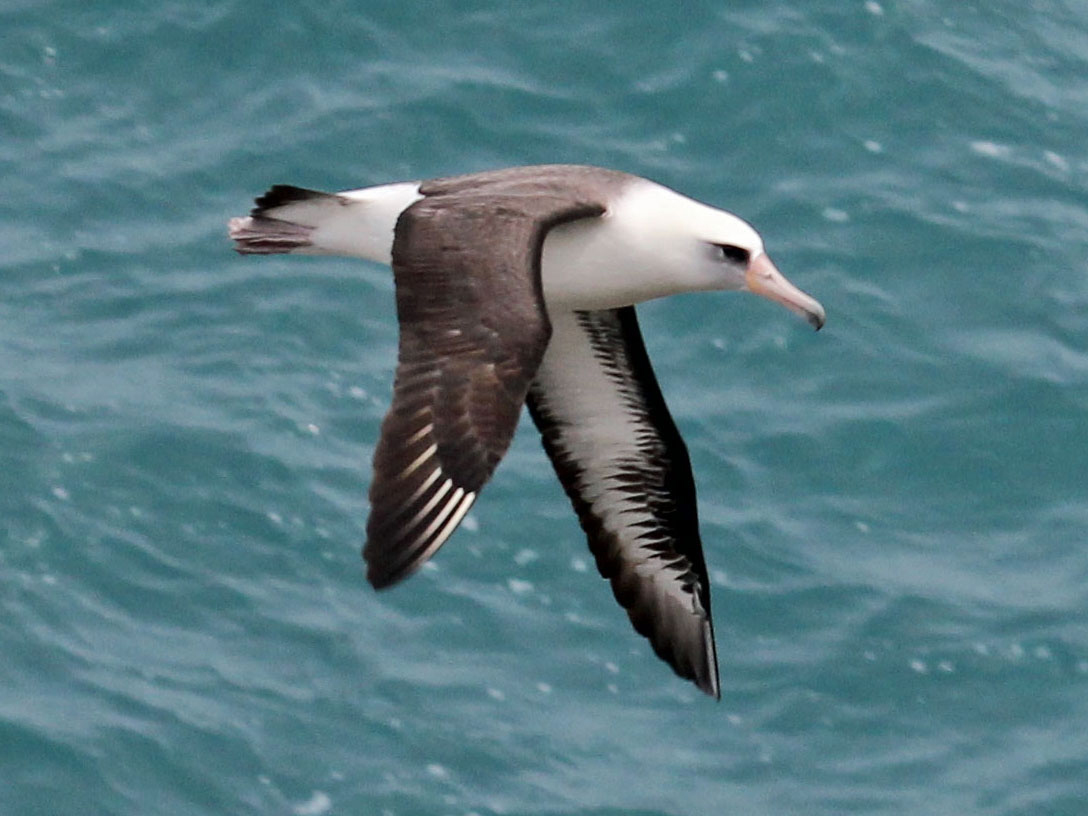
Laysan Albatross (Phoebastria immutabilis) lives in open Pacific Ocean across North Pacific Ocean. It feeds on squid and fish. Its conservation status is Near Threatened.
Fascinating facts about the Laysan Albatross
- Nearly 1.2 million Laysan albatrosses circle the North Pacific, yet 99.7% of them roost on a string of tiny islands. Their wings stretch up to two metres, letting them glide for weeks without flapping, while males tip the scales at up to 4.1 kg and females at 3.6 kg. This concentration makes the Northwestern Hawaiian Islands a single-point stronghold for a species that would otherwise be scattered across millions of square kilometres of ocean. Such dependence means any disturbance there ripples through almost the entire global population.
- Wisdom, the world's oldest wild bird, has outlived every other known albatross, reaching at least 74 years old and still laying eggs. Band-ed in 1956, she was already breeding by December that year, and her latest chick hatched on 1 February 2021. Her longevity shows that Laysan albatrosses can survive decades of ocean life, but also that each long-lived individual can add dozens of offspring to a population still recovering from historic feather-hunting.
- Lead-based paint on abandoned Midway military buildings has poisoned thousands of chicks each year. An estimated 10,000 chicks, about 5 % of all hatchlings, die from ingesting paint chips, and those nesting within 5 m of structures develop "droop wing," a condition that prevents flight and leads to starvation. This hidden toxin threatens a species already vulnerable to longline fishing, underscoring the need for habitat cleanup.
- Laysan albatrosses spend roughly half the year at sea, cruising from the Aleutians to Japan on wind currents before returning to breed. Their flight relies on dynamic soaring, using wind gradients to glide with minimal wing beats, which makes take-offs and landings difficult but allows them to cover vast ocean distances without fatigue.
- Each Laysan albatross lays a single, buff-white egg that averages 10.7 cm by 6.8 cm and weighs 284 g, then both parents share a 65-day incubation shift before the chick spends about 160 days growing.
Sources
Every fact above was checked against these pages, and kept only where one of them states it.
At a glance
RangeNorth Pacific Ocean
HabitatOpen Pacific Ocean
DietSquid and fish
About the Laysan Albatross
Across the vast expanse of the Pacific, the Laysan Albatross glides effortlessly, its snowy-white feathers glistening like a spectral apparition as it rides the wind currents with majestic precision. With wings outstretched, it soars over the waves, its piercing gaze scanning the horizon for the telltale signs of its next meal, a masterful hunter in a world of endless blue. As it banks and turns, the sunlight catches its wings, illuminating the delicate patterns of its feathers, a fleeting glimpse of beauty in a realm where survival is a constant, delicate balance.
Hear the Laysan Albatross, and 4,400+ more
Real recorded sounds, 11 nature games and a free Daily 5, 1v1 quiz duels, conservation wins and a safe Kids mode. Free on Feravox.