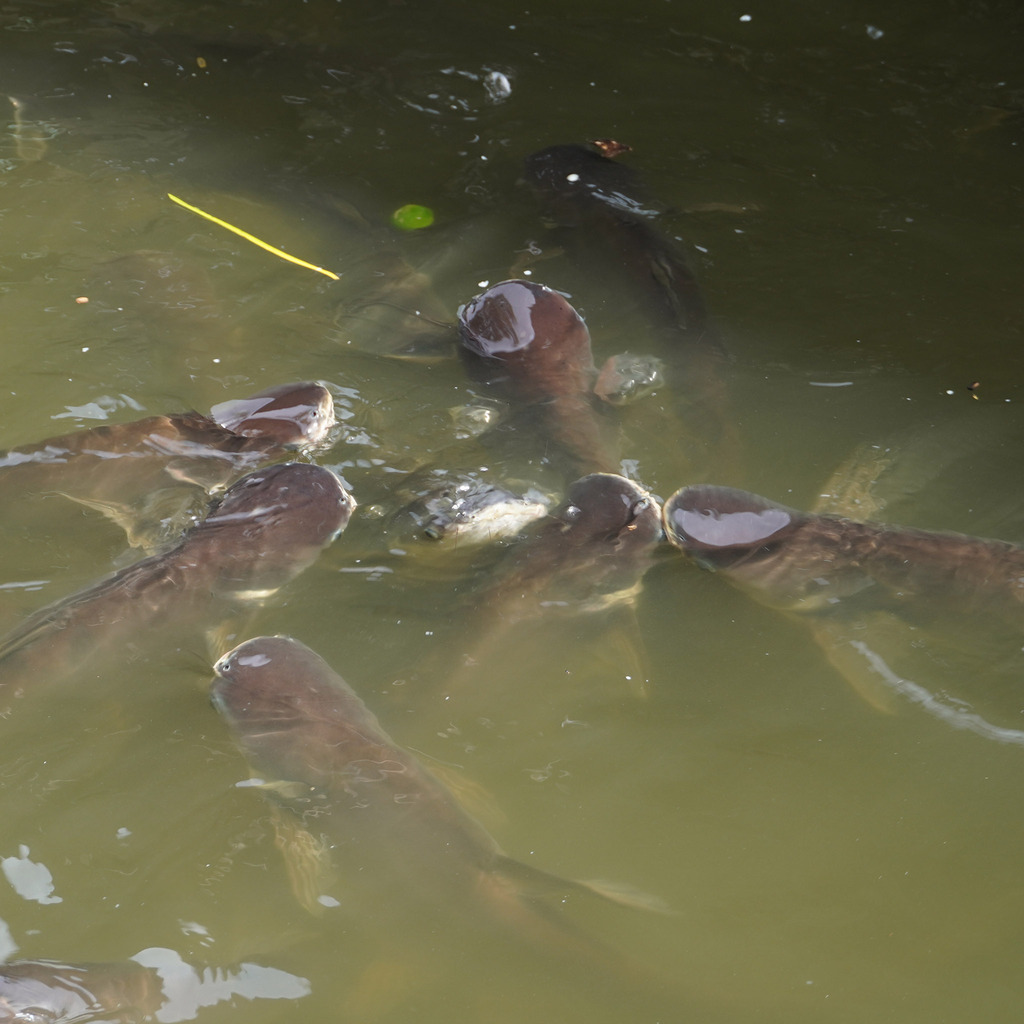
Photo: nbasargin
Feravox · The Voice of the Wild
Iridescent Shark
Pangasianodon hypophthalmus
Endangered
Iridescent Shark (Pangasianodon hypophthalmus) lives in large freshwater rivers across Southeast Asia. It feeds on crustaceans, fish, plants. Its conservation status is Endangered.
The iridescent shark catfish, Pangasianodon hypophthalmus, dazzles with a shimmering, rainbow-tinged sheen in its juvenile years, a trait that earned it its name despite being a true catfish, not a shark. Adults grow to a formidable 130 cm (4.3 ft) and can weigh as much as 44 kg (97 lb), their bodies turning a uniform grey while the fins stay dark grey or black. Juveniles display a distinctive black stripe along the lateral line and a second stripe below it, a pattern that fades as they mature. Native to the great rivers of Southeast Asia, most notably the Mekong and Chao Phraya basins, these fish thrive in tropical freshwater with a pH of 6.5–7.5, water hardness of 2.0–29 dGH, and temperatures between 22 °C and 26 °C (72–79 °F). Their swim bladder doubles as an air-breathing organ, allowing them to survive hypoxic waters and undertake seasonal migrations: upstream from May to July in the Mekong, and downstream again from September through December, with regional variations near the Khone Falls. Iridescent sharks are opportunistic omnivores, feeding on crustaceans, smaller fish, and plant material, a diet that supports their massive aquaculture industry where they are marketed as swai, panga, cream dory or basa. Their migratory instincts and schooling nature make them a spectacular sight in the wild, often swimming alongside spot pangasius and red-tailed tinfoil barb. A surprising trait is their ability to tolerate rapid changes in oxygen levels, a resilience that paradoxically makes them vulnerable to modern hydropower projects, blade strikes, shear forces and turbulence can cause severe injury and mortality, a stark reminder that their very adaptability can become a liability in altered riverine landscapes…
Real recorded sounds, 11 nature games and a free Daily 5, 1v1 quiz duels, conservation wins and a safe Kids mode. Free on Feravox.