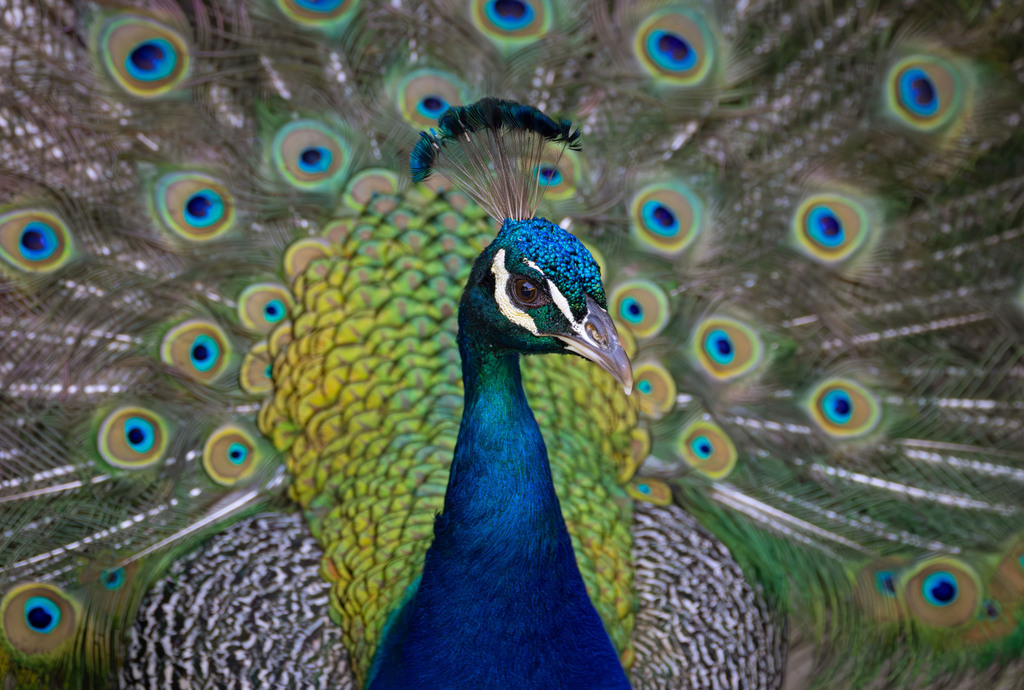
Indian Peafowl (Pavo cristatus) lives in tropical forests across Indian subcontinent. It feeds on insects and seeds. Its conservation status is Least Concern.
Fascinating facts about the Indian Peafowl
- The male's train can reach 200-230 cm when fully grown, extending far beyond its 100-120 cm body length. These stiff upper-tail coverts are lined with eye-spots that are fanned and quivered in the classic courtship display. The train and the leg spur only begin to develop in the second year and are not fully mature until the bird is four years old. This spectacular ornament is unique to the peacock and is absent in the brown-coloured peahen.
- A peacock weighs between 4.1 and 5.2 kg, making it one of the heaviest birds in the pheasant family. Despite this bulk it is still capable of flight, though it prefers to run through undergrowth when disturbed. It will take short, noisy flights to reach tall trees where it roosts at night. Its powerful legs and heavy body therefore combine with occasional flight to evade predators.
- The Indian peafowl is omnivorous, foraging on the ground for berries, grains and a variety of insects. It also preys on small vertebrates, taking snakes, lizards and rodents when the chance arises. In cultivated areas it will feed on crops such as peanuts, tomatoes, paddy, chili peppers and bananas, and even scavenge human food scraps. This flexible diet allows it to thrive in both wild and semi-domestic habitats.
- The peacock's spectacular train does not rely on pigments; instead, each feather is built from microscopic structures that split and reflect light, creating the brilliant blues, greens and copper tones seen in the eye-spots. These structural colours arise from the feather's surface architecture, which produces vivid hues without any coloured chemicals. This optical effect gives the display its dazzling, iridescent quality that captivates observers.
- A young male peafowl looks much like a female because its ornamental train and leg spur only start to form after the second year of life. During the following years the feathers grow gradually, and the full, elaborate train is not reached until the bird is about four years old. Until then the juvenile remains inconspicuous, lacking the striking fan of eye-spotted feathers that characterises mature males.
Sources
Every fact above was checked against these pages, and kept only where one of them states it.
At a glance
RangeIndian subcontinent
HabitatTropical forests
DietInsects and seeds
About the Indian Peafowl
As the Indian Peafowl strides through the forest, its resplendent plumage glistens like a kaleidoscope of emeralds and sapphires, a mesmerizing spectacle that seems almost otherworldly. With each step, its majestic train feathers rustle and shimmer, a symphony of color and movement that announces the bird's presence to the world, a declaration of its unbridled beauty and vitality. In a whirling dance of courtship, the peacock unfurls its magnificent fan, a dazzling display of iridescent blues and greens that seems to defy the very laws of nature.
Hear the Indian Peafowl, and 4,400+ more
Real recorded sounds, 11 nature games and a free Daily 5, 1v1 quiz duels, conservation wins and a safe Kids mode. Free on Feravox.