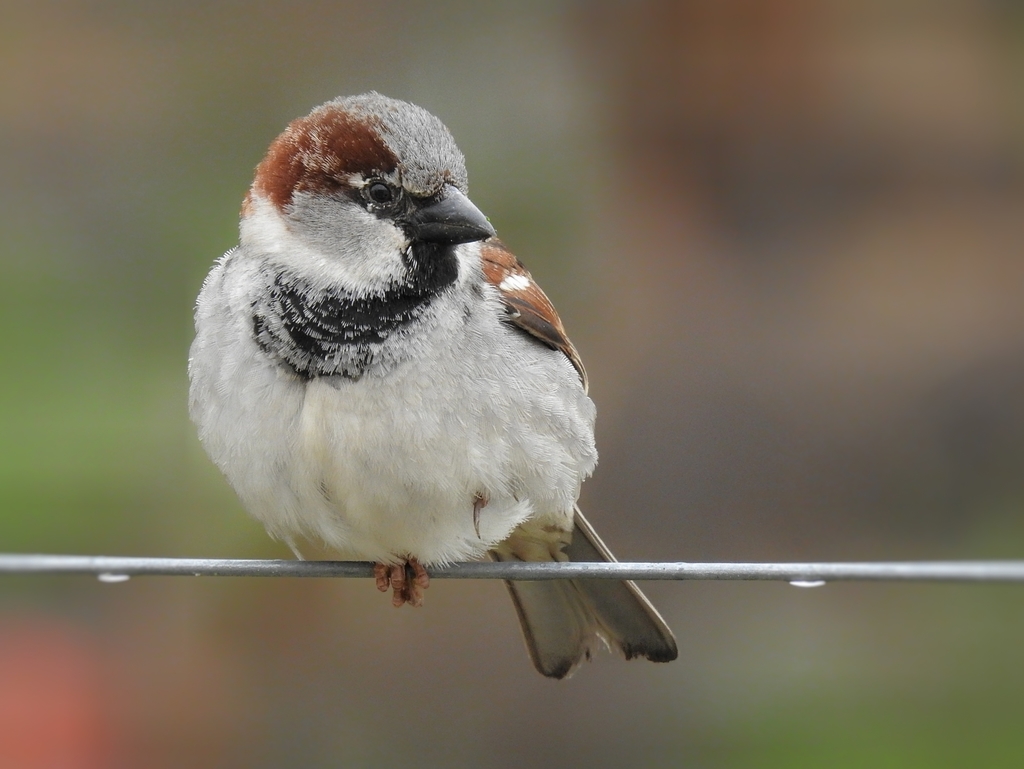
House Sparrow (Passer domesticus) lives in urban and suburban across Most parts of the world. It feeds on seeds and insects. Its conservation status is Least Concern.
Hear the House Sparrow
A real field recording of the House Sparrow, made in the wild.
It lives in most parts of the world. The bird is strongly linked to human habitation and thrives in both urban and rural settings, often feeding at household bird-feeding stations. It usually avoids extensive woodlands, grasslands, polar regions and hot, dry deserts far from human development, and adults measure about 16 cm in length.
It was one of the earliest animals to receive a Linnaean binomial, described by Carl Linnaeus in the 1758 10th edition of Systema Naturae. Linnaeus named the type specimen Fringilla domestica, a name later transferred to the genus Passer when Mathurin Jacques Brisson created it in 1760. The Latin species name domesticus means "belonging to the house", echoing the bird's close association with human dwellings.
Male house sparrows sport a black throat patch, known as a "badge", that grows larger as they age. The badge is a variable black patch on the throat and chest, and studies have shown its width reliably expands with age. While the patch may signal social status or fitness, research has only conclusively linked its size to the bird's age, not to any other behavioural trait.
Sparrows that live farther north or at higher elevations tend to be larger than those in tropical regions, following Bergmann's rule. Birds at higher latitudes, colder climates, and sometimes higher altitudes are larger, both between and within subspecies. The species ranges from 14 to 18 cm in length and weighs between 24 and 39.5 g.
The house sparrow comprises twelve recognised subspecies that fall into two main groups. domesticus group, found in the Palaearctic region, displays grey cheeks, whereas the Oriental P. indicus group shows white cheeks, a brighter crown, a smaller bill and a longer black bib. Some members, such as P. hyrcanus, are noticeably larger than their close relatives, illustrating the diversity within the species.
Sources
Every fact above was checked against these pages, and kept only where one of them states it.
In a whirl of dusty brown and grey, the house sparrow darts through the urban landscape, its energetic chirps punctuating the air as it flits between crumbling brick and rusted steel. With an irrepressible air of busy curiosity, it probes every nook and cranny, seeking out the hidden treasures of seeds and scraps that sustain its vibrant, pulsing existence. As it moves, its tiny feet barely touching the ground, the house sparrow embodies the unyielding spirit of adaptability that has allowed it to thrive in even the most inhospitable of human-dominated environments.
Advertisement
Hear the House Sparrow, and 4,400+ more
Real recorded sounds, 11 nature games and a free Daily 5, 1v1 quiz duels, conservation wins and a safe Kids mode. Free on Feravox.