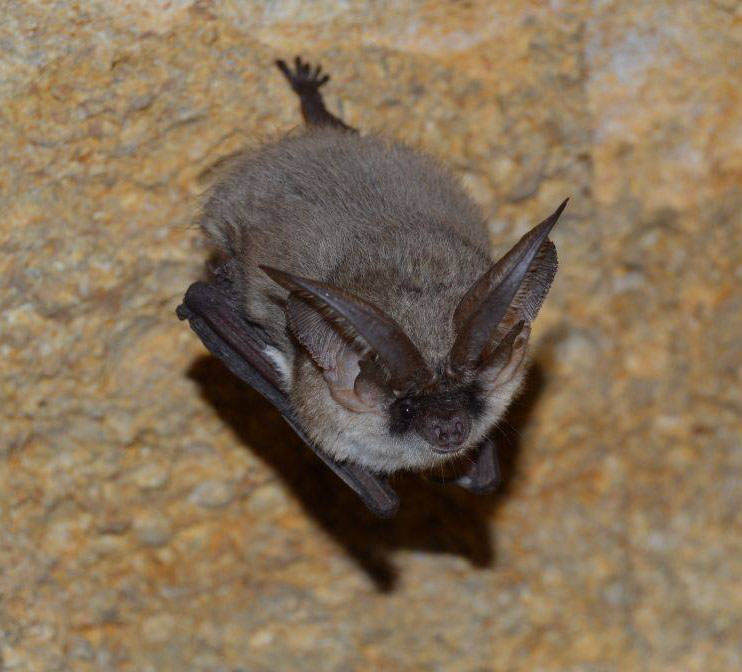
Grey Long-eared Bat (Plecotus austriacus) lives in temperate forests across Europe and Asia. It feeds on insects and moths. Its conservation status is Near Threatened.
Fascinating facts about the Grey Long-eared Bat
- Grey long-eared bats navigate the night with a razor-thin sonar sweep that spans from 18 to 45 kHz, concentrating most of its power at 28 kHz, and each call lasts just 5.8 ms. This ultra-high-frequency chatter lets the bat pinpoint tiny moths fluttering above lowland meadows and marshes, where it forages. By squeezing so much detail into a blink-of-an-eye pulse, the bat can hunt in woodland and even capture prey during daylight flights.
- Grey long-eared bats live a long life for such a tiny mammal, wild individuals can reach 21 years, with an average of 15 years. This longevity, combined with a single reproductive cycle per year, means each female must store sperm after a fall mating, delay fertilisation until spring, and raise a single litter that stays in the roost through July and August.
- In the United Kingdom, a 2013 study warned the grey long-eared bat is on the brink of disappearing, even though the species remains common across continental Europe. The main culprit appears to be the loss of low-lying meadow and marsh foraging grounds. Conservationists have responded with the Back from the Brink project, which aims to increase foraging habitats around known roosts, aiming to halt the UK decline and give the bat a fighting chance.
- Grey long-eared bats are surprisingly urban adapters: they roost in old buildings, tunnels, and even under rocks, often returning to the same site year after year. In villages with plenty of trees and warm, crevice-filled structures, they find safe winter hibernation spots at cave entrances and feed in nearby grasslands. This reliance on human-made habitats makes them vulnerable to chemical treatments.
- A single adult grey long-eared bat weighs between 5 and 20 g, averages 10 g, and measures 45-70 mm in body length (average 58 mm) with a wingspan of 35-52 mm (average 44 mm). Its ears, folded under the wings in winter, stretch about 40 mm.
Sources
Every fact above was checked against these pages, and kept only where one of them states it.
At a glance
RangeEurope and Asia
HabitatTemperate forests
DietInsects and moths
About the Grey Long-eared Bat
In the whispering hours of dusk, the Grey Long-eared Bat unfurls its delicate wings, a lacy silhouette against the fading light, as it embarks on a nocturnal waltz through the forest. With large, endearing ears that rotate independently, this enchanting creature navigates the shadows, its acute hearing guiding it through a world of subtle sounds and hidden prey. As it flits and weaves, its gentle, fluttering flight belies a remarkable adaptability, allowing it to thrive in a wide range of habitats, from ancient woodlands to urban landscapes.
Hear the Grey Long-eared Bat, and 4,400+ more
Real recorded sounds, 11 nature games and a free Daily 5, 1v1 quiz duels, conservation wins and a safe Kids mode. Free on Feravox.