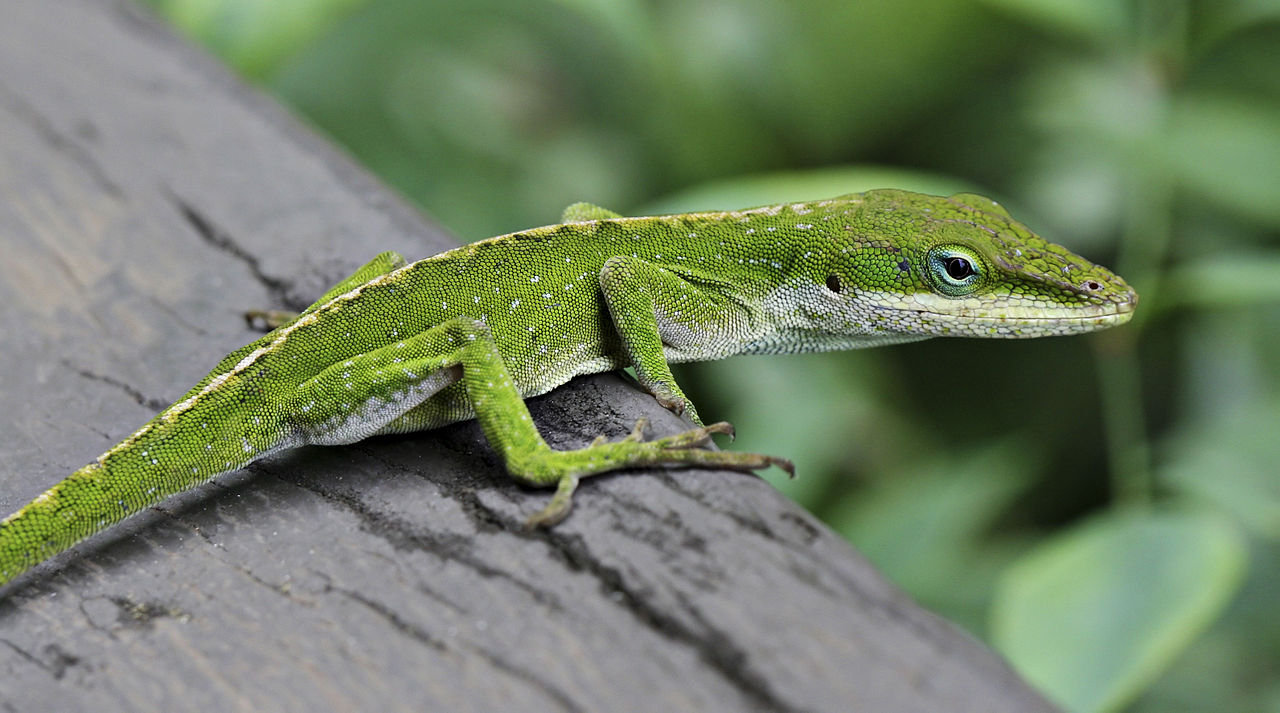
Green Anole (Anolis carolinensis) lives in subtropical forests across Southeastern United States. It feeds on insects and spiders. Its conservation status is Least Concern.
Fascinating facts about the Green Anole
- Blue-phased green anoles are vanishingly scarce, appearing in roughly one out of every 20,000 wild individuals. This rarity stems from a genetic loss of xanthophores, leaving the lizard with a pastel blue skin instead. Because the blue coloration offers almost no camouflage, these mutants rarely survive long in the wild, making them prized by hobbyists.
- Male green anoles grow about fifteen percent larger than females, reaching lengths of 12.5-20.3 cm (4.9-8.0 in) with tails that make up 60-70 % of that size, and they weigh between 3-7 g (0.11-0.25 oz). This size advantage fuels their territorial battles and higher bite forces, while females stay smaller and lighter.
- Genetic studies trace the Carolina anole back to a single oceanic jump from Cuba to the southern United States in the late Miocene or Pliocene, making it a rare case of an island species colonising a continental mainland rather than the usual reverse flow. This historic dispersal seeded the only mainland member of a thirteen-species Caribbean clade, showing how a chance over-water event can launch an entire lineage onto a new continent.
- In southern Florida the native green anole regularly interbreeds with the introduced Cuban green anole (A. porcatus). A 2022 study uncovered asymmetric introgression of three porcatus alleles that are tightly linked to urban-related environmental variables. This gene flow may give the native population new tools to thrive in cities, illustrating how hybridization can sometimes boost, rather than threaten, a species' adaptability to human-altered habitats.
- Male green anoles are fiercely territorial; when another male appears they compress their bodies, flare a three-times-larger orange-red dewlap, puff a dorsal ridge, bob their heads and chase the intruder. Research shows a direct positive correlation between the size of a male's dewlap and its bite-force, meaning larger-dewlapped lizards can deliver stronger bites.
Sources
Every fact above was checked against these pages, and kept only where one of them states it.
At a glance
RangeSoutheastern United States
HabitatSubtropical forests
DietInsects and spiders
About the Green Anole
In the dappled light of the forest, the green anole dances through the underbrush, its slender body weaving with effortless ease between the tangled vines and leafy branches. As it moves, its vibrant green scales seem to shimmer and glow, like the first tender shoots of spring, and its delicate feet barely touch the ground, giving the impression of a creature barely tethered to the earth. With a flick of its brightly colored dewlap, the anole announces its presence to the world, a tiny, iridescent king proclaiming its dominion over this sun-drenched realm.
Hear the Green Anole, and 4,400+ more
Real recorded sounds, 11 nature games and a free Daily 5, 1v1 quiz duels, conservation wins and a safe Kids mode. Free on Feravox.
Green Anole photographed on Feravox
More reptiles to discover