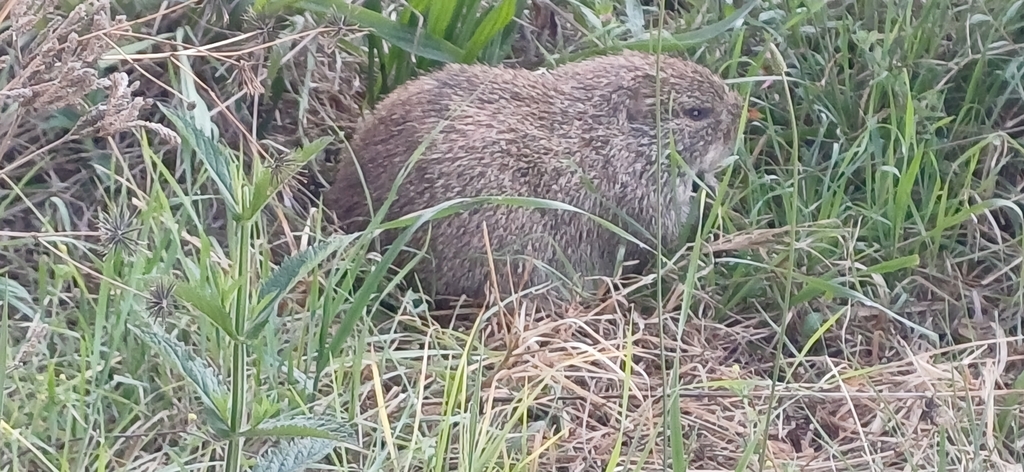
Greater Cane Rat (Thryonomys swinderianus) lives in tropical wetlands across Sub-Saharan Africa. It feeds on grasses and leaves. Its conservation status is Least Concern.
Fascinating facts about the Greater Cane Rat
- A greater cane rat can stretch its body from just under half a meter to a full 60 cm, with a tail that adds another 16-19.5 cm, roughly the length of a school ruler plus a small notebook. Typical adults weigh between 3.2 and 5.2 kg, but the biggest individuals tip the scales at 7-9 kg, rivaling a small Labrador. Males average about 4.5 kg while females sit near 3.5 kg, making them one of Africa's heftiest rodents.
- Reproduction runs on a tight clock: the estrous cycle lasts just 6.62 days, and once fertilized, a female carries the young for 137-172 days. Litters usually contain four pups, and females can produce two litters each year, meaning a single pair can add eight offspring annually. Newborns arrive at roughly 129 g, already furred, eyes open, and able to sprint, giving them a head start against predators. Sexual maturity arrives at about one year.
- Greater cane rats are true wet-land grazers, favoring elephant grass and sweet potatoes, but they will also munch on maize, wheat, sugar-cane, cassava and a host of other crops. Their preference for moist, carbohydrate-rich plants brings them into direct conflict with farmers, turning them into costly pests in sugar-cane and maize fields.
- Cane rat meat commands premium prices, often fetching almost twice the value of beef or pork in West African markets. In one Ghanaian market, roughly 200,000 kg of meat, worth about $220,000, was sold in a single year, highlighting its economic pull. This high demand has spurred the start of cage-rearing operations, turning a wild pest into a potential solution for protein shortages across the continent.
- In the wild, a greater cane rat typically lives just over four years, with captive records showing a maximum of four years and four months.
Sources
Every fact above was checked against these pages, and kept only where one of them states it.
At a glance
RangeSub-Saharan Africa
HabitatTropical wetlands
DietGrasses and leaves
About the Greater Cane Rat
In the lush, vibrant grasslands of sub-Saharan Africa, the Greater Cane Rat moves with purpose, its stout body undulating as it navigates the dense undergrowth with ease. With a twitching nose and alert, beady eyes, this formidable rodent weaves through the tall reeds and canes, its razor-sharp claws clicking against the earth as it forages for the tender shoots and roots that sustain it. As it moves, the Greater Cane Rat leaves behind a trail of neatly clipped vegetation, a testament to its remarkable ability to thrive in this challenging, yet beautiful, environment.
Hear the Greater Cane Rat, and 4,400+ more
Real recorded sounds, 11 nature games and a free Daily 5, 1v1 quiz duels, conservation wins and a safe Kids mode. Free on Feravox.