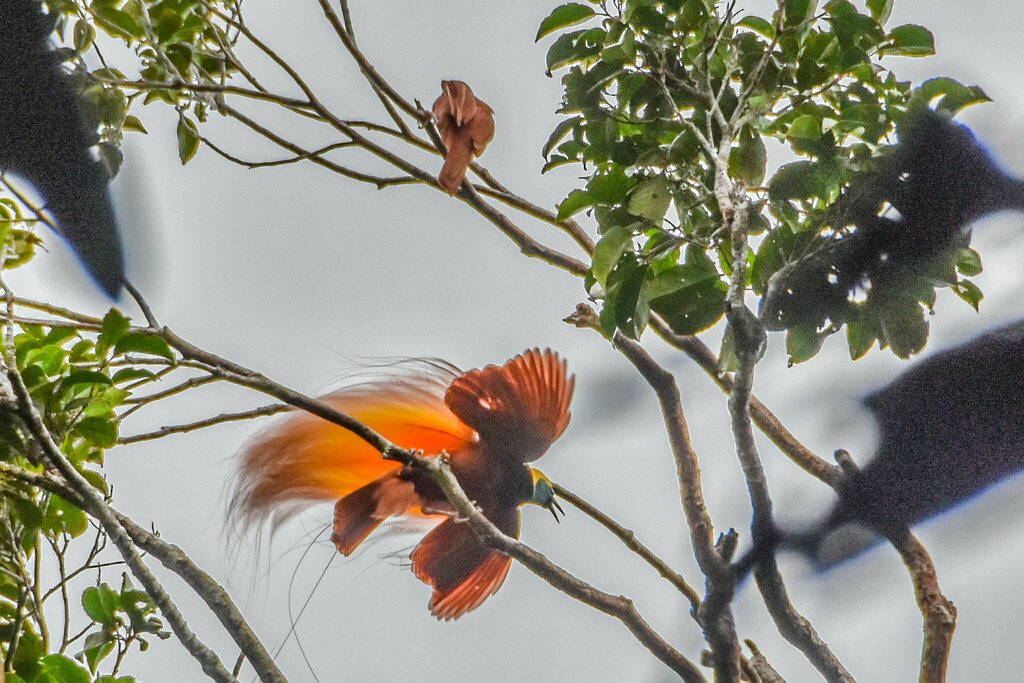
Greater Bird-of-Paradise (Paradisaea apoda) lives in tropical rainforest across New Guinea and Aru Islands. Its conservation status is Least Concern.
Fascinating facts about the Greater Bird-of-Paradise
- Carl Linnaeus christened the species Paradisaea apoda, or "legless bird-of-paradise," after early trade skins arrived in Europe stripped of wings and feet. Those skin-only specimens sparked the myth that these birds floated on their feathers and never touched the ground until death. The formal description in 1758 cemented a name that still hints at a centuries-old misunderstanding, reminding us how cultural lenses can warp scientific perception.
- Greater birds-of-paradise are frugivorous insectivores that gorge on tree fruits and arthropods, especially those of mahogany and nutmeg trees. By swallowing fruit whole and later excreting the seeds in nutrient-rich guano, they plant new trees, helping those plant species spread across the jungle. This seed-dispersal service boosts forest diversity.
- The greater bird-of-paradise is listed as Least Concern on the IUCN Red List, reflecting its abundance across lowland and hill forests of southwest New Guinea and the Aru Islands. Yet a tiny off-site colony was introduced by Sir William Ingram between 1909 and 1912 to Little Tobago Island in the West Indies; that group survived at least until 1966 before likely disappearing.
- The male greater bird-of-paradise stretches up to 43 cm (17 in) long, not counting its spectacular twin tail-wires, while the female tops out at about 35 cm (14 in). the title of the most glamorous display in the bird world.
Sources
Every fact above was checked against these pages, and kept only where one of them states it.
At a glance
RangeNew Guinea and Aru Islands
HabitatTropical rainforest
DietFruits and insects
About the Greater Bird-of-Paradise
In the lush, vibrant rainforests of Indonesia, the Greater Bird-of-Paradise reigns supreme, its resplendent plumage a dazzling spectacle of gold, crimson, and emerald green. As it moves through the forest canopy, its long, flowing plumes undulate like a dark, iridescent mist, drawing the eye inexorably to this most charismatic of creatures. With each majestic step, the bird seems to embody the very essence of its surroundings, its beauty and allure woven inextricably into the fabric of the tropical landscape.
Hear the Greater Bird-of-Paradise, and 4,400+ more
Real recorded sounds, 11 nature games and a free Daily 5, 1v1 quiz duels, conservation wins and a safe Kids mode. Free on Feravox.