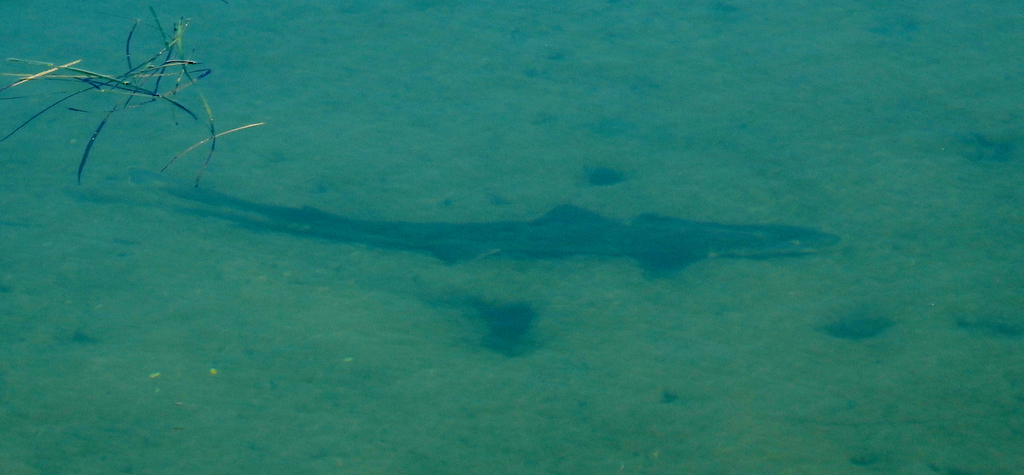
Photo: James M. Maley
Feravox · The Voice of the Wild
Gray Smooth-hound
Mustelus californicus
Least Concern
Gray Smooth-hound (Mustelus californicus) lives in shallow continental shelf across California to Gulf. It feeds on crustacean prey. Its conservation status is Least Concern.
The gray smooth-hound (Mustelus californicus) glides along the warm continental shelves of the eastern Pacific, a sleek, spotless shark whose brown-to-dark-gray back contrasts with a stark white belly. Its narrow head and long, blunt snout give it a distinctive silhouette, while the dorsal fin sits nearer the pelvic fin than the pectoral, a subtle clue that separates it from the brown smooth-hound. Adults range from 0.5 to 1.6 m, with females growing larger than males, and newborns emerge at about 20–30 cm after a viviparous gestation supported by a yolk-sac placenta. These sharks favor shallow, muddy estuaries and bays, often less than 12 m deep in California, but up to 80 m along the Gulf of California, where they hunt benthic crustaceans, especially red and Pacific rock crabs, and supplement their diet with herring, toadfish, and occasional innkeeper worms. Their movements are dictated by temperature and oxygen, shuttling between warm mid-basin waters by day and cooler, prey-rich edges at night, a behavior that likely aids thermoregulation. A rare quirk sets this species apart: three documented cases of true albinism, including a pregnant female in Elkhorn Slough that bore five albino pups, highlight the genetic mysteries still lurking beneath their muted coloration.
Real recorded sounds, 11 nature games and a free Daily 5, 1v1 quiz duels, conservation wins and a safe Kids mode. Free on Feravox.