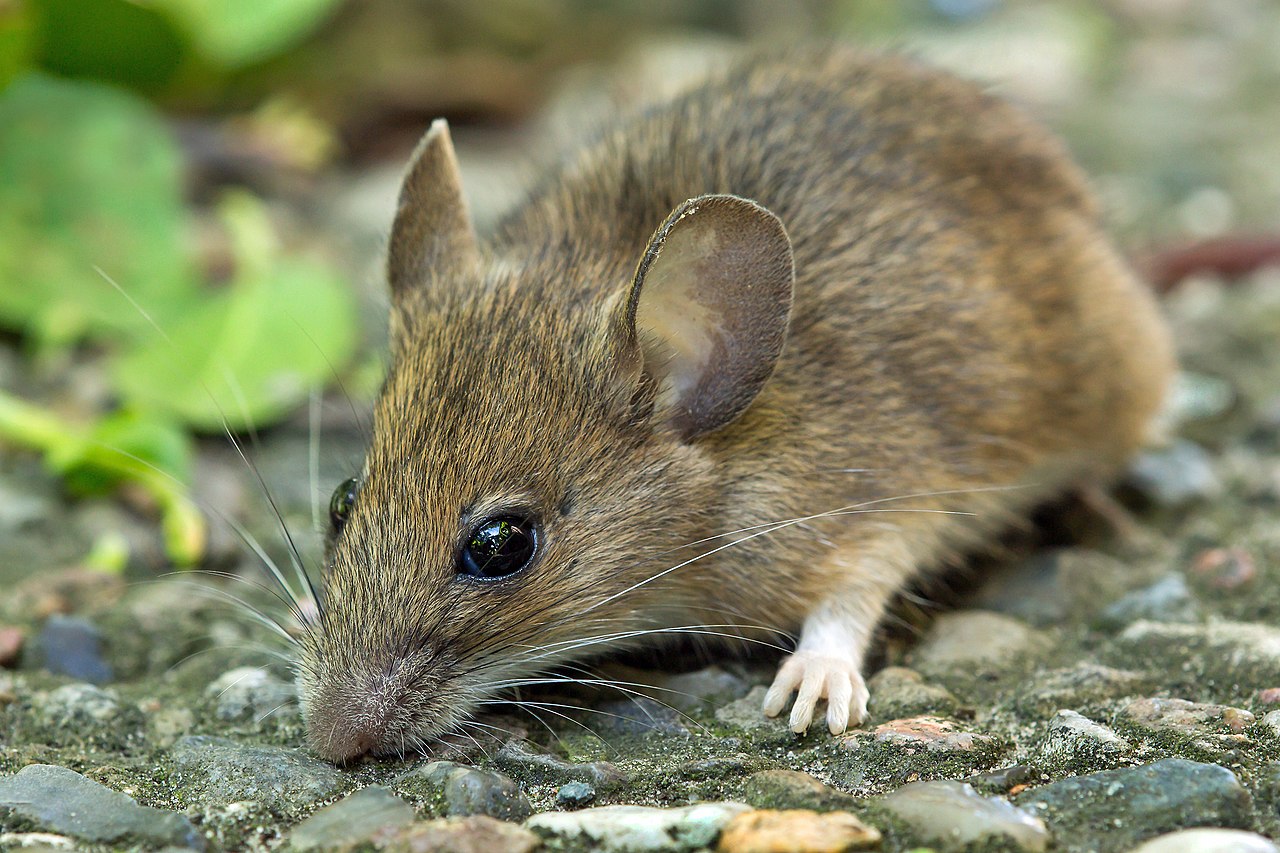
European Wood Mouse (Apodemus sylvaticus) lives in temperate woodland across Western Eurasia. It feeds on seeds and insects. Its conservation status is Least Concern.
Fascinating facts about the European Wood Mouse
- When a predator grabs a wood mouse by the tail, the rodent can instantly detach the tip, a piece that never grows back, providing a rapid escape. This autotomy is part of several anti-predatory strategies that the largely nocturnal mouse has evolved to avoid being caught. By shedding the tail segment the mouse can sprint away into its burrow or dense vegetation, reducing the chance of fatal injury.
- Male European wood mice produce sperm with uniquely sickle-shaped heads that bear a tiny hook at the tip. After release in the female tract these hooks latch onto one another, linking sperm into travelling 'mobile trains'. Experiments have shown that these trains move more efficiently through the reproductive tract than solitary cells, giving them a motility advantage.
- The wood mouse is a known potential carrier of the Dobrava hantavirus, which can affect humans and may pose serious health risks. It is a common species that often lives close to human dwellings.
- In winter some wood mice have been observed attacking hibernating bats, although researchers are still unsure how frequent this behaviour is. The species normally feeds on seeds such as oak and beech, storing them in nests when they are abundant, and only turns to animal prey when plant food is scarce. When bats are available underground, the mouse may seize the opportunity, but the claim remains contested among scientists.
- Wood mice never truly hibernate, yet during especially severe winters they can enter a torpid state, markedly slowing their metabolism. This physiological pause helps them survive prolonged cold while they continue to forage in sheltered burrows or hedgerows. Their nocturnal habits and tendency to seek more wooded areas in winter further reduce exposure to the harshest conditions, allowing them to persist without full hibernation.
Sources
Every fact above was checked against these pages, and kept only where one of them states it.
At a glance
RangeWestern Eurasia
HabitatTemperate woodland
DietSeeds and insects
About the European Wood Mouse
In the whispering depths of the forest, the European Wood Mouse weaves an unseen tapestry of life, its tiny paws barely disturbing the leaf litter as it darts with furtive purpose through the underbrush. With eyes shining like dark jewels, this diminutive creature navigates the intricate network of its woodland realm, driven by an insatiable curiosity and a will to survive in a world of hidden dangers. As it pauses to sniff the air, its twitching whiskers betray a keen sensitivity to the subtlest vibrations of its surroundings, a testament to the remarkable adaptability of this unassuming, yet resilient, woodland dweller.
Hear the European Wood Mouse, and 4,400+ more
Real recorded sounds, 11 nature games and a free Daily 5, 1v1 quiz duels, conservation wins and a safe Kids mode. Free on Feravox.