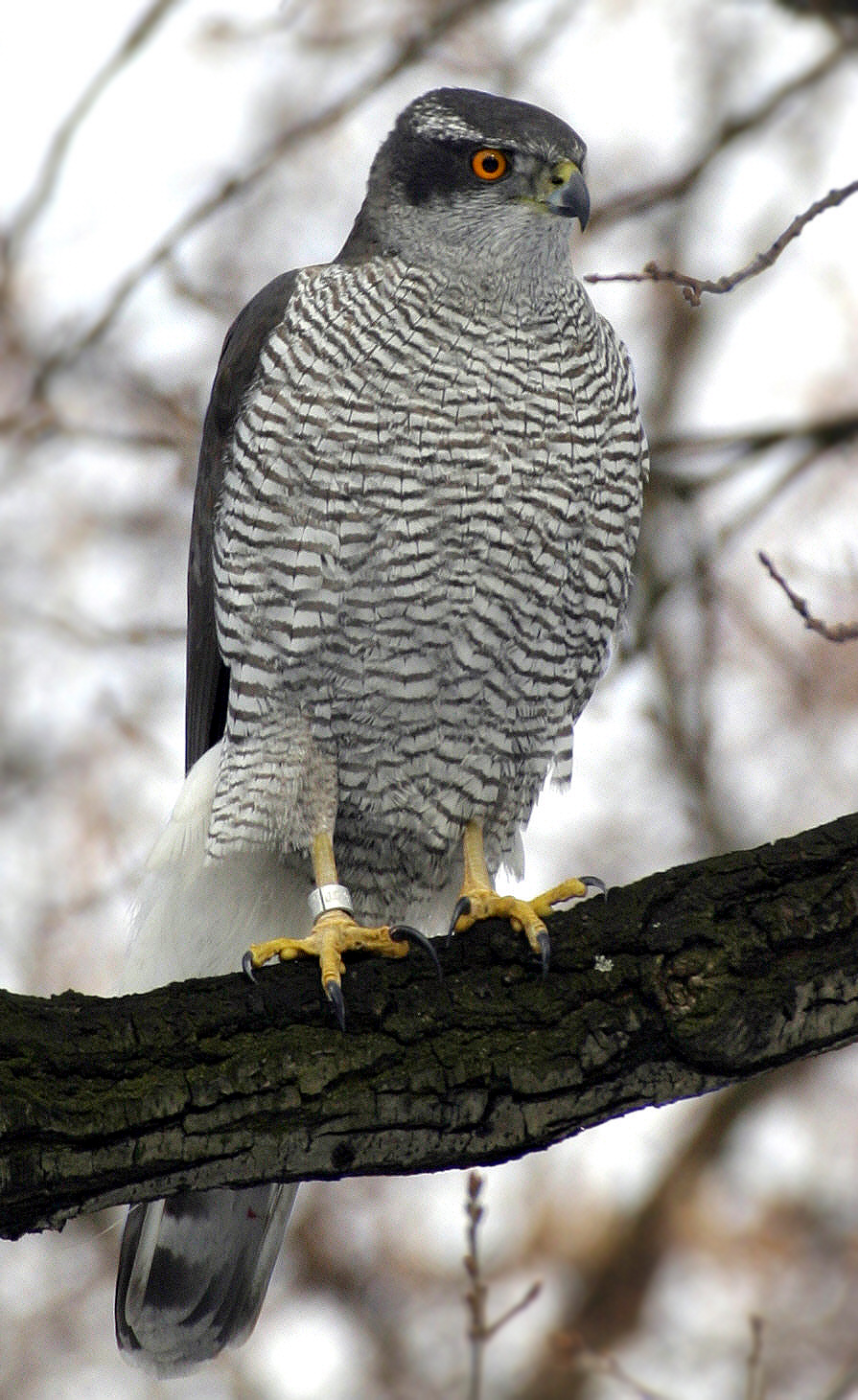
Eurasian Goshawk (Astur gentilis) lives in coniferous forests across Northern Hemisphere. It feeds on small mammals birds.
Fascinating facts about the Eurasian Goshawk
- Female Eurasian goshawks can be up to four times heavier than the smallest males. In the nominate race, male wing chords span 300-342 mm and females 336-385 mm, while body mass ranges from 517-1,110 g in males and 820-2,200 g in females. Central Fennoscandian birds average 865 g (males) and 1,414 g (females).
- The smallest Eurasian goshawks belong to the schvedowi subspecies, where males can weigh as little as 357 g and females just over 1,000 g. Males measure 298-323 mm in wing chord, females 330-362 mm, yet females are more than twice the male's mass on average. This extreme dimorphism likely evolved to split prey sizes in the sparse, steppe-like woodlands they inhabit.
- Spanning from the Atlantic coasts of Europe to the far east of Kamchatka, the Eurasian goshawk occupies almost every temperate forest across Eurasia, yet it completely avoids treeless tundra. Its range stretches south to extreme north-western Morocco, Corsica, Sardinia, the "toe" of Italy, and even reaches Taif in Saudi Arabia and possibly Tonkin, Vietnam in winter. Occasionally, individuals turn up far from home as vagrants in Alaska, Newfoundland, and even the Izu Islands, showing the species' surprising wanderlust despite its generally sedentary nature.
- While traditionally forest dwellers, goshawks have learned to thrive in human-made green spaces, nesting in city parks and even the Imperial Palace gardens of Tokyo. First recorded breeding there in 2001, a pair raised chicks in an evergreen oak, benefitting from intensive tree-planting and crow control. Similar urban colonies now exist in Berlin and Hamburg, where the birds use isolated trees and small copses.
- Genetic work overturned long-standing assumptions about the goshawk's family tree: a 2019 molecular study showed the Eurasian and American goshawks are not closest relatives. Instead, the Eurasian species shares its most recent ancestor with Meyer's goshawk of southeast Asia, hinting at a hidden Asian lineage. The genus Astur itself dates back tens of millions of years, likely evolving alongside the explosive rise of small forest birds.
Sources
Every fact above was checked against these pages, and kept only where one of them states it.
At a glance
RangeNorthern Hemisphere
HabitatConiferous forests
DietSmall mammals birds
About the Eurasian Goshawk
Through the shadowy recesses of ancient forests, the Eurasian Goshawk moves with deliberate stealth, its slate-grey plumage blending seamlessly into the dappled gloom as it pursues its unsuspecting prey with ruthless precision. With wings beating in a swift, staccato rhythm, this formidable hunter navigates the dense canopy with an agility that belies its powerful build, its sharp eyes scanning the underbrush for the slightest hint of movement. As it bursts into a sudden, thrilling chase, the goshawk's very presence seems to electrify the forest, its raw intensity a testament to the enduring power of wild nature.
Hear the Eurasian Goshawk, and 4,400+ more
Real recorded sounds, 11 nature games and a free Daily 5, 1v1 quiz duels, conservation wins and a safe Kids mode. Free on Feravox.