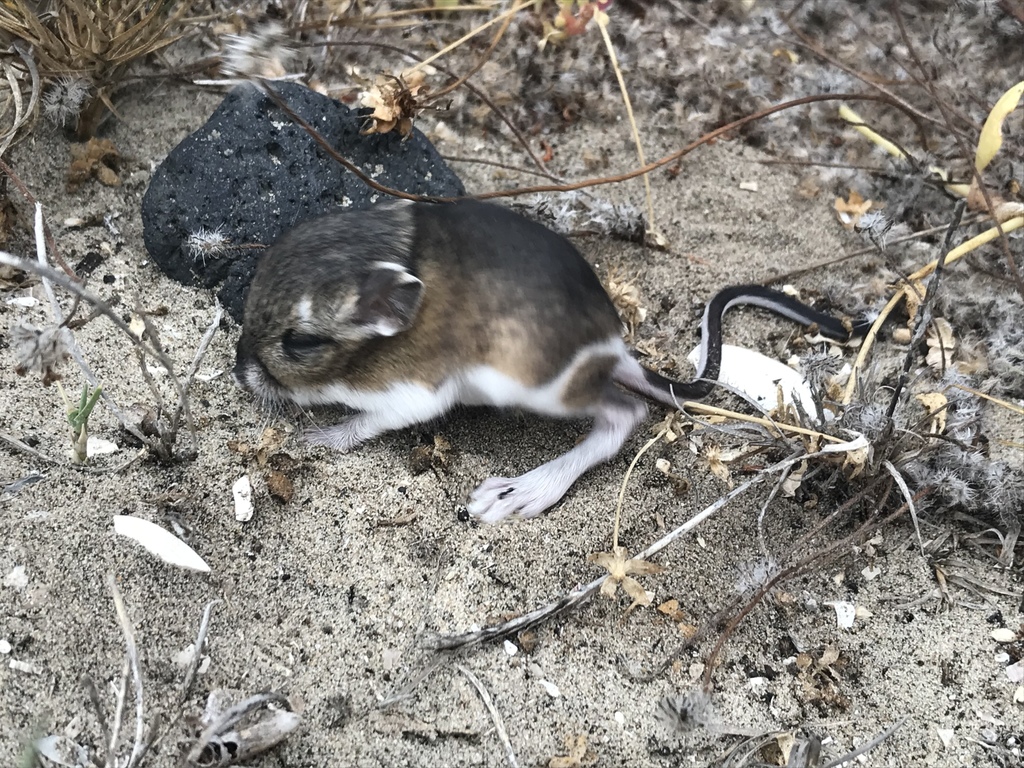
Dulzura Kangaroo Rat (Dipodomys simulans) lives in dry grasslands across Southwestern North America. It feeds on seeds and grasses. Its conservation status is Least Concern.
Fascinating facts about the Dulzura Kangaroo Rat
- The Dulzura kangaroo rat possesses a chromosome count of 2n=60, distinguishing it from its close relative the agile kangaroo rat, which has 2n=62. Historically the two were thought to be the same species, but detailed studies revealed clear morphological differences that supported their separation. The differing karyotypes were a key factor in recognising them as distinct species, confirming their separate evolutionary lines.
- Its hind feet bear five toes each, measuring 43 to 46 mm in length, a trait that sets it apart from some related kangaroo rats that have only four toes. These long, five-toed hind feet power the animal's characteristic series of hops, allowing it to move swiftly across sandy and gravelly soils. The robust hind limbs work together with its long, well-haired tail, which provides balance during these rapid leaps.
- In the United States the Dulzura kangaroo rat is described as common, with local densities reaching up to 45 individuals per hectare. Although it is less abundant in Mexico, the overall population across its range is considered stable and no specific threats have been identified. This stability underpins its IUCN classification as a species of least concern, reflecting a healthy and resilient presence in its desert and scrub habitats.
- During daylight the Dulzura kangaroo rat stays hidden in its underground home, often blocking the tunnel mouths to keep predators out, and only leaves for a brief nocturnal foray lasting a few hours. Its burrow is complex, with multiple openings that may be tucked at the base of shrubs, giving quick escape routes. While active at night it gathers seeds, green plant parts and insects, stuffing them into its cheek pouches before retreating to the safety of the burrow.
- Each Dulzura kangaroo rat leads a solitary life, with females actively defending a personal territory against any intruders that approach. Reproduction is not confined to a strict season; breeding can occur throughout the year, though it peaks during the cooler months of winter and spring. When a female does breed, she typically produces a single litter of two to four young, ensuring the continuation of the species in its arid habitats.
Sources
Every fact above was checked against these pages, and kept only where one of them states it.
At a glance
RangeSouthwestern North America
HabitatDry grasslands
DietSeeds and grasses
About the Dulzura Kangaroo Rat
In the moonlit expanse of the California desert, the Dulzura Kangaroo Rat dances across the sand, its oversized hind legs propelling it in effortless bounds as it searches for the scattered seeds and leaves that sustain it. With each leap, its long tail streams behind like a banner, balancing the rat's nimble form as it navigates the dark, rocky outcrops and spinifex grass with an air of quiet confidence. As it pauses to sniff the night air, its large, round eyes shine like polished onyx, drinking in the subtlest whispers of its desert world.
Hear the Dulzura Kangaroo Rat, and 4,400+ more
Real recorded sounds, 11 nature games and a free Daily 5, 1v1 quiz duels, conservation wins and a safe Kids mode. Free on Feravox.