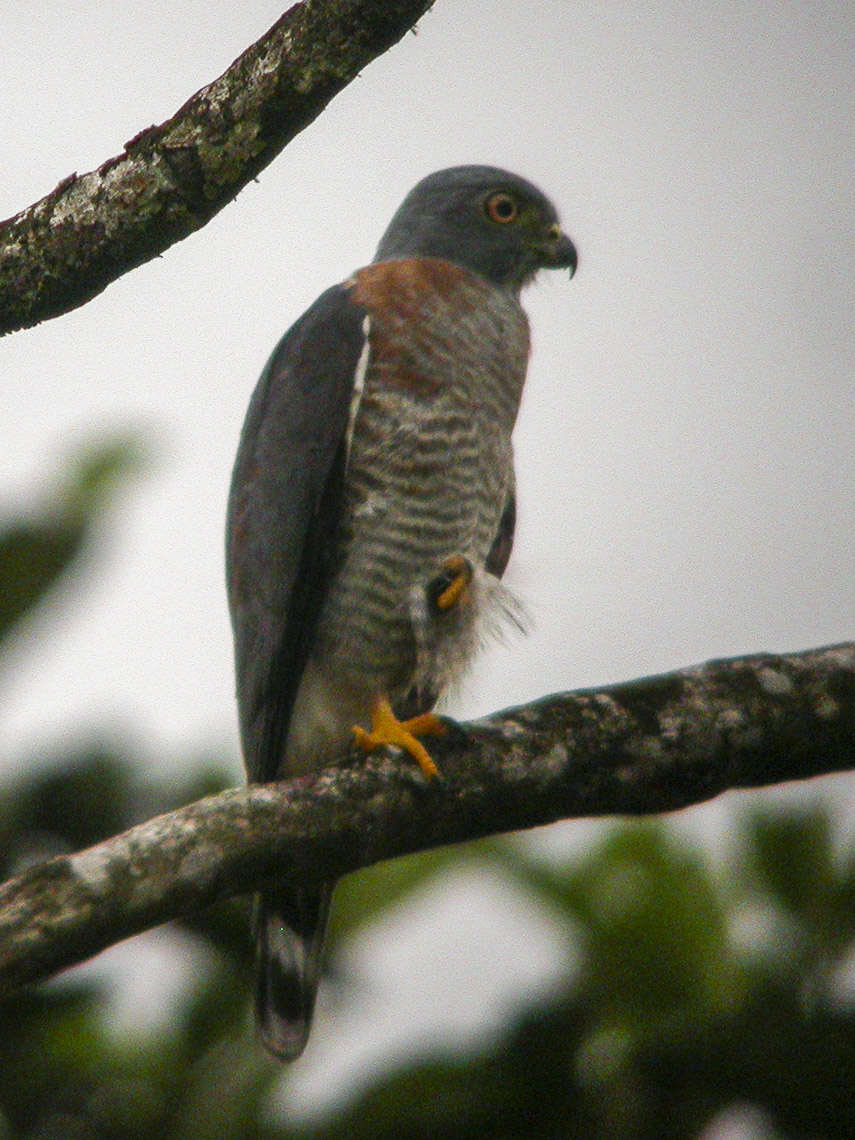
Double-toothed Kite (Harpagus bidentatus) lives in tropical forests across Central America. It feeds on insects and spiders. Its conservation status is Least Concern.
Fascinating facts about the Double-toothed Kite
- Its English name comes from the tooth-like notches on the edge of its maxilla. Although called a kite, genetic studies place it with the true hawks rather than most other kites, and it shares the genus Harpagus with the rufous-thighed kite. Two recognised subspecies exist, the nominate H. bidentatus and H. fasciatus, each occupying different parts of its broad range.
- The double-toothed kite habitually trails monkey troops through the forest interior, snapping up insects and small vertebrates that are flushed from the foliage. It usually launches its hunt from a perch, diving to snatch prey; a study found about two-thirds of captures taken directly from vegetation, the remainder mostly in flight. While insects are more numerous, vertebrates contribute the greater biomass to its diet.
- Females build a shallow, saucer-shaped nest of small twigs in a forked tree branch, sometimes as high as 33 m above the ground and often near the forest edge, occasionally with assistance from the male. The usual clutch comprises two eggs, which the female incubates almost alone for 42 to 45 days. After hatching, the chicks remain in the nest for 27 to 31 days before fledging, becoming independent roughly two months later.
- The species occupies an extremely large range across Central and South America, supporting an estimated population of at least a half million mature individuals. Despite this abundance, it remains dependent on intact mature forest, disappearing from heavily deforested areas.
- Generally sedentary, the double-toothed kite rarely moves far, though at least one individual has been recorded as a vagrant in Texas. Its range stretches from central Mexico through Central America into much of northern and eastern South America.
Sources
Every fact above was checked against these pages, and kept only where one of them states it.
At a glance
RangeCentral America
HabitatTropical forests
DietInsects and spiders
About the Double-toothed Kite
As the Double-toothed Kite takes to the skies, its wings beat with a slow, deliberate rhythm, casting a hypnotic spell over the lush tropical landscape below. With eyes ever-vigilant, it scans the forest canopy for the slightest stirrings of life, its sharp talons poised to strike with deadly precision. In a flash of slate-grey and chestnut, it plunges downwards, a whirlwind of feathers and fury, as it seizes its unsuspecting prey in a lightning-fast display of aerial mastery.
Hear the Double-toothed Kite, and 4,400+ more
Real recorded sounds, 11 nature games and a free Daily 5, 1v1 quiz duels, conservation wins and a safe Kids mode. Free on Feravox.