Photo: Pierre Pericard
Feravox · The Voice of the Wild
Dotted Mantis Shrimp
Lysiosquilla maculata
Not Evaluated
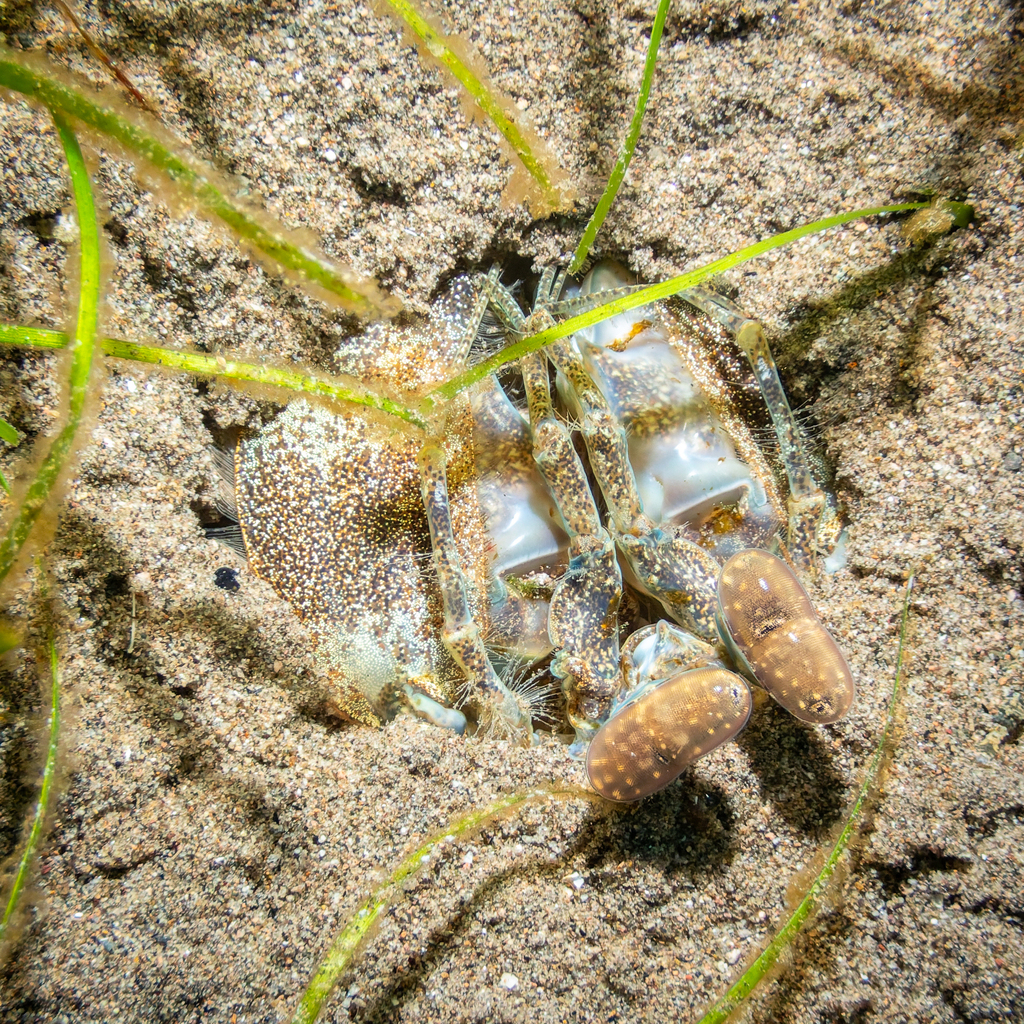
Dotted Mantis Shrimp (Lysiosquilla maculata) lives in sandy burrow across Indo-Pacific. It feeds on small fish and malacostracans.
The zebra mantis shrimp, Lysiosquilla maculata, commands attention across the Indo-Pacific, from East Africa to the Galápagos and Hawaiian Islands. Reaching up to 40 cm, it is the world’s largest mantis shrimp, its sleek, striped carapace marked by a dark distal half on the uropodal endopod, a key difference from its close relative L. sulcata. Burrowing in soft sand, each individual constructs a burrow that is used for protection and as a hunting ambush site, and the costly effort to build these burrows is linked to its monogamous pairing. Males wield larger raptorial appendages, yet both sexes share similar overall size, and the female alone tends the clutch of eggs, a rare example of maternal care among crustaceans. When prey, small fish or malacostracans, drift within striking range, L. maculata peeks from its burrow, then launches a spear-type strike. Powered by a four-bar linkage and spring-loaded latch, the spear reaches a mean peak speed of 2.3 m s⁻¹ over a 24.98 ms burst, trading raw force for reach. Its eyes, among the most complex visual systems known, operate independently, detecting polarized light and a spectrum of up to 16 pigments, allowing the shrimp to lock onto moving targets with precision.
Real recorded sounds, 11 nature games and a free Daily 5, 1v1 quiz duels, conservation wins and a safe Kids mode. Free on Feravox.