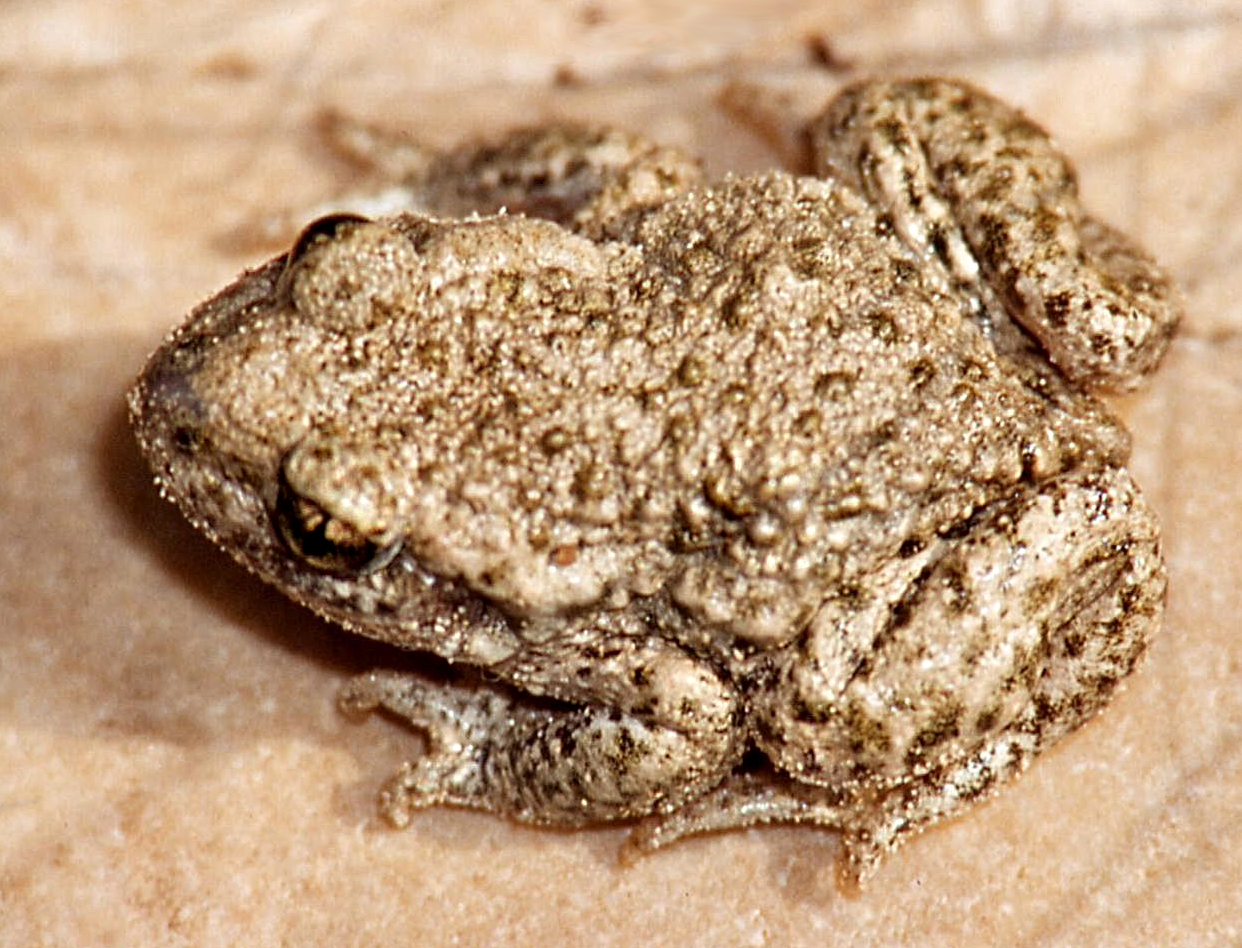
Common Midwife Toad (Alytes obstetricans) lives in moist terrestrial across Western Europe. It feeds on insects and worms. Its conservation status is Least Concern.
Hear the Common Midwife Toad
A real field recording of the Common Midwife Toad, made in the wild.
The male midwife toad carries the fertilised egg strings wrapped around his back legs, often holding up to three separate clutches that together contain about 150 eggs. While the eggs develop he keeps them moist by resting in a damp spot during daylight and by swimming if they begin to dry out. He can also secrete a skin substance that protects the eggs from infection, ensuring they remain viable until hatching.
A single male may guard three clutches totalling roughly 150 eggs and can mate again while still carrying an earlier batch. He watches over the eggs until they are ready to hatch, a period that lasts three to eight weeks. When hatching time arrives he releases the strings into a calm water body such as a ditch, village pond, spring or drinking trough, and even temporary containers like flower-pot saucers in gardens have been used.
Although it usually stays close to water, the common midwife toad will sometimes travel as far as 500 metres from a pond and settle in sunny, dry spots such as hills, cultivated fields, quarries, rocky slopes, gravel pits, woods, parks and gardens. It is most active at dusk and throughout the night, while by day it hides in damp undergrowth, crevices, under logs or stones.
In the Pyrenees the common midwife toad can be found at elevations as high as 2,400 metres, where the cooler climate still supports its life cycle. At these heights it occupies a mosaic of habitats such as hilly terrain, cultivated fields, quarries, rocky slopes, gravel pits, woods, parks and gardens.
Arthur Koestler's 1971 book *The Case of the Midwife Toad* placed this amphibian at the centre of a debate over the mechanisms of inheritance, using it to illustrate the controversy sparked by Paul Kammerer's experiments. The work highlighted discussions of Lamarckian inheritance.
Sources
Every fact above was checked against these pages, and kept only where one of them states it.