Photo: Tom Robillard
Feravox · The Voice of the Wild
Common Firecrest
Regulus ignicapilla
Least Concern
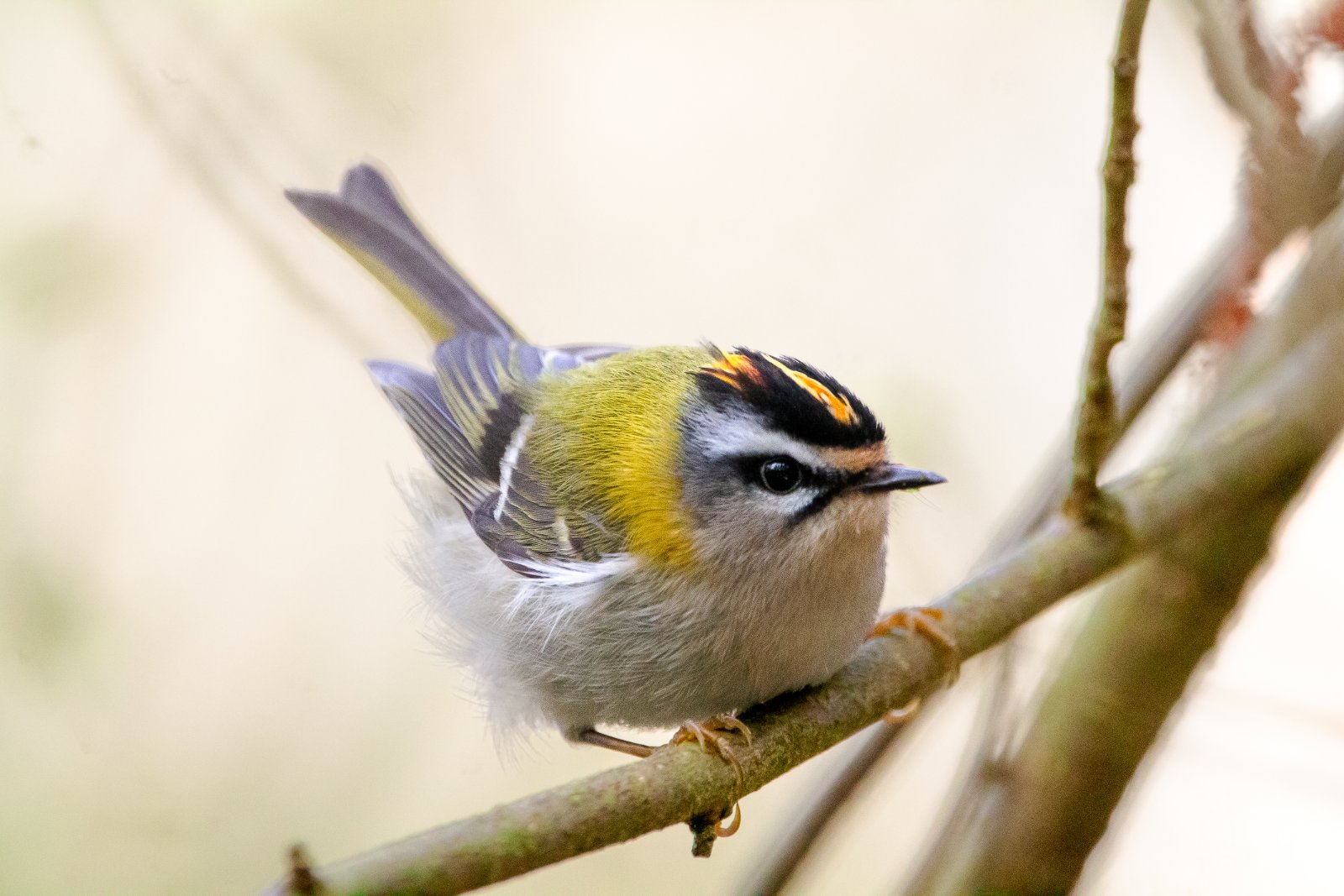
Common Firecrest (Regulus ignicapilla) lives in coniferous woodland across Europe and western Asia. It feeds on small insects and spiders. Its conservation status is Least Concern.
Every fact above was checked against these pages, and kept only where one of them states it.
The Common Firecrest, Regulus ignicapilla, is a diminutive marvel of the European woodlands, barely a few centimeters long yet dazzling with a crown of fiery orange that crowns a sleek, olive‑green back and a pale, almost translucent underbelly. Its iridescent black eye‑stripe and the delicate, needle‑like bill are perfectly adapted for probing the mossy bark and lichen where its primary prey, tiny insects and their larvae, hide. In winter it seeks refuge in evergreen conifers, while in the breeding season it flits among the canopy of broad‑leaf forests, often perched on spruce or oak branches where sunlight filters through the leaves, highlighting its metallic plumage. Its song, a rapid trill of high‑pitched notes, is a signature sound of temperate forests, echoing through the understory as the bird darts from twig to twig in a blur of motion. Beyond its vibrant appearance, the Firecrest exhibits a surprising physiological trick: it can lower its body temperature by up to 5 °C during cold nights, entering a shallow torpor that conserves energy while it clings to a branch in a frozen canopy. This nocturnal adaptation, rare among passerines, allows it to survive harsh alpine winters that would otherwise deplete its tiny fat reserves. Its territorial behavior is equally fierce; males defend a modest radius with swift aerial displays, ensuring a steady supply of insects for their offspring, while females meticulously construct a cup‑shaped nest woven from spider silk and lichen, hidden among the dense foliage. The Firecrest’s relentless energy and subtle adaptations make it a living testament to the intricate balance of forest ecosystems, a tiny ember that keeps the cycle of life alight.
Real recorded sounds, 11 nature games and a free Daily 5, 1v1 quiz duels, conservation wins and a safe Kids mode. Free on Feravox.