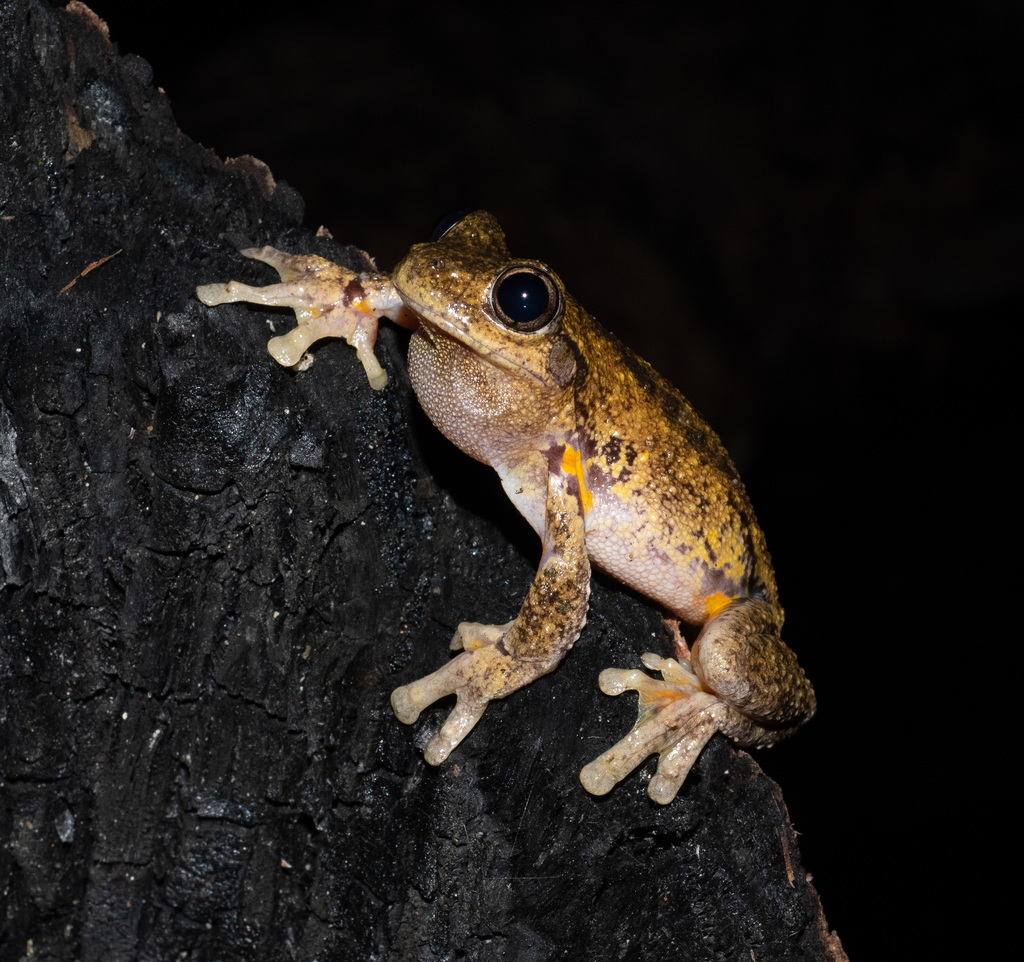
Photo: Kerri-Lee Harris
Feravox · The Voice of the Wild
Peron's Laughing Tree Frog
Pengilleyia peronii
Least Concern
Peron's Laughing Tree Frog (Pengilleyia peronii) lives in forests, woodlands across Australia. It feeds on insect prey. Its conservation status is Least Concern.
Peron's laughing tree frog, Pengilleyia peronii, dazzles with a palette that shifts in under an hour, ranging from near-white to deep greys and browns, punctuated by mottled yellow-black thighs, armpits, and groin. Emerald speckles may appear on the back and multiply with age, while its cross-shaped pupils set it apart from most Pelodryadidae, a trait it shares only with Tyler's tree frog. Males measure 44–53 mm and females 46–65 mm, their slender frames built for an arboreal life among stones, sticks, and bark crevices. They favour forests, woodlands, shrublands, and even open suburban patches, often far from permanent water, yet they will seize any pond or rain-filled depression for breeding. At night they become luminous silhouettes on windows and street lamps, hunting insects drawn to artificial light, a habit especially noted along the Murray River in South Australia. Their high-pitched cackle, so distinctive it earned the monikers "laughing" and "maniacal cackle" frog, resonates through the canopy, a vocal beacon that draws mates and warns rivals. This amphibian’s uncanny ability to linger in water for extended periods, coupled with its preference for climbing material, makes it a versatile survivor in a landscape where natural and human-made structures intertwine, constantly redefining its niche.
Real recorded sounds, 11 nature games and a free Daily 5, 1v1 quiz duels, conservation wins and a safe Kids mode. Free on Feravox.