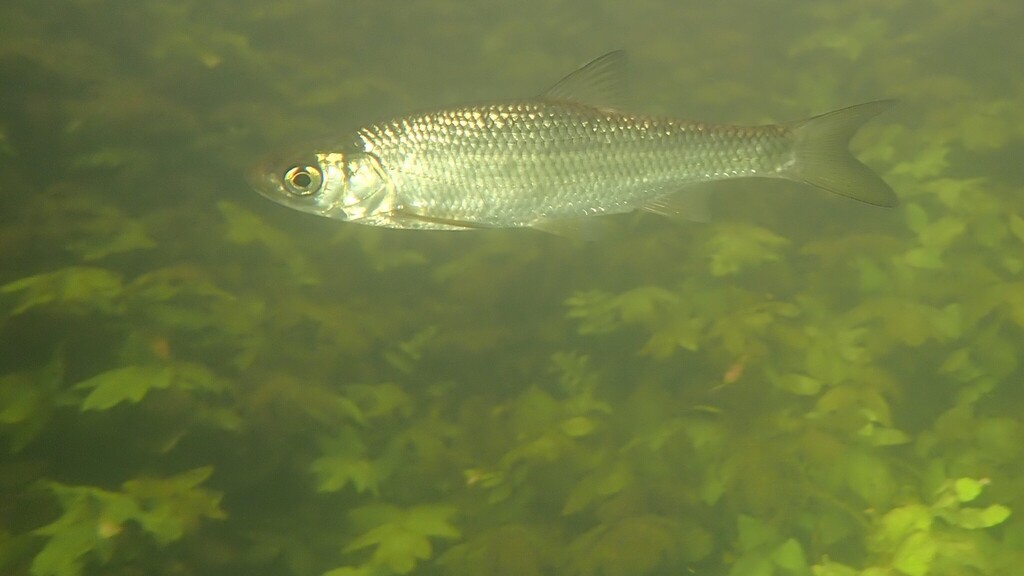
Photo: Nicola Crockford
Feravox · The Voice of the Wild
Common Dace
Leuciscus leuciscus
Not Evaluated
Common Dace (Leuciscus leuciscus) lives in rivers and streams across Europe and northern Asia. It feeds on small invertebrates.
The common dace (Leuciscus leuciscus) glides through European rivers with a sleek silhouette marked by large silvery scales and a forked caudal fin. Its inferior mouth, slightly longer upper jaw and yellowish iris set it apart from its Leuciscus cousins, while the dorsal fin bears two to three spines and seven to nine soft rays, and the anal fin a concave margin with three spines and eight to nine soft rays. Growing up to 30 centimetres (12 in) in total length, this ray-finned fish forms shimmering shoals that drift along the lower reaches and backwaters during winter, only a few daring adults remaining upstream to guard the spawning grounds. When March and April arrive, the dace embarks on an upstream pilgrimage, scattering pale yellow eggs across shallow gravel beds in fast-flowing streams. The adhesive eggs cling to stones, and the hatchlings hide among bank-side roots and cavities before venturing into swifter currents. Their diet is a constant pursuit of small invertebrates, but a surprising twist in their story emerged after their early-1900s introduction to Ireland: freed from their native parasites, the dace gained a hidden competitive edge that may have reshaped local fish communities, a subtle reminder of how a single ecological release can ripple through an ecosystem
Real recorded sounds, 11 nature games and a free Daily 5, 1v1 quiz duels, conservation wins and a safe Kids mode. Free on Feravox.