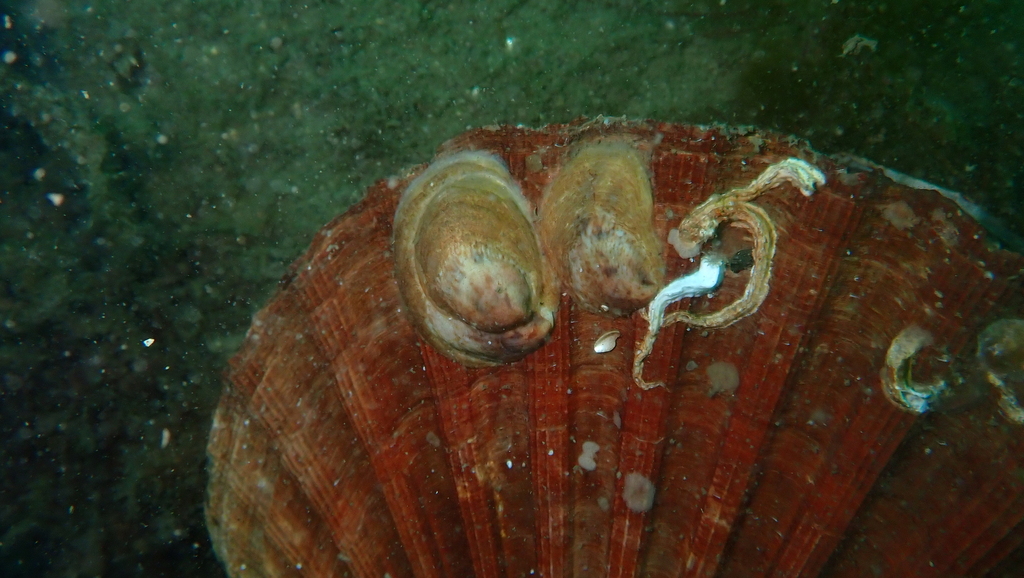
Common Atlantic Slippersnail (Crepidula fornicata) lives in marine coastal across Eastern North America. It feeds on algae & plankton.
Fascinating facts about the Common Atlantic Slippersnail
- In Crepidula fornicata colonies the largest, oldest individuals form the base of a stack while the smallest, youngest snails sit on top. Each pile may hold as many as twelve members, creating a vertical hierarchy. When the bottom females die, the biggest male on the summit changes sex, so the whole assemblage functions as a sequential hermaphrodite. This gender shift keeps the colony reproductively active without new arrivals.
- Crepidula fornicata first reached Europe by attaching itself to shipments of the eastern oyster, Crassostrea virginica, and has since established populations across the continent. It is now listed as invasive in Denmark, France, Italy, the Netherlands, Spain and the United Kingdom, and its range has further extended into Norway and Sweden. The snail's ability to thrive on various hard substrates has helped it spread rapidly in these new waters.
- The earliest European observation of the common slipper limpet occurred on 28 September 1911 when a specimen was found attached to an oyster in Ostend, Belgium. From that initial discovery the species rapidly became common along the Belgian shoreline, a status it has maintained since the 1930s. Its early establishment there illustrates how quickly the snail can colonise new coastal habitats when introduced with shellfish stock.
- Crepidula fornicata can be found from the water's surface down to about 70 m, allowing it to occupy both intertidal zones and deeper submerged habitats. It thrives especially in wave-protected bays, estuaries and the sheltered sides of islands where hard substrates are abundant. Individuals commonly attach to rocks, shells, horseshoe crabs and dock pilings, often forming dense stacks of several snails.
- Breeding in the common slipper limpet spans from February through October, with the highest reproductive activity recorded in May and June. During this peak, roughly 80-90 % of females release eggs, and most females will spawn twice in a year, typically timed after neap tides. The sequential hermaphroditic nature of the species means that if the bottom females die, the largest male in the stack will change sex to maintain the breeding population.
Sources
Every fact above was checked against these pages, and kept only where one of them states it.
At a glance
RangeEastern North America
HabitatMarine coastal
DietAlgae & plankton
About the Common Atlantic Slippersnail
In the murky, sun-dappled waters of the Atlantic coast, the Common Atlantic Slippersnail glides effortlessly, its translucent, saucer-shaped shell a delicate shield as it navigates the tidal zone with gentle, almost languid, purpose. As it moves, the slippersnail leaves behind a trail of silken threads, a gossamer map of its meandering path through the seaweed forests and rocky crevices it calls home. With its soft, boneless foot and patient, grazing demeanor, this unassuming mollusk embodies the quiet, unhurried beauty of life in the ocean's shallows.
Hear the Common Atlantic Slippersnail, and 4,400+ more
Real recorded sounds, 11 nature games and a free Daily 5, 1v1 quiz duels, conservation wins and a safe Kids mode. Free on Feravox.
More ocean life to discover