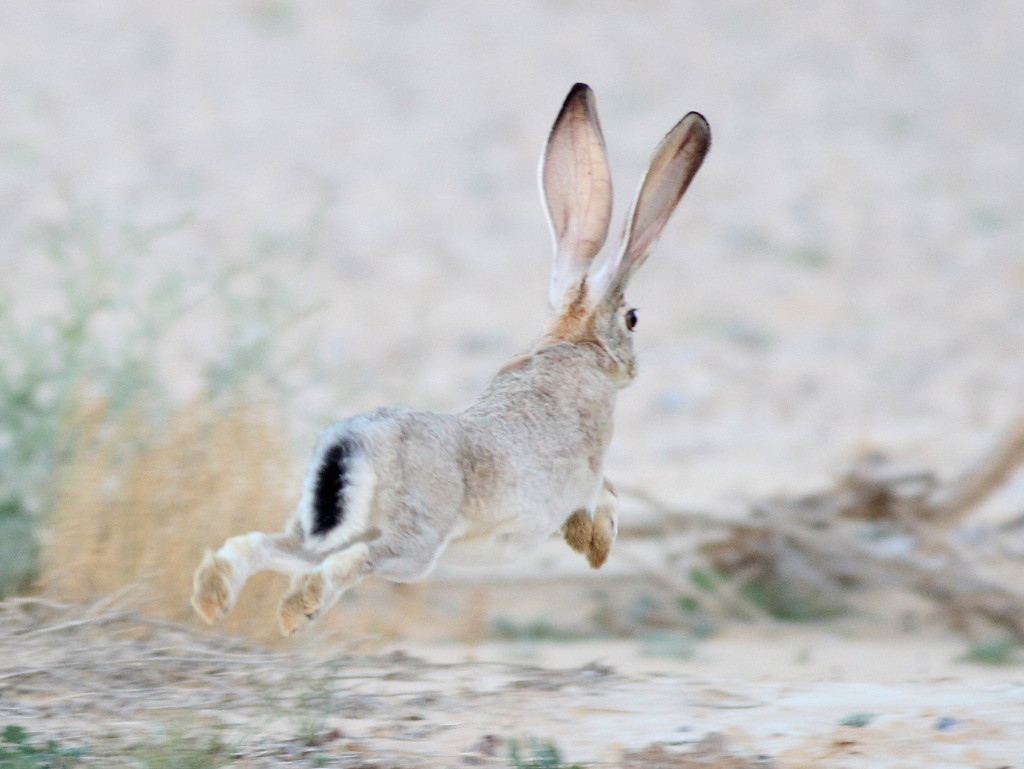
Cape Hare (Lepus capensis) lives in desert and grasslands across North Africa and Asia. It feeds on grass and leaves. Its conservation status is Least Concern.
Fascinating facts about the Cape Hare
- Pregnancies in Cape hares last exactly 42 days, after which a female typically delivers one to three leverets. These young are precocial, emerging with open eyes and the ability to move shortly after birth. Because the species can produce up to four litters each year, it can rapidly increase its numbers when conditions are favourable.
- A Cape hare kept in captivity lived to nearly nine years. In the wild, however, its exact lifespan remains uncertain, as environmental pressures and predation are not recorded. The hare is a nocturnal herbivore, feeding on grass and various shrubs.
- Archaeologists have uncovered a mummified Cape hare in a tomb near Dendera. The species was significant enough to be associated with the Egyptian god Unut, who was depicted as a hare.
- Cape hares are found in a range of open habitats, from macchia-type vegetation and grassland to bushveld and the vast Sahara Desert. They also thrive in semi-desert regions where sparse shrubs provide cover and forage. Their distribution stretches across Africa and Arabia and even reaches parts of the Indian subcontinent. In the Ethiopian Highlands they are especially common in locales such as Degua Tembien.
- Carl Linnaeus first gave the Cape hare its scientific name in 1758, publishing Lepus capensis in the 10th edition of Systema Naturae. This early description placed the species within a broader Lepus group that later proved to be a complex of closely related forms. Modern studies have kept Lepus capensis sensu lato as a paraphyletic grouping.
Sources
Every fact above was checked against these pages, and kept only where one of them states it.
At a glance
RangeNorth Africa and Asia
HabitatDesert and grasslands
DietGrass and leaves
About the Cape Hare
As the sun dips over the savannah, the Cape Hare emerges, its long ears twitching with every snap of a twig, its large brown eyes drinking in the fading light. With powerful hind legs, it leaps effortlessly across the grasslands, its gentle bounds a testament to its remarkable agility, as if floating across the landscape with an ethereal grace. In this fleeting moment, the Cape Hare is a master of its domain, a symbol of wild beauty and resilience in the harsh yet breathtaking world of the African plains.
Common questions
What does the Cape Hare eat?
Diet: grass and leaves.
Where does the Cape Hare live?
Habitat: desert and grasslands. Range: North Africa and Asia.
Is the Cape Hare endangered?
The Cape Hare is listed as Least Concern on the IUCN Red List.
Hear the Cape Hare, and 4,400+ more
Real recorded sounds, 11 nature games and a free Daily 5, 1v1 quiz duels, conservation wins and a safe Kids mode. Free on Feravox.